
MBG Programme on Saturdays Abolished to Save Rp 50 Trillion, Economist Highlights This Issue
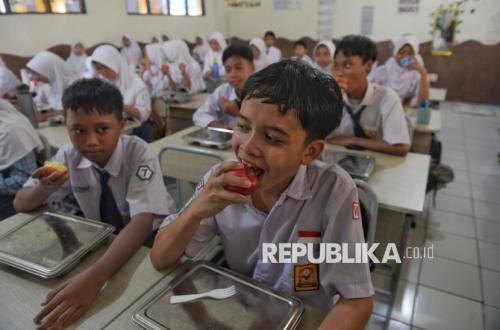
The government is evaluating the Free Nutritious Meals (MBG) programme as one of the efforts to refocus the budget amid rising energy prices due to the war in the Middle East. The MBG programme on Saturdays has been abolished to save around Rp 50 trillion per year.
Economist from Bogor Agricultural Institute (IPB), Bambang Juanda, views the policy of abolishing the MBG programme on Saturdays as a good decision. However, the government must place greater emphasis on improving the management of the MBG implementation.
“MBG is reduced by one day, namely on Saturday, whether it makes sense or not, the short answer is that it is better than nothing, better than no change at all,” said Bambang during the Strategic Talk Series 1 event titled ‘Governance of Free Nutritious Meals for Optimal Fiscal Policy’ held by the Faculty of Economics and Management (FEM) IPB on Wednesday (29/4/2026).
Nevertheless, the reduction in days for the MBG programme is not the most highlighted variable. Bambang sees the management of the MBG programme as a fundamental matter that must be improved. “Then, whether it should indeed be reduced by two days or three days, if we can solve this (MBG problem) not just by reducing days, but how the policy runs optimally,” he stated.
Bambang explained that with the jumbo MBG fund of Rp 335 trillion in the 2026 State Revenue and Expenditure Budget (APBN), its utilisation should be able to achieve the goals. The goals of MBG are to improve the nutritional status of the community, support child growth and development and human resource quality, habituate healthy and balanced nutritional eating patterns, reduce household expenditure burdens, and encourage the local economy.
However, the question is whether the implementation of the MBG programme, which has been running for more than a year, is proceeding in line with the goals? Meanwhile, many problems have arisen, such as MBG poisoning cases and the erosion of the small people’s economy.
It is known that the goals of MBG according to the National Nutrition Agency (BGN) consist of five things, namely improving the nutritional status of the community (especially addressing stunting and malnutrition), supporting child growth and development and human resource quality, providing nutrition education and healthy eating patterns, reducing the risk of illness and death, and encouraging the local economy.
Looking at the dynamics occurring in the field, the fundamental values that should be focused on include partner selection. According to Bambang, MBG partners or Nutrition Fulfilment Service Units (SPPG) must be professional, not haphazard. This minimises various problems that arise regarding management to the quality of products reaching students.
“Partner selection must be professional. I am not antipathetic if executives, legislators, for example TNI or Police are not allowed (to be MBG partners). They may, we support, if they have the capacity, meaning if they already have a track record of being accustomed to providing services,” he explained.
By engaging professional MBG partners, it is believed that problems arising in the field can be minimised, such as MBG quality that is not nutritious, MBG quality that is no longer fit for consumption, or cases of student MBG poisoning.
“So in my opinion, it is better to change the fundamentals. Do not just reduce the days,” he said.