
Mbah Tarminah’s Resilience and Circular-Economy Waste Management in Guwosari
BANTUL — Waste production is unavoidable in daily life and is often seen as a burden on people and the environment. But in Guwosari Village, Pajangan District, Bantul Regency, Yogyakarta Special Region, household waste is no longer a source of problems; it has become a driver of a circular economy that sustains many local residents.
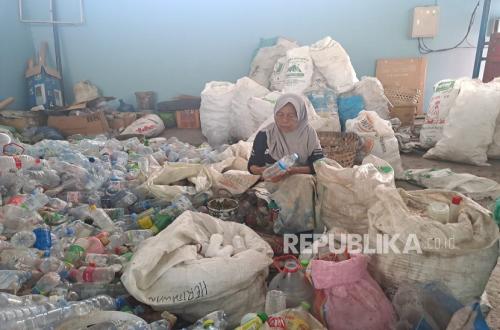
That afternoon, 84-year-old Mbah Tarminah sat quietly on a small wooden stool inside a green, warehouse-like building. Before her lay a heap of used mineral-water bottles.
Her wrinkled hand, clutching a small knife, moved slowly but deftly. With measured motions honed over years of practice, she cut and removed the plastic labels attached to each bottle. She also took off the caps and poured out any remaining water. She then placed the clean bottles in a sack.
Mbah Tarminah does this every day at the Go-Sari Rehabcycle 3R (Reduce, Reuse, Recycle) waste-processing facility, which is managed by the Maju Sejahtera Village-Owned Enterprise (BUMDes) in Guwosari. She works from 8am to 4pm and earns Rp55,000 a day, with about an hour’s break between noon and 1pm.
“My job is to peel the labels off these bottles,” Mbah Tarminah said in Javanese. She told Republika she could not speak Indonesian during an interview at the facility on Friday, 11 September 2026.
Still speaking Javanese, Mbah Tarminah explained that she does the work to support herself and her son, who is around 50. Eight years ago, he was injured in a traffic accident, which damaged his brain nerves and left him unable to earn a living.
Since then, Mbah Tarminah has had to work hard on her own, taking odd jobs. Her husband died in 2014, as did her four other children. Only the son with the nerve disorder is left.
When she was stronger, Mbah Tarminah says, she worked as a farm labourer. But she is now too weak to do the various tasks required in the fields. She and her son still need to eat every day.
“I can’t do strenuous work any more; I’m no longer able to harvest,” she said.
Faced with these financial pressures, Mbah Tarminah went to the Guwosari Village Office. She said she needed a job to cover daily living costs, including her son’s regular medical treatment, but was elderly and no longer strong.
After hearing her appeal, the village head asked the BUMDes management to take her on at the Go-Sari 3R facility. The enterprise agreed, and Mbah Tarminah accepted the opportunity with gratitude. She has worked there for the past two years and is now one of the facility’s oldest employees.
“The Rp55,000 I earn at the 3R facility goes towards whatever we need, such as rice and side dishes, and supporting my son, who is helpless because of his illness,” Mbah Tarminah said.
She added that her son had previously been married and had a child. After the accident left him unable to work, he divorced his wife. Their child now lives with the former daughter-in-law.
As a mother, Mbah Tarminah says she is deeply saddened by her son’s condition. But she leaves everything to God and remains grateful that, in her old age, she is still able to work at the 3R facility and provide for herself and her son.
Satiyem, 72, also feels grateful to be able to work in her later years. She previously worked at a business that later closed after going bankrupt.
After losing her job, Satiyem was at a loss, as finding new work was not easy at her age. She was then offered a position at the Go-Sari 3R facility and accepted it.
“They asked if I wanted to work at the rubbish site, and I said yes. Then I started here at the 3R facility, and I’m still here,” she said.
Unlike Mbah Tarminah, Satiyem works in the waste incineration section. She earns Rp450,000 a week.
Satiyem said all three of her children are married, but that has not stopped her from working. As well as meeting her own daily needs, she puts some of her earnings towards her grandchildren’s education.
“I have three grandchildren who still need help from me. Two are at university, and one is in the final year of secondary school. The one in secondary school says they want to go to maritime school after graduating. So I work to help with their education costs,” said the grandmother of ten grandchildren and two great-grandchildren.
Mbah Tarminah and Satiyem are among the residents whose livelihoods are supported by the Go-Sari 3R facility. A total of 27 local people are directly employed and paid there.
The workers are involved throughout the waste-management process, from collection in the community and digital record-keeping through the Go-Sari app to transporting waste to the facility and sorting it there.
Source: jawawa.id (https://jawawa.id/newsitem/mbah-tarminahs-resilience-and-circular-economy-waste-management-in-guwosari-1792900249)
Originally published by Republika (https://rejogja.republika.co.id/berita/tng0oy282/ketegaran-mbah-tarminah-dan-pengelolaan-sampah-menjadi-ekonomi-sirkular-di-guwosari), translated from Indonesian