
Mbah Rono: Mount Anak Krakatau Can Naturally Erupt Again
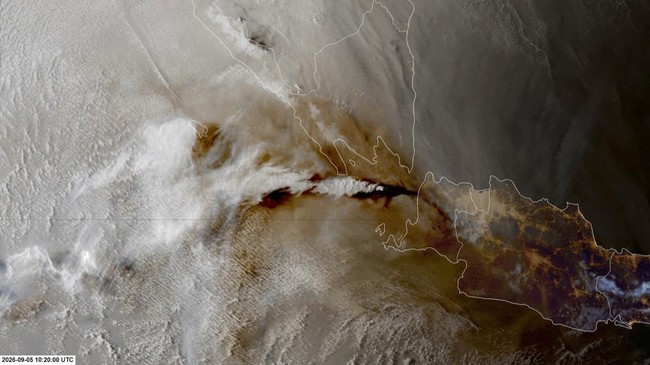
Jakarta, CNBC Indonesia – Volcanology expert Surono, affectionately known as Mbah Rono, has explained that Mount Anak Krakatau naturally still has the potential to experience follow-up eruptions. The phenomenon is part of the volcano’s physical growth phase following the major landslide event in 2018.
Mbah Rono explained that, as a young volcano, Anak Krakatau needs time to rebuild its body into a complete form. He stressed that the accumulation of magma pressure requires the volcano to release energy to the surface.
“The most likely danger is that the potential for another landslide still exists. But not in the near future — the last one was only in 2018. It takes time to form a complete body again. That is why it will erupt frequently and so on,” he told CNBC Indonesia on Monday (7/9/2026).
Mbah Rono said the frequency of intense eruptions is the volcano’s natural way of building its peak structure taller and larger. However, this condition simultaneously enlarges the magma chamber, which increases the potential strength of future eruptions.
“The bigger Anak Krakatau gets, the bigger its magma kitchen — its magmatic chamber — becomes. And if it gets bigger, then the eruption potential will be greater,” he added.
The physical formation process of Anak Krakatau involves the expulsion of new material, the majority of which falls around the peak and body of the volcano. Although heavy material is retained in the crater area, the impact most felt by surrounding areas is the spread of fine ash carried by wind direction and speed.
“It must release new material that falls around its body, so Anak Krakatau grows bigger and taller. The fine ash that spreads high into the sky is a consequence of every volcanic eruption like this,” he explained.
Mbah Rono considers the eruption risk a major public concern because of the volcano’s geographical proximity to vital national strategic assets such as Soekarno-Hatta Airport and Raden Inten Airport. He predicts that disruptions to air transport operations due to volcanic ash exposure could potentially happen again in the future.
“Now Soekarno-Hatta has been affected, so it will certainly be hit again in the future — that is the problem. I am not trying to scare anyone, but something that has been affected now has the potential to be affected again,” he added.
Regarding the simultaneous increase in volcanic activity at other mountains such as Semeru, Merapi and Mount Ibu, he confirmed that the phenomenon is driven by separate magma chambers. The string of simultaneous eruptions across various parts of Indonesia is purely coincidental and does not stem from a single geological system.
“Actually, it is quite an ordinary occurrence because we have so many volcanoes — it is just a coincidence that they happen at the same time. Fundamentally, they each have different magma sources and different sources of pressure,” he explained.
The government has in fact provided disaster-prone zone maps as a reference for regional governments in spatial planning. Mbah Rono stressed that regional governments have full authority to regulate community activities on the ground based on technical recommendations provided by geology experts.
“Now it is up to the regional governments to respond to the reports on the volcano’s activity based on the recommendations given by the Centre for Volcanology and Geological Hazard Mitigation,” he concluded.
Anak Krakatau Eruption Intensity Decreases
The Ministry of Energy and Mineral Resources (ESDM) recorded that, after experiencing a continuous eruption episode lasting 25 hours, Mount Anak Krakatau in Lampung Province has again shown eruptive activity with a pattern of mild eruptions occurring periodically. Although the long eruption episode has ended, the volcanic activity of Mount Anak Krakatau is still being closely monitored because seismicity levels remain high.
For communities in the coastal areas of Banten and Lampung, developments in Anak Krakatau’s activity are a concern due to the potential eruption hazards. The Geological Agency of the Ministry of Energy and Mineral Resources has reminded residents, tourists and climbers not to approach or conduct activities within a 3-kilometre radius of the volcano’s activity centre.
The Head of the Geological Agency, Lana Saria, explained that the continuous eruption episode of Mount Anak Krakatau, which had been underway since Friday (4/9) at 23.07 WIB, ended on Sunday (6/9) at 00.04 WIB. After that period, eruptive activity returned to the characteristics of mild eruptions that have long been the hallmark of Anak Krakatau’s activity.
“After the continuous eruption episode ended, three Strombolian eruptions with black eruption columns were observed. The return of Strombolian eruptions, which are a distinctive characteristic of Mount Anak Krakatau, is for the time being interpreted as the end of that rather long continuous eruption episode,” said Lana Saria in Bandung on Monday (7/9).
Although the continuous eruption episode has ended, instrumental monitoring during the period of 6–7 September 2026 still recorded high seismic dynamics, including:
3 eruption earthquakes
9 blowing earthquakes
93 low-frequency earthquakes
98 hybrid/multiphase earthquakes
4 continuous tremor earthquakes
1 shallow volcanic earthquake
These conditions mean the activity level of Mount Anak Krakatau remains at Level III (Siaga, or Watch). Lana Saria said the likelihood of further eruptions in the coming periods remains high.
“The main potential hazards are incandescent rock ejections and heavy ash rain, as well as the potential for lava flows if continuous eruptions occur again,” Lana explained.