
Mayapada Doctors Successfully Remove Prostate Cancer via Robotic Surgery
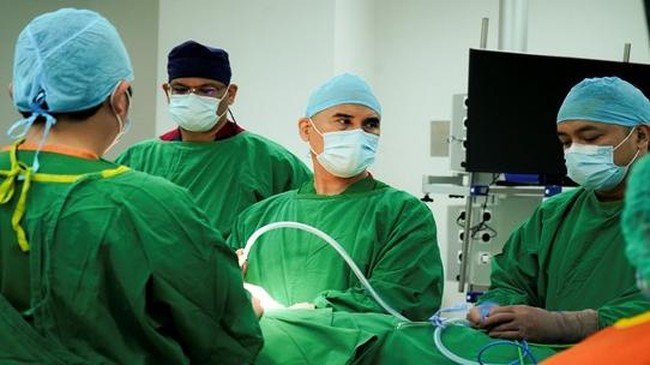
A team of urologists at Mayapada Hospital Jakarta Selatan (MHJS) has successfully treated prostate cancer in a 72-year-old patient through a Robotic-Assisted Radical Prostatectomy (RARP). RARP is a minimally invasive surgical procedure using a robotic system controlled by urology specialists to remove the entire prostate gland.
The procedure involves a high level of difficulty, as the prostate is located in a hard-to-reach area surrounded by vital structures. Consequently, doctors utilised robotic technology to support the operation through clearer visualisation and instruments with more flexible and precise movements to remove cancerous tissue while preserving surrounding organs.
Dr Syamsu Hudaya, the urologist leading the procedure, explained that the prostate’s proximity to nerves, blood vessels, and the urinary and reproductive tracts necessitates extreme precision. “Prostate cancer surgery presents unique challenges because the prostate is located in a narrow pelvic area that is difficult to access, adjacent to nerves and blood vessels of the urinary and reproductive tracts. Therefore, the procedure requires high precision. Robotic technology assists doctors in working more precisely through 3D visualisation and instruments with a wide range of motion and better ergonomics, allowing the surgical area to be seen more clearly and the procedure to be more targeted,” said Syamsu on Friday (2/10/2026).
Despite the use of robotic technology, Syamsu emphasised that the success of the procedure does not rely on technology alone. The skill of the doctors and team collaboration remain vital components of the patient management process. “We believe that the robot is a very helpful instrument. However, it is the ‘man behind the gun’—the cooperation and collaboration of the team from start to finish—that will be decisive for the patient’s recovery and, of course, a better outcome,” added Syamsu.
Also involved in the procedure was Dr Stevano LH Sipahutar, a urology specialist in robotic surgery, FRICS. He noted that the use of robotic technology provides several advantages that support the patient’s recovery process. “With clearer 3D visualisation, an enlarged field of view, more precise instrument movements, and the elimination of tremors, the procedure can be performed with a higher level of precision. This helps minimise bleeding and injury to organs around the surgical area, allowing for a faster patient recovery (Length of Stay/LOS),” he stated.
In this specific case, the patient was able to be discharged approximately two to three days after the surgery.
The successful treatment of the prostate cancer patient also received appreciation from Sanjai Kumar, an Uro-Oncology and Robotic Surgery Expert from Apollo Hospitals Jubilee Hills, Hyderabad, India. With experience performing over 1,000 robotic urological surgical procedures, Sanjai assessed that robotic technology has now become a standard of service at Mayapada Hospital.
“Robotic technology is no longer the standard of the future, but the standard of service today, and it has now become part of the standard service at Mayapada Hospital. Mayapada Hospital has demonstrated mastery of robotic technology and international-standard surgical techniques, including technical control and clinical decision-making to ensure safe and effective procedures,” revealed Sanjai.
The success of this robotic surgery reflects the capability of the Mayapada Hospital Jakarta Selatan urology team in handling prostate cancer cases through a combination of clinical expertise, multidisciplinary collaboration, and the utilisation of robotic technology. This support is part of the commitment of Mayapada Healthcare, through its flagship Tahir Uro-Nephrology Center at Mayapada Hospital Jakarta Selatan, to provide comprehensive services for various kidney and urinary tract disorders, including prostate cancer.
These services are supported by a multidisciplinary team, ranging from detection and diagnosis to advanced treatment using da Vinci technology to assist in more precise and targeted surgical procedures according to patient needs.