
Mawlid: A Garden of Love That Ever Blooms
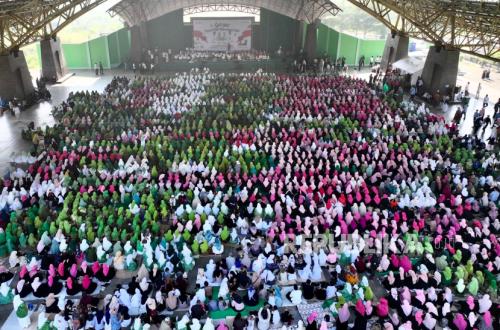
Finally, the month full of festivals has arrived, like spring appearing adorned with buds of flowers blooming in a myriad of colours.
There is no month as colourful as Rabiul Awal, when almost every day praises, noble character, miracles and the history of a great human being named Muhammad Rasulullah are recited.
In the Indo-Pakistan subcontinent and India, the sky seems full of stars with hanging decorative lights. Na’at or poetry is recited, sweets and confectionery are distributed, because in that charity there is blessing.
In Morocco and Turkey, the Qasidah Burdah is recited with deep feeling. The Ottoman Mevlid flows, its soft tones touching the ceilings of old mosques.
Throughout the month of Rabiul Awal, Al-Azhar in Egypt becomes like a sea of activity, the Prophet’s biography is retold and the markets are filled with the chanting of shalawat.
In Yemen, every night the verses of Ad-Diba’i are whispered softly, full of feeling and wisdom, homes are enveloped in the fragrant aroma of perfume, hearts become calm, as if the Prophet were present as a guest.
Perhaps only in this country is the Mawlid celebration the most boisterous and festive, held from one end of the archipelago to the other, from the Presidential Palace to the prayer houses in remote villages. Mawlid has become a tradition and has blended with local customs and culture. There is Sekaten as in Java, there is the rebana, there are various competitions, there is tumpeng, there are charitable meals, there is Barzanji, communal eating and there is a public holiday.
“Indonesia… It is truly a country of a thousand Mawlids.”
Indonesia is truly a country of a thousand Mawlids, said Annemarie Schimmel, a German orientalist and Professor of Islamic Studies at Harvard, famous for her books Mystical Dimensions of Islam and And Muhammad is His Messenger.
The Mawlid festival does not need a visa to cross from one country to another. Although the countries are different, the tones are different, the customs and cultures are different, the expression of love and the tears of longing remain the same.
Because Mawlid is not merely an ordinary celebration, but a “monument of time”, a signpost for the community to return to loving its Prophet.
Classical Controversy
The debate over whether Mawlid is a religious innovation, permissible or not, has become a classical debate and for some reason continues to be inherited by history. However, it should be noted that almost all of the four schools of thought, Maliki, Hanafi, Shafi’i and part of the Hanbali, permit and encourage it, as long as there is no wrongdoing within it. Only a portion of the contemporary Hanbali school does not permit it.
Do not judge the matter of love for the Prophet with complicated legal foundations on the grounds that the Prophet, his Companions, and the three best generations never celebrated the 12th of Rabiul Awal, citing the evidence:
“Whoever introduces something new into this matter of ours that is not from it, it will be rejected.” (Narrated by Bukhari)
Or being overly concerned about innovation and excessiveness because it is considered to resemble Christmas and fearing excessive praise to the level of divinity.
Yet this is not a matter of jurisprudence or theological conception; it is merely a debate about love for the Prophet. Everyone agrees that loving the Prophet is obligatory, only the expression of the “way” often differs, is disputed and debated.
Yet, do not forget that within Mawlid there is shalawat, reading of the prophetic biography, charity, and remembrance. All praise of the Prophet is within the limits of his humanity as a chosen and noble creature.
Basyarun laa kal basyar.
A human being, but not like an ordinary human being.
The image and humanity of Muhammad as a human in the history of Mawlid has never exceeded the degree of divinity, as in other religions and beliefs. He remains an ordinary human being who was given revelation by Allah SWT.
According to the principles of Islamic legal theory, it is stated:
Al-aslu fil asyya’ al-ibahah = the original rule of everything is permissible, as long as there is no prohibition.
Jonathan Brown, an American Muslim and Professor of Islamic Studies at Georgetown, opined that:
“The debate over Mawlid in Islam is similar to the debate over Christmas in early Christianity. The early Church also did not celebrate Christmas. But over time, the community needed a special day to remember.”
Mawlid is a natural sociological development of religion when Muslims need a “monument of time” to remember and renew their love for their Prophet Muhammad Rasulullah SAW.