
Mathematics Learning Developed Through Sundanese Ethnomathematics and AR
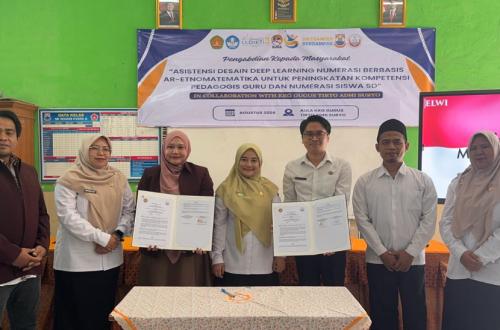
Numeracy learning in primary schools requires more than just mastering mathematical concepts; it also necessitates approaches that make the material more relatable to students’ experiences. In Cimahi, 53 teachers from five primary schools are participating in a numeracy learning development programme that blends Sundanese culture, Augmented Reality (AR) technology, and deep learning.
The programme is being implemented by Universitas Bhayangkara Jakarta Raya (Ubhara Jaya) through a Community Service (PkM) scheme for Community-Based Empowerment, in collaboration with the KKG Gugus Tirto Adhi Suryo in Cimahi and supported by the Cimahi City Education Office. The programme is led by Dian Anggra0adgraeni Maharbid, alongside Sandi Budhi Iriawan, Faridatul ’Ala, and student assistants Rifqah Nur Alvisyahri and Michelle Miranda.
The approach combines deep learning with Sundanese ethnomathematics and AR technology. Various local cultural games and objects, such as congklak, engklek, galah asin, weaving patterns, and traditional Sundanese architecture, are being used to link mathematical concepts to the students’ familiar environment.
The PkM team leader, Dian Anggraeni Maharund, explained that the programme was designed based on a needs assessment of teachers in partner schools. Initial mapping showed that the average pedagogical competence of teachers reached 76.8 per cent based on five teaching skill indicators, while abilities in formative assessment and providing scaffolding still require strengthening.
The Ubhara Jaya team has prepared training modules containing deep learning concepts, the integration of ethnomathematics, and the development of AR media for numeracy learning. These modules are currently undergoing the ISBN publication process.
In addition to the modules, the team has drafted 30 initial ethnomathematics-based lesson plans and prepared 13 3D QR markers as the foundation for AR media development. This media is intended to provide interactive visualisations of Sundanese cultural objects while simultaneously connecting them to mathematical concepts.
The lesson plans include using congklak (dakon) for arithmetic operations, engklek (sondah) for plane geometry, galah asin for measurement, and weaving patterns to introduce symmetry and patterns. The next phase will focus on developing teaching modules and AR media for use in partner schools.
School supervisors involved in the programme believe this approach can help teachers make mathematics more relevant to students’ lives. “Through this activity, teachers are gaining new ways to package mathematics so that it is closer to the lives and culture surrounding the students. Especially when ethnomathematics is combined with Augmented Reality technology, I see great potential to make students more interested and active in learning,” Dian stated on Thursday.
The readiness for technological implementation is supported by school infrastructure and teacher resources. According to the programme’s progress report, 89 per cent of teachers possess smartphones capable of supporting AR applications, while 73 per cent of partner schools have internet access.
The programme’s execution aligns with the Cimahi City Education Office’s agenda and the academic calendars of the five partner schools. Deep Learning Numeracy training and an AR Media Development Workshop using Assemblr Edu are scheduled for late August 2026, while the Sundanese Ethnomathematics Design Workshop is still being coordinated with partners.
Following the training, assistance will focus on developing teaching modules, AR media, and implementing numeracy lesson designs in the classroom. Evaluation will be conducted through student numeracy tests, learning interest surveys, product quality evaluations, and reflection forums with teachers.
The programme also includes the preparation of a digital repository, ISBN publication, copyright management, scientific publication, and the formation of a numeracy teacher practitioner community within the KKG Gugus Tirto Adhi Suryo. Ensuring sustainability is vital so that the introduced approach does not end with the training but can be continuously used and developed by teachers in schools.