
Mastel Estimates Indonesia's 5G Investment Needs at Rp900 Trillion by 2030
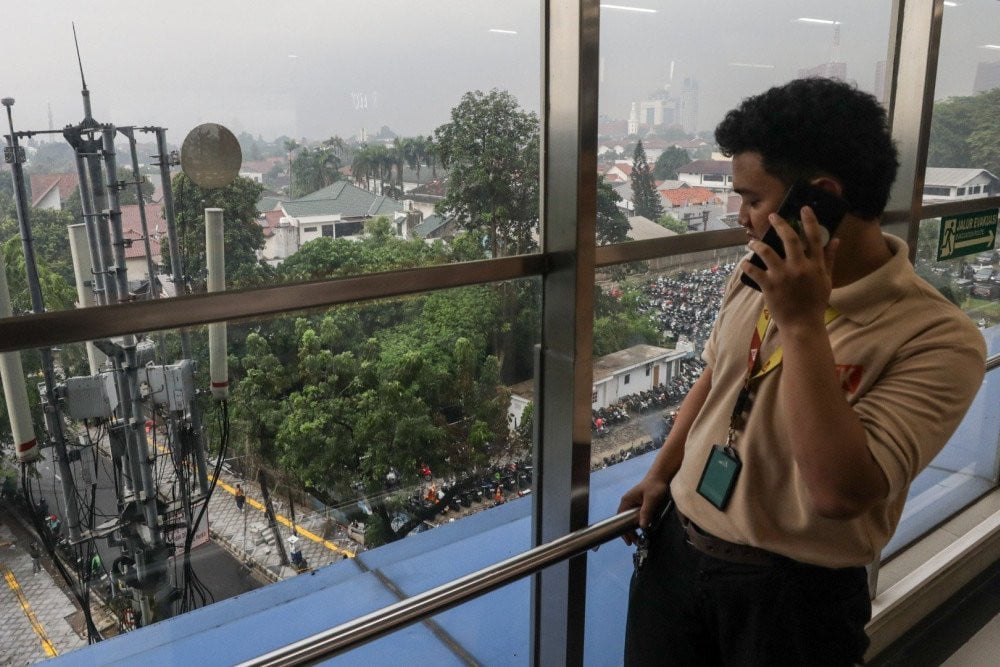
The Indonesian Telematics Society (Mastel) estimates that 5G network investment in Indonesia will require between US$30 billion and US$50 billion, or approximately Rp540 trillion to Rp900 trillion, by 2030 to drive fifth-generation service coverage to 60%–70% of the population.
Teguh Prasetya, Chairman of Mastel’s Artificial Intelligence (AI), Internet of Things (IoT), and Big Data division, said the estimate is based on the assumption of massive network development through base transceiver station (BTS) densification, expansion of fibre optic networks (fibreisation), and development of the supporting ecosystem for 5G services.
Meanwhile, the Ministry of Communication and Digital Affairs (Komdigi) is targeting 5G service penetration of 32% by 2030. This target indicates significant growth potential, given that Indonesia’s current 5G adoption rate still lags behind Malaysia, which has reached approximately 80%.
According to Teguh, the sheer scale of investment required could become a challenge for telecommunications operators if not accompanied by adequate policy support. Without restructuring fiscal incentives and more aggressive infrastructure sharing schemes, the capital expenditure requirement could become a structural barrier to accelerating 5G implementation in Indonesia.
“It directly affects the realisation of projected 5G contributions to GDP,” Teguh told Bisnis.
Mastel’s estimate was compiled with reference to a number of studies and investment projections published by various institutions. A GSMA study estimates Indonesia’s 5G network investment needs at US$18 billion, or around Rp324 trillion, by 2030, assuming infrastructure sharing and network densification at a moderate level. Meanwhile, research from the Bandung Institute of Technology (ITB) estimates a larger investment requirement of Rp473 trillion–Rp591 trillion over the 2021–2030 period, covering spectrum frequency costs, BTS construction, backhaul networks, and core network upgrades.
GSMA also notes an additional investment requirement of US$16 billion, or around Rp288 trillion, for the 2024–2030 period to support 5G service implementation by telecommunications operators and the industrial sector. For comparison, cumulative mobile infrastructure investment by operators for 2G, 3G, 4G, and 5G network development during 2015–2025 reached approximately US$29 billion, equivalent to Rp522 trillion.
According to Mastel’s calculations, investment needs will increase significantly if Indonesia aims to provide 5G coverage equivalent to the current 4G network, which reaches around 97% of the population. With the number of 4G BTS estimated at around 350,000 units, the projected requirement for 5G BTS is 1 million to 1.05 million units. As of early 2026, the number of operational 5G BTS is estimated at only around 12,000–15,000 units, leaving a need for approximately 985,000–1.035 million additional BTS.
Assuming an average construction cost of US$150,000, or around Rp2.7 billion per site, the infrastructure investment requirement alone is estimated at US$147 billion–US$155 billion, or around Rp2,646 trillion–Rp2,790 trillion. Mastel assesses that the realistic cost of building a new 5G site (greenfield) in Indonesia ranges from US$120,000 to US$180,000, or around Rp2.16 billion to Rp3.24 billion per site, covering 5G Radio Access Network (RAN) equipment based on massive Multiple-Input Multiple-Output (massive MIMO), fibre backhaul network construction, power and cooling systems, civil works, installation, and tower land lease costs.
Teguh said such funding requirements will be difficult to meet solely from operators’ internal cash flows, especially amid stagnating average revenue per user (ARPU). In a national coverage scenario, the investment burden per operator is estimated at US$10 billion–US$17 billion, or around Rp180 trillion–Rp306 trillion, by 2030.
Therefore, Mastel considers alternative financing schemes necessary, such as infrastructure sharing through Multi-Operator Core Network (MOCN) or Single Wholesale Network (SWN) models, expansion of tower as a service model, public-private partnerships (KPBU), issuance of infrastructure sukuk, and strategic foreign investment. “The required fiscal incentives are tax credits for 5G capex, a reduction in frequency usage fees proportional to macroeconomic impact, and access to low-cost financing from state-owned banks for projects in frontier, outermost, and least developed regions,” Teguh said.