
Massive Tsunami Threatens Indonesian Regions, Researchers Reveal Grim Facts
Jakarta, CNBC Indonesia - The terrifying potential of natural disasters continues to haunt Indonesian territory. Researchers have recently disclosed the existence of a colossal fault line stretching beneath Sulawesi. This fractured crust harbours massive energy that could trigger a devastating tsunami at any moment.
This alarming discovery was identified thanks to sensor signal analysis by Tang Tingwei, a researcher at the Institute of Geology and Geophysics of the Chinese Academy of Sciences.
The structure is none other than the Palu-Koro fault, a colossal fault that extends far down to the seafloor and slices through the Earth’s crust at ocean depths.
The latest findings prove that the fault along Sulawesi’s coastline connects directly to submarine fault systems. Consequently, if it shifts, its effects could shake a wider marine system and launch a massive tsunami wave.
Extreme Underwater Conditions
Geological conditions beneath the Sulawesi Sea are extremely harsh and unstable. In that region, the crust thickness is recorded at only about 8 kilometres — far thinner than the surrounding area where thickness reaches 26 kilometres. Moving further north, it can reach depths of up to 30 kilometres.
This stark thickness contrast indicates that the fault acts as a ‘bridge’ linking several different faults. On one side lies the ocean floor with thin crust, while on the other side stands continental crust far thicker.
This striking difference is the alarm of danger. After all, Earth’s tectonic pressures usually focus and accumulate at the interface between two layers of crust with different thicknesses.
Answering the Palu 2018 Tsunami Mystery
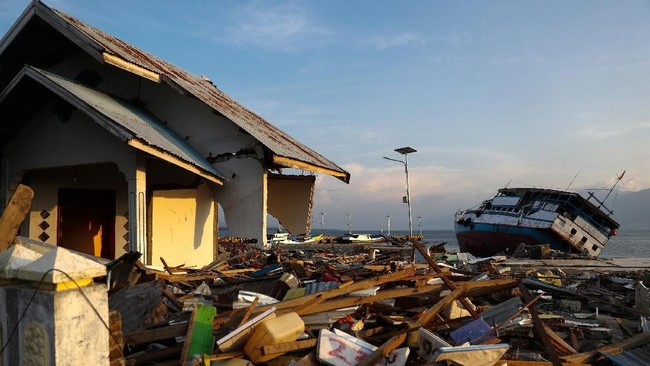
This new finding also provides scientific answers to the terrifying scene when the earthquake struck Palu on 28 September 2018. At that time, the western coast of Sulawesi was hit by a tsunami of about 11 metres.
The height of the wave at the time astonished experts and was beyond prediction. For Palu-Koro is a strike-slip fault (lateral movement), which in theory should produce a smaller rise of sea level than a thrust fault.
Now the mystery is solved. The fault, extending further and deeper into the sea, causes the seabed to buckle and subside severely during an earthquake.
Even more alarmingly, in that 2018 event the fault underwent a rapid collapse, categorised as a super-shear phenomenon. The rate at which the rock ruptured was so extreme that the destructive energy of the quake propagated along the fault line, also unsettling the hydrological system in the Sulawesi Sea.
With the fact that this fault is interconnected, earthquakes centred on land in Sulawesi are no longer merely a terrestrial threat but potentially capable of moving the seabed and triggering deadly tsunami waves.