
Massive NTT Earthquake Brings Permanent Threat, Expert Issues Warning
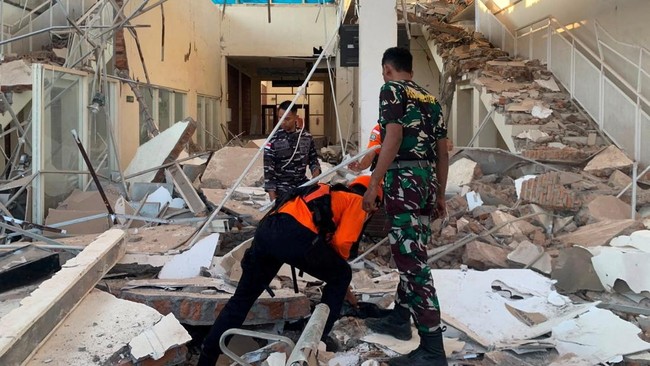
A magnitude 7.7 earthquake shook the East Nusa Tenggara (NTT) region on Saturday (15/8/2026) at 04:58 WIB. Initial analysis indicates the epicentre was at a shallow depth of 15 kilometres, resulting in very strong shaking. Preliminary reports have detected massive damage to several buildings, as well as the emergence of a minor tsunami on the northern coast of Flores and the Selayar Islands.
Daryono, a member of the Indonesian Association of Disaster Experts (IABI), presented his analysis regarding the massive earthquake in NTT. He stated that the characteristics of today’s earthquake generator are very identical to the activity of the Flores Back-Arc Thrust, an active fault stretching from the north of Bali, Nusa Tenggara, to the waters of Wetar. This fault was formed due to the compression of tectonic forces from the subduction of the Indo-Australian Plate beneath the Eurasian Plate.
The combination of a very shallow hypocentre depth and a thrust faulting mechanism on the seabed was the main trigger for the vertical deformation of the earth’s crust that caused damage and generated tsunami waves. The following are important facts and the dark track record of the Flores Back-Arc Thrust compiled by Daryono, quoted from his written statement, Saturday (15/8/2026):
High Vulnerability Zone
Daryono said the Flores Back-Arc Thrust has high vulnerability due to the accumulation of strain that has been locked for years. The release of M 7.7 energy today confirms the estimated maximum magnitude potential in the NTT back-arc segment.
Based on the 2017 Indonesia Earthquake Source and Hazard Map released by the National Earthquake Study Centre (PUSGEN), the following are the movements and potential magnitudes in each segment of the Flores Back-Arc Thrust:
Discovered Since 1979 by World Geology-Tectonics Experts
This active fault line on the bottom of the Flores Sea has a long history in geoscience literature:
1979: Warren B. Hamilton, a geology-tectonics expert from the US, became the first researcher to identify the existence of this back-arc thrust in his book Tectonic of The Indonesia Region.
1986: Eli A. Silver from the University of California Santa Cruz published Multibeam Study of the Flores Back Arc Thrust Belt, mapping the fault line and discovering that the northern fault plane underthrusts the southern plane.
1987: Robert McCaffrey and John L. Nabelek strengthened the evidence that the dip of this thrust fault is north-south oriented and extends to the north of Bali-Lombok.
1994 & 2000: Digital seismic research by Masturyono (1994) and Daryono (2000) further emphasised the characteristics of this active fault network.
Track Record of Past Massive Earthquakes and Tsunamis
The Flores Back-Arc Thrust has repeatedly triggered major earthquakes and deadly tsunamis in the Bali to Nusa Tenggara region:
22 November 1815: An M 7.0 earthquake triggered a tsunami on the northern coast of Bali and Lombok.
28 November 1836: A strong M 7.5 earthquake shook the Bima area.
13 May 1857: An M 7.0 earthquake again triggered a tsunami in Bali and Lombok.
14 July 1976 (Seririt Earthquake): An M 6.6 earthquake destroyed 67,419 houses and claimed 559 lives in Bali.
12 December 1992 (Flores Earthquake): A massive M 7.8 earthquake triggered a severe tsunami and killed more than 2,500 people.
Mitigation Lessons, Permanent Threat
To date, no technology is capable of predicting the exact time of an earthquake. However, the threat from the Flores Back-Arc Thrust in the north of Bali to Nusa Tenggara is permanent.
“Seeing the many damaged houses, it is important that there are real and serious efforts to realise earthquake-resistant and safe buildings. If not, every time a strong earthquake occurs, the community will continue to become victims,” Daryono said in his writing.
“When an earthquake will occur, we are not yet able to predict, but we must be ready to face it. Mitigation socialisation, education and realising real earthquake mitigation efforts must continue to be carried out continuously so that we can live in harmony with nature,” he concluded.