
Massive AI Use Risks Worsening Global Inequality
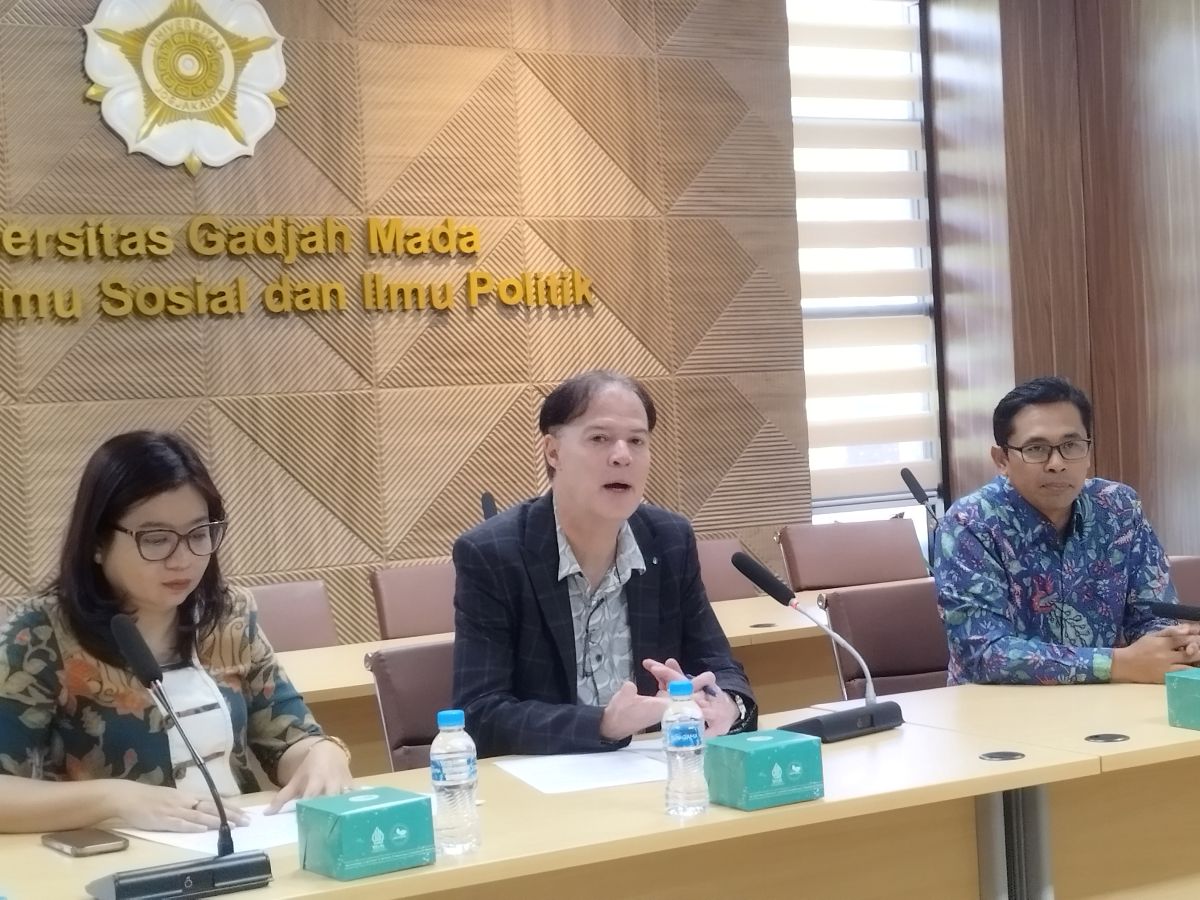
The increasingly massive use of artificial intelligence (AI), including in higher education, is feared to have the potential to exacerbate global inequality. At the 6th Australia–Indonesia in Conversation (AIC) 2026 forum, organised by FISIPOL UGM and The University of Melbourne, experts argued that AI must be understood through a multidisciplinary lens, considering dimensions of ethics, social justice, sustainability, and humanitarian interests.
Associate Professor Edwin Jurriëns from The University of Melbourne stated that AI is not only a technological matter but also a social, political, and humanitarian issue. The rapid development of technology now influences nearly all aspects of human life. ‘This forum positions AI not merely as a technological problem, but as an issue closely linked to ethics, power relations, culture, politics, and the future of social life,’ he said during the conference themed ‘Is AI the Game-Changer? Intelligence Unbound: Ethics, Power, and the Imagination of Life in the Digital Age’ at FISIPOL UGM on Monday (20/7).
Jurriëns emphasised that the main challenge today is no longer about the machine’s ability to think, but rather society’s capacity to think critically about AI development and to use it responsibly. ‘We need to start asking, as humans with cultural identities and social relationships, how AI development affects the way we work, interact, and live our lives,’ he explained. He added that the crucial question is not just how technology evolves, but what the future holds for humanity, human relations, and our position amidst such rapid change. Therefore, he urged, we must consider our stance to avoid being left behind and to better prepare for this transformation.
The development of AI, he noted, must be understood within the historical context of power relations, colonialism, and the exploitation of natural resources and knowledge. Without ecological and ethical awareness, AI risks becoming a new instrument that reinforces global inequality. ‘The most important thing is that we understand not only the technology, but also the political and economic decision-making processes behind AI development,’ he said.
Convener of AIC 2026, Syaifa Tania, added that the complexity of AI demands an interdisciplinary approach. The forum thus featured two main panels discussing AI from the perspectives of governance, the politics of knowledge, creativity, and the sustainability of human life.
Professor Robert Hassan argued that ‘Homo Analogicus’ represents our true identity as beings who naturally develop through physical processes, time-consuming effort, and genuine interaction with nature and fellow humans, rather than through the instant automation offered by the digital world. He noted that the development of digital technology has altered the way humans adapt to their environment, with technology no longer serving merely as a tool but shaping the way people think, work, and understand social reality. ‘The fact that we stopped evolving physically when we became modern humans is because technology has taken over so many roles that we no longer need to adapt to our environment,’ he said.
The second panel concluded that the future of AI is determined not only by technological sophistication but also by humanity’s ability to maintain imagination, creativity, and ethical responsibility in its use. AI is expected to evolve as an instrument that strengthens human life and planetary sustainability, rather than merely enhancing efficiency and productivity.
Dean of FISIPOL UGM, Dr. Wawan Mas’udi, affirmed that the AIC 2026 is part of a long-standing strategic collaboration between the two universities, encompassing the Tri Dharma Perguruan Tinggi through joint degree programmes, double degree programmes, staff exchanges, and various collaborative research initiatives. He explained that the Australia–Indonesia in Conversation initiative was born during the COVID-19 pandemic, when both universities agreed to establish an international academic forum that prioritises dialogue as the core of collaboration. Unlike typical academic conferences, AIC is designed as a conversational space bringing together experts to exchange knowledge, experiences, and perspectives in response to various global challenges. He also stressed that this partnership contributes to strengthening the global academic network through the Global Humanities Alliance, a consortium of eight world universities that promotes the development of humanities, social sciences, human rights, and the decolonisation of knowledge.