
Mass Protests Erupt as Residents Grow Fed Up with Worsening Crisis
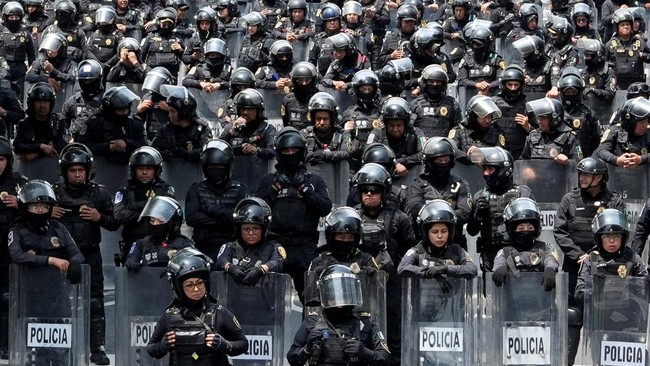
Residents of Guadalajara, one of Mexico’s largest cities, are demanding answers over a worsening clean-water crisis. Tap water flowing into homes has reportedly smelled foul and contained muddy sediment. The situation has sparked a wave of demonstrations, culminating in clashes with police.
Mass protests held last weekend drew national attention after police deployed water cannon and tear gas to disperse the crowds. Dozens of people were reportedly injured and nearly 40 demonstrators were arrested.
The incident prompted a sharp rebuke from President Claudia Sheinbaum over the police’s repressive actions. She also promised to review two water infrastructure projects in the area.
Further protests are expected to continue. Videos circulating widely on social media show residents collecting murky brown, sometimes almost black, water directly from their household taps.
The crisis has exposed the poor management of water in the metropolitan area, which has a population of more than five million. Guadalajara, in the state of Jalisco, is not only a major residential centre but also Mexico’s largest industrial and manufacturing hub.
The situation also reflects a broader water crisis in cities across Mexico, driven by ageing infrastructure, environmental pollution and population pressure on limited resources.
An independent monitoring report by the Mexican Institute for Community Development (IMDEC) tested 184 household water samples from 90 neighbourhoods in June. The results were alarming: more than 93% of samples contained no residual chlorine, the main disinfectant used to kill harmful bacteria in water systems.
Laboratory tests also found elevated levels of hazardous substances including lead, mercury and nitrates, as well as E. coli bacteria indicating faecal contamination.
In response to the findings, IMDEC urged the government to declare a public health emergency, retest samples through an accredited independent laboratory and fully investigate the source of the pollution.
At a protest on Thursday evening (15 October), local resident Aleida Morales, 54, said the water supplied to her home had often been cloudy and brown for the past 15 years.
Residents’ frustration has grown as they believe Guadalajara’s economic expansion, in a city that is also among the hosts of the World Cup, has come at a steep environmental cost.
Guadalajara lies in the Lerma-Santiago river basin, one of Mexico’s most polluted river systems, owing to the accumulation of industrial and domestic waste and rapid urbanisation.
“There must be a more environmentally friendly way to create jobs. The government’s current approach is tantamount to poisoning us,” Morales said, according to Reuters on Saturday (17 October 2026).
She recalled that three decades ago her grandparents could enjoy the rivers and waterfalls in the area, which she described as “paradise”. “Now that place has become a source of poison,” she added.
Long-standing environmental challenges
Mexico’s federal government has acknowledged the scale of the environmental threat in the region. In July, President Sheinbaum and Environment Minister Alicia Barcena launched a 20-billion-peso (about Rp17.1 trillion) programme to restore the Lerma-Santiago basin and two other polluted rivers. The government says it has identified hundreds of major sources of pollution.
Allan Tejeda, an environmental engineering expert at the University of Guadalajara, said the water crisis was the culmination of years of neglected environmental pressures, rather than a single pollution incident.
He pointed to a damaging combination of untreated or inadequately treated waste discharges, illegal dumping, rapid urban growth and a lack of sustained investment in water-treatment infrastructure.
Existing treatment facilities can no longer cope with the volume of pollutants entering the water system, Tejeda said. “This systemic problem has never received the serious attention it requires,” he said.
The National Assembly for Water, Life and Territory, a Mexican human rights coalition, also voiced its support for the protesters and called for “real, comprehensive and evidence-based solutions”.
“Water is not a concession granted by the government, nor a privilege that only those who can afford it may buy. Water is an absolute necessity for life, health, food and the survival of communities,” the coalition said in a statement.
Source: jawawa.id (https://jawawa.id/newsitem/mass-protests-erupt-as-residents-grow-fed-up-with-worsening-crisis-1792209019)
Originally published by CNBC Indonesia (https://www.cnbcindonesia.com/news/20261017001332-4-777048/demo-besar-besaran-meletus-warga-sudah-muak-krisis-makin-parah), translated from Indonesian