
Market Turmoil Risks Disrupting Investment
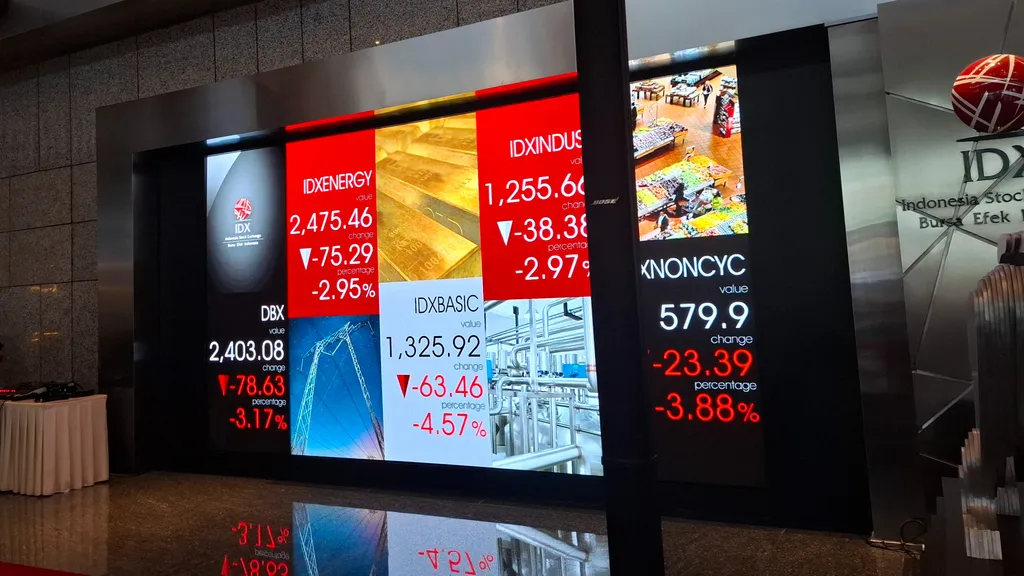
The risk to watch is not a sudden halt to investment, but delays to investment decisions.
JAKARTA — Capital-market volatility and rising perceptions of investment risk in Indonesia could delay manufacturing expansion, particularly projects still awaiting investment decisions. If pressure on financial markets continues, higher financing costs and a weaker rupiah could add to the expense of building factories, buying machinery and funding industrial working capital.
Didik Prasetiyono, deputy chairman of the Indonesian Industrial Estates Association (HKI), said on Monday (19 October 2026) that capital-market volatility should not immediately be interpreted as the cancellation of direct investment.
There is still no sufficiently robust aggregate database to measure the value of investments by industrial-estate tenants that have been specifically delayed or renegotiated because of issues related to Morgan Stanley Capital International (MSCI).
“From the perspective of industrial estates, this is a serious situation. But it would be premature to conclude that manufacturing investment has stopped or that tenants are cancelling expansions en masse,” Didik said.
The risk to watch is not a sudden stop in investment, but a delay to investment decisions.
Investors who have already started projects tend to continue investing. Those who have yet to reach a final decision may wait until market conditions, the exchange rate and financing costs become more certain.
“In the industrial-estate business, a delay of six months to a year already has consequences. Land purchases are postponed, factory construction is pushed back, demand for electricity and utilities shifts, hiring is delayed, and related investments are held up as well,” Didik said.
According to data from the Ministry of Investment and Downstreaming/the Investment Coordinating Board, investment realisation in the first half of 2026 reached Rp 1,010.6 trillion, up 7.2 per cent on the same period a year earlier.
That was equivalent to 49.5 per cent of the 2026 national investment target of Rp 2,041.3 trillion. Foreign investment reached Rp 507.6 trillion, or 50.2 per cent of the total, while investment in downstreaming stood at Rp 300.1 trillion.
Didik cautioned, however, that the figures reflect conditions through June 2026, before financial-market volatility in October. The impact on investment plans for the fourth quarter of 2026 and 2027 is therefore what needs to be monitored.
Financial-market pressure could affect investment by raising the cost of capital, Didik said. If the country risk premium rises and government bond yields increase, corporate borrowing costs could also climb.
Companies issuing bonds may have to offer higher yields, while banks could factor in higher funding costs and risk when setting lending rates.
The impact is particularly significant for industries requiring large capital expenditure and long-term financing, including factory construction, data centres, mineral smelters and petrochemical plants.
A weaker rupiah also raises the cost of imported machinery and working capital for industries that still rely on imported raw materials and intermediate goods.
“The effects can compound: risk premiums rise, financing interest rates increase, the rupiah weakens and imported machinery becomes more expensive. As a result, the minimum rate of return required by investors—the hurdle rate—rises, and projects previously considered viable may have to be reassessed,” Didik said.
Concerns intensified after MSCI announced on 15 October 2026 that it was consulting on a proposal to reclassify Indonesia from an emerging market to a standalone market. Under the announcement, Indonesia remains an emerging market, and a final decision on the proposed reclassification is scheduled no later than the end of June 2027.
Didik said that if the reclassification went ahead, the impact could be far-reaching because Indonesian shares might be removed from global indices used as benchmarks by various international investment funds. He cited a Goldman Sachs estimate of potential passive fund outflows of around US$5.6 billion.
In his view, the more fundamental concern is not simply a fall in the Jakarta Composite Index, but the possibility that the turmoil could structurally increase Indonesia’s risk premium and cost of capital.
That could undermine the viability of manufacturing projects and affect Indonesia’s competitiveness in attracting global investment.
Didik added that international investors compare Indonesia with competitors such as Vietnam, Malaysia, Thailand and India when deciding where to build production facilities. Alongside land, electricity, gas, logistics and regulatory certainty, they also consider exchange rates, access to clean energy and financing costs.
“Financial-market volatility needs to be anticipated so that it does not develop into a crisis of confidence in the Indonesian economy as a whole. Capital markets and direct investment are different channels, but both are influenced by investors’ perceptions of risk and the certainty of doing business.”
To preserve Indonesia’s investment appeal, Didik urged the government to improve the credibility of financial markets while strengthening the real sector’s competitiveness. He said capital-market reform should focus on disclosure of share ownership structures, transparency over beneficial owners, the quality of shares available to the public (free float), and enforcement against suspected trading violations.
Indonesian capital-market authorities have announced several reforms, including greater disclosure of share-ownership data and an increase in the minimum free-float requirement to 15 per cent. But Didik said global investors would not be reassured by regulatory announcements alone. They needed evidence that rules were applied consistently and produced verifiable improvements.
“International markets are not convinced by announcements alone. They look at enforcement, consistency and results. When a violation is identified, sanctions must be prompt, transparent, proportionate and have a deterrent effect,” he said.
In the real sector, the government also needs to ensure that the cost of doing business in Indonesia does not continue to rise. This could be achieved by providing certainty over electricity and gas prices and supply, speeding up permits, ensuring land tenure, improving logistics efficiency, strengthening fiscal incentives and expanding access to long-term investment financing.
Didik said first-half 2026 investment growth showed that Indonesia had a solid investment base. But that advantage needed to be matched by policy certainty and better governance if investors were to continue seeing Indonesia as a competitive destination.
He said the MSCI review should be used as an impetus to improve capital-market governance, rather than viewed solely as a threat to share indices. If the government and authorities responded transparently and credibly, investor confidence could still be restored.
Conversely, if reforms failed to deliver measurable change, pressure could spread from equities to the currency and bonds, raising the cost of capital and affecting decisions to build factories. A problem that began in financial markets could ultimately become an obstacle to investment realisation and the national industrialisation agenda.
Stock-market volatility is not considered to have a direct impact on investment decisions in the textile and textile-products (TPT) industry. More fundamental problems for this labour-intensive sector include shrinking access to finance, product competitiveness and regulations considered burdensome to businesses.
Anne Patricia Sutanto, chairwoman of the Indonesian Garment and Textile Association (AGTI), said capital-market volatility had no significant impact on investment decisions in the TPT industry. This was because the sector’s development did not rely solely on raising capital through the stock market, but also depended on loans from financial institutions and suppliers’ credit.
“Developing the TPT industry is not just about equity. It can also be financed through suppliers’ credit or financial-institution credit. So it depends not on the capital market, but on the TPT market among consumers in Indonesia and abroad,” Anne said in an interview in Jakarta on Monday (19 October 2026).
According to Anne, investment needs in the TPT industry, such as buying machinery and developing production systems, are largely determined by demand prospects and product competitiveness.
Stock-market volatility is therefore not the main obstacle to expansion. More fundamental challenges are securing financing and developing a competitive advantage to compete in domestic and export markets.
Anne said access to financing for the TPT industry was in fact narrowing. This made it difficult for companies seeking funds to replace machinery, raise productivity and expand production capacity.
“More competitive financing must come first. Access to financing for the TPT industry is not improving; it is shrinking. So how are we supposed to expand?” Anne said.
Alongside financing, regulatory reform to ease the burden on businesses should be a priority. Anne said government support did not have to take the form of large fiscal incentives; it could instead involve simplifying rules that hinder investment and productivity. Incentives would not be effective if companies continued to face onerous regulatory requirements.
“The TPT sector does not need overprotection—safeguards or import quotas—because these risk prompting retaliation from other countries. We need benchmarking against competitors, such as Vietnam, and protection through reasonable import duties should only be temporary, for around three years,” she said.
These issues are also linked to the labour-intensive nature of the garment industry. Anne said labour regulations needed to balance worker protection with the need to maintain competitiveness and create jobs.
The government should also ensure that imported goods comply with legal requirements, while encouraging improvements in technology, productivity and the quality of domestic products.