
Market Sentiment Next Week: US Inflation to Prabowo's Speech
Jakarta, CNBC Indonesia - Financial market participants in Indonesia should prepare for the week of 10-14 August 2026, where domestic attention will be focused on the State Address and the Financial Note for the Draft 2027 State Budget (RAPBN). Meanwhile, from abroad, market participants will monitor the release of United States (US) inflation data and UK economic growth figures.
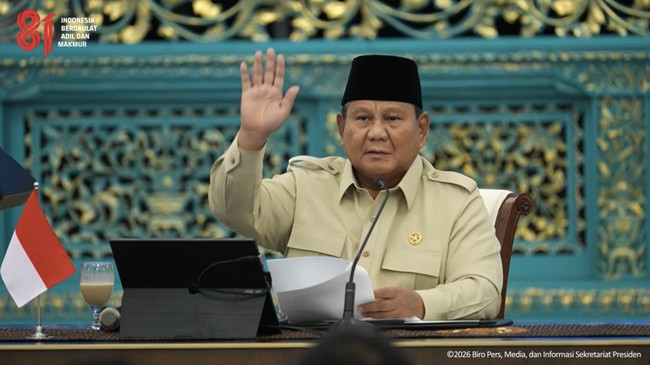
The attention of the public, business players, and investors will be directed at the Joint Session of the House of Representatives (DPR), the People’s Consultative Assembly (MPR), and the Regional Representative Council (DPD) to be held on Friday (14/8/2026). This moment is crucial because President Prabowo Subianto will deliver the State Address and outline the government’s fiscal policy direction for the 2027 budget year. Unlike previous years, which were held on 16 August, this year’s Joint Session has been brought forward by two days because 16 August 2026 falls on a Sunday.
Prabowo is scheduled to deliver the State Address in the morning. In the afternoon, the President will deliver the Government’s Introductory Statement on the Draft Law (RUU) on the 2027 State Budget along with its Financial Note. These two speeches will serve as important signals for the market. Through the State Address, Prabowo will convey the government’s achievements in 2026 and future priorities. The public is waiting to see which priority programmes will form the backbone of 2027. The Free Nutritious Meals (MBG) programme is also eagerly anticipated, as it concerns not only state spending but also people’s purchasing power, domestic product absorption, and economic activity in the regions.
However, the market’s greatest attention will be on the 2027 Draft State Budget. Through the Financial Note, the government will show how much the state will spend, where revenue will be obtained, and how the government will finance its various priority programmes. A number of macroeconomic indicators will also be in the spotlight, including the economic growth target, inflation, the rupiah exchange rate, oil and gas lifting, and the Indonesian Crude Oil Price (ICP) assumption. These figures are not just targets on paper; for investors, they provide a picture of the government’s fiscal policy direction. For the business world, these figures provide clues about demand prospects, investment, business costs, and business opportunities in 2027.
Previously, during the 23rd Plenary Meeting of the House of Representatives for the 2025-2026 Session, the Budget Committee (Banggar) and the government agreed on the Macroeconomic Framework and Fiscal Policy Fundamentals (KEM-PPKF) for 2027, targeting economic growth of around 5.8% to 6.5%. Following this agreement, the government will use the draft range as the basis for setting the initial figures for the Draft State Budget Law and its Financial Note.
From the global front, market participants will also focus on US inflation data for the July 2026 period. In the last release, the US recorded a monthly deflation of 0.4% in June 2026, but annual inflation still stood at 3.5%. Core inflation fell to 0% month-to-month but rose to 2.6% year-on-year. For July 2026, US inflation is expected to rise 0.1% monthly and ease slightly to 3.4% annually. US inflation is likely to show easing energy-related price pressures, which had previously increased in the months after the US began its war with Iran in late February.
Additionally, the UK economy is expected to record growth again this quarter as businesses find ways to cope with the impact of the Iran war, although some industries are expected to face increasing pressure, according to economists. Data from the Office for National Statistics showed the economy’s resilience in the face of supply chain issues and price pressures linked to the conflict, as well as a period of political uncertainty. The market consensus expects gross domestic product (GDP) to increase by 0.4% in the second quarter of 2026, driven by a strengthening services sector and stockpiling by factories and manufacturing companies in anticipation of supply shortages and price increases.