
Maritime Nation Indonesia Still Imports Millions of Tonnes of Salt, Here's Prabowo's Directive
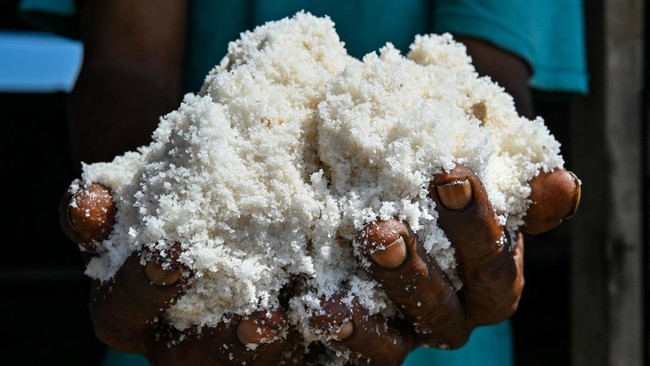
Indonesia, known as an archipelagic nation with a long coastline, still depends on imported salt, particularly to meet industrial needs. This situation is considered ironic and is one of the reasons the government is accelerating the salt self-sufficiency programme, targeted for completion by 2027.
Minister of Marine Affairs and Fisheries Sakti Wahyu Trenggono stated that President Prabowo Subianto has instructed that Indonesia should no longer rely on imported salt. Consequently, the government is preparing a number of measures, ranging from revitalising community salt ponds to constructing the National Salt Industry Centre (K-SIGN) in Rote Ndao, East Nusa Tenggara (NTT). This programme is one of the government’s strategic projects to pursue salt self-sufficiency.
“We are an archipelagic nation, a maritime country, yet our salt imports are huge. That is actually ironic. Our country is in the middle of the sea, yet we still import salt. This is why the President has instructed us to stop importing salt,” Trenggono said during the CNBC Indonesia Economic Update 2026 on Thursday (25/6/2026).
According to Trenggono, the biggest challenge is not only meeting household salt consumption needs but also fulfilling the requirements of various industrial sectors that demand salt with different specifications, ranging from the food, pharmaceutical, drilling, to paper industries.
“The need for salt is not just for public consumption, but also for the food industry, the pharmaceutical industry, the drilling industry, the paper industry, and others that require salt. They require different specifications,” he said.
“Meanwhile, salt from community ponds is produced using traditional methods, so the quality can fluctuate,” he added.
To address this issue, the Ministry of Marine Affairs and Fisheries is building a modern salt industrial zone model in Rote Ndao. The location was chosen because its seawater characteristics are considered similar to those of salt production areas in Australia, one of the world’s largest salt producers.
“We are trying to create a model, the National Salt Industry Centre (K-SIGN). We are building it in Rote Ndao. Why Rote? Because the water is the same as that used in Australia,” Trenggono said.
“In Australia, production is very large and has been ongoing since the 1960s, with very stable exports to all over the world. So, because the water is the same, the environment is the same, we are trying to build it,” he continued.
He explained that the 2,000-hectare area is estimated to be capable of producing around 500,000 tonnes of salt per year. Meanwhile, national salt demand currently reaches around 5 million tonnes, while community salt production is close to 3 million tonnes with varying quality.
In addition to building a new zone in Rote Ndao, the government is also collaborating with state-owned salt company PT Garam to accelerate the development of salt centres in Eastern Indonesia.
“PT Garam was originally established by the Dutch in the Madura region. Madura is now heavily contaminated, so it needs to be revitalised. We have asked PT Garam to expand into Eastern Indonesia, which is still in better condition. That is what we are doing, but specifically, the one in Rote is quite good,” he said.
“By the end of this year, the hope is that production will be running well, so that our target of achieving self-sufficiency by the end of 2027 should be attainable,” Trenggono concluded.
Source: jawawa.id (https://jawawa.id/newsitem/maritime-nation-indonesia-still-imports-millions-of-tonnes-of-salt-heres-prabowos-directive-1782377480)
Originally published by CNBC Indonesia (https://www.cnbcindonesia.com/news/20260625125319-4-745655/ri-negara-maritim-tapi-impor-garamnya-jutaan-ton-ini-titah-prabowo), translated from Indonesian