
Marinus Gea Urges Unias to Build Pancasila-Based Character Leadership
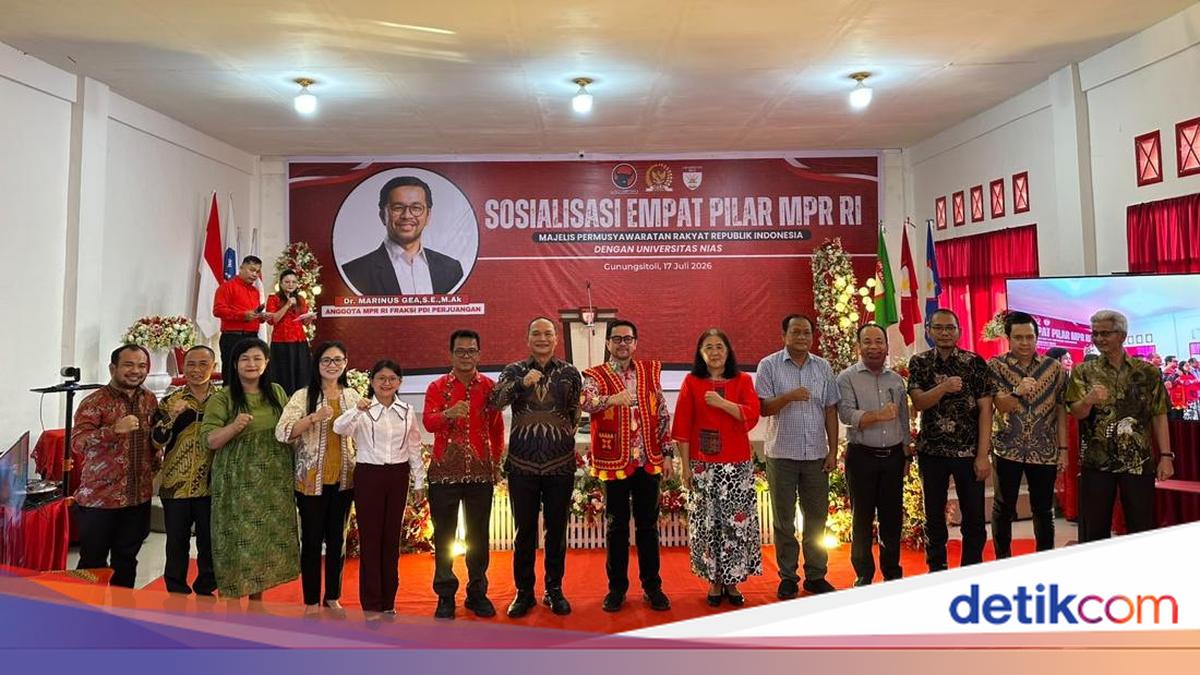
People’s Consultative Assembly (MPR) member Marinus Gea has emphasised that leadership grounded in Pancasila values serves as the primary foundation for developing Universitas Nias (UNIAS) into a Centre of Excellence. He made the remarks while delivering a presentation on the MPR’s Four Pillars socialisation at Universitas Nias on Friday (17/7/2026).
Gea stated that many intelligent individuals fail as leaders because they lose their moral compass. According to him, true leadership relies not only on intellectual capability but also on values, character, and integrity rooted in Pancasila. “Leadership is not merely about intellectual prowess, but about values, morality, and character. Pancasila is the moral compass that must guide every leadership process,” Gea said.
He also urged the academic community to fully understand the history of Pancasila’s birth. Gea explained that Pancasila emerged through a historical process beginning with Bung Karno’s speech on 1 June 1945, followed by the Jakarta Charter on 22 June 1945, and was finally ratified in the Preamble to the 1945 Constitution on 18 August 1945. He noted that this historical understanding is crucial so that the younger generation is not easily swayed by historical distortions or ideologies contrary to the nation’s identity.
Gea stressed that Pancasila must not be reduced to a mere symbol or classroom recitation. As a living ideology, Pancasila should be believed, understood, and manifested in real actions by the entire academic community. “If Pancasila is only memorised, then substantively it is dead. But if it is practised in daily life, Pancasila will become a real force capable of bringing about change,” he said.
In his presentation, Gea described gotong royong, or mutual cooperation, as the essence of Pancasila. He argued that the progress of Universitas Nias can only be achieved if all campus elements—from the foundation, rectorate, and lecturers to students and administrative staff—move forward in a spirit of collaboration. “A great university is not built by one great person, but by a strong culture of cooperation. Gotong royong is the main strength to make Universitas Nias a superior campus,” he said.
Gea then outlined five core values of Pancasila Leadership that should underpin higher education governance: Belief in God, Humanity, Unity, Democracy, and Social Justice. He said these values would produce leaders with integrity who uphold humanity, are capable of uniting differences, prioritise deliberation, and deliver justice in every policy.
He specifically advised the leadership of Universitas Nias to view their positions as a mandate to build academic quality while shaping the character of the younger generation. Gea stressed that the measure of a Centre of Excellence is not merely grand buildings or large student numbers, but integrity, research quality, transparent service, community engagement, and commitment to national values.
He also encouraged the implementation of the Tri Dharma of Higher Education to address real problems faced by the Nias community, including strengthening micro, small, and medium enterprises, developing the tourism sector, and fostering innovation in agriculture, marine, and fisheries.
In his closing remarks, Gea invited the entire academic community to make Universitas Nias a crucible for producing future leaders who are faithful, have integrity, embody the spirit of mutual cooperation, and are capable of advancing the Nias Islands into a progressive, competitive, and prosperous region. “The campus must be present as a solution centre for society. By bringing Pancasila values and the spirit of gotong royong to life, Universitas Nias will be able to give birth to a generation of future leaders who bring progress to Nias and Indonesia,” Gea concluded.