
Map of the World's Richest: From Japanese Property Kings to US Tech Giants
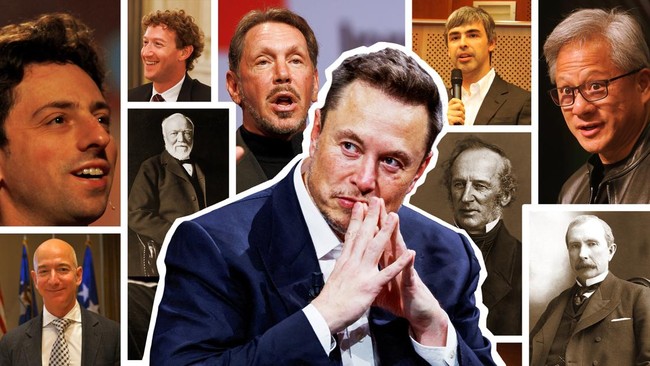
Over the last 40 years, the title of the world’s richest person has undergone a massive shift, moving from Japanese property tycoons to United States technology billionaires. This change reflects a broader shift in the world’s primary sources of wealth. From Microsoft, telecommunications, e-commerce, and luxury goods to the most recent waves of electric vehicles and space technology, each era has produced its own record-breaking wealth.
Data from Visual Capitalist, sourced from the Forbes billionaires list, illustrates this transformation since 1987. Historical wealth estimates have been adjusted for inflation using US Consumer Price Index data, while 2026 figures utilise real-time Forbes estimates from September 2026. It is important to note that billionaire wealth is highly dependent on asset prices, meaning values can change significantly in a short period. For instance, in the 2026 annual Forbes list, Elon Musk’s wealth was estimated at US$839 billion based on March asset prices, whereas the Forbes real-time tracker in September placed it around US$923 billion.
Japanese Property Tycoons Dominated the Early Era
From the late 1980s to the early 1990s, the list of the world’s richest people reflected the peak of the Japanese asset bubble. Surging land and property prices allowed several Japanese real estate entrepreneurs to amass unprecedented wealth. Yoshiaki Tsutsumi held the top position in six out of eight annual lists between 1987 and 1994, while Taikichiro Mori topped the list in 1991 and 1992. Tsutsumi’s inflation-adjusted wealth reached approximately US$58 billion in 1987, built through the Seibu business empire, which included railway networks and large-scale property holdings.
This dominance began to wane when the Japanese asset bubble burst. In 1995, Bill Gates took over the top spot, marking a shift in the world’s primary wealth source from property to technology.
Bill Gates Dominated for More Than a Decade
Bill Gates became the name most frequently occupying the top spot over the last 40 years. The Microsoft founder topped the Forbes annual list in 18 of the 40 years since 1987, including 13 consecutive years from 1995 to 2007. Gates’ inflation-adjusted wealth reached approximately US$178 billion in 1999, during the peak of the dot-com bubble. Despite being overtaken several times, Gates managed to return to the top, with his final stint as the world’s richest person ending in 2017.
Elon Musk Brings Billionaire Wealth to New Levels
In recent years, the value of wealth at the top of the list has increased much more rapidly. Jeff Bezos was the world’s richest person for four consecutive annual lists from 2018 to 2021. The Amazon founder’s wealth, adjusted for inflation, reached approximately US$215 billion in 2021. Elon Musk then recorded wealth of around US$246 billion in 2022, before Bernard Arnault and his family took the top position in 2023 and 2024. Musk returned as the world’s richest person in 2025 and maintained that position in the 2026 Forbes annual list.
Forbes estimates Musk’s wealth reached a record US$839 billion in March 2026, more than three times the wealth of Larry Page, who sat in second place with approximately US$257 billion. Musk’s wealth is also highly volatile; Forbes noted his wealth briefly reached US$1.45 trillion in June 2026 following SpaceX’s public listing, before declining again. Musk is also recorded as the world’s highest-paid CEO. In 2025, his total compensation reached US$132.3 billion, primarily derived from long-term Tesla stock awards linked to market capitalisation targets and company operational performance.
Comparison with Indonesia?
The scale of Elon Musk’s wealth appears far greater when compared to Indonesia’s richest individuals. Based on real-time Forbes data as of 16 September 2026, Prajogo Pangestu’s wealth reached approximately US$16.2 billion. Meanwhile, Visual Capitalist notes Elon Musk’s wealth reached US$923 billion in September 2026. With these figures, Musk’s wealth is equivalent to approximately 57 times that of Prajogo Pangestu.
The scale is also evident when compared to the Indonesian economy. The World Bank recorded Indonesia’s Gross Domestic Product (GDP) in 2025 at approximately US$1.45 trillion. This means Musk’s wealth is equivalent to about 64% of Indonesia’s annual GDP. This comparison is purely illustrative, as GDP represents the value of goods and services produced over a year, whereas net wealth represents the value of assets at a single point in time.
Another comparison can be seen in population size. Indonesia’s population in 2025 reached approximately 285.7 million people. If Elon Musk’s wealth of US$923 billion were hypothetically divided equally among the entire Indonesian population, each person—from infants to the elderly—would receive approximately US$3,230, or about Rp57.3 million, assuming an exchange rate of Rp17,753 per US dollar.
Source: jawawa.id (https://jawawa.id/newsitem/map-of-the-worlds-richest-from-japanese-property-kings-to-us-tech-giants-1789721737)
Originally published by CNBC Indonesia (https://www.cnbcindonesia.com/research/20260918130809-128-769012/peta-crazy-rich-dunia-dulu-raja-properti-jepang-kini-bos-teknologi-as), translated from Indonesian