
Many Indonesians Complain About Land and Railway Issues, Here Is AHY's Response
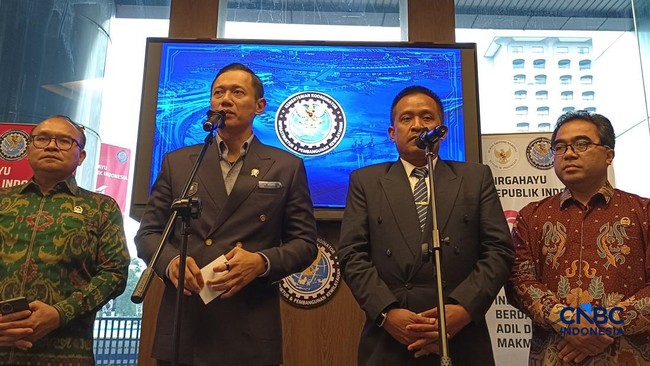
Jakarta, CNBC Indonesia - Coordinating Minister for Infrastructure and Regional Development Agus Harimurti Yudhoyono (AHY) has revealed a number of findings and public complaints regarding public services in the infrastructure and regional development sector. Based on initial mapping with the Indonesian Ombudsman, agrarian and land issues have drawn the most attention.
AHY said these issues encompass public services in the land sector, including spatial planning. He noted that the land sector has many problems that must be resolved, including long-running conflicts.
“We mapped it earlier; the most numerous are indeed agrarian and land affairs, because there are so many public services in the land or agrarian sector, including regional spatial planning. I know this very well, having previously led the ATR/BPN ministry, albeit briefly for eight months, but there are indeed many issues that must be resolved. Then there are conflicts that have dragged on for years, involving multiple parties and becoming complicated, which often demand a swift and thorough response from officials, both at the provincial level, where there are regional offices, and at the district/city level, where there are land offices. This is one of the portraits they conveyed,” AHY said at a press conference at his office in Jakarta on Wednesday (19/8/2026).
Besides the land sector, AHY said there were complaints and public expectations regarding the transport sector. This has become a government concern, particularly regarding railway safety.
“Then in transport affairs, there are complaints and expectations at the same time, and this is highly relevant because before the meeting with the Ombudsman, I had just held a meeting with colleagues from KAI to discuss railway transport safety,” he said.
AHY revealed that the government is currently continuing efforts to improve safety around level crossings. He said there are approximately 1,400 level crossings that are of concern.
“A few months ago, we all closely followed the train incident or accident at Bekasi Timur Station, which indeed demands that we all immediately and seriously improve the railway safety system. There are around 1,400 level crossings that we are currently striving to make safer, with barriers being built and automated, although personnel are still deployed,” he said.
According to him, a number of level crossings must also have guard posts with officers monitoring them 24 hours a day.
“Earlier I received a report that there is a guard post and four people over 24 hours who always man that level crossing. And these exist in many places, so that was also among the findings. We conveyed the response that this is being worked on, but it does require time and process, because level crossings are actually also the domain of local governments,” he said.
AHY explained that the authority to handle level crossings depends on the status of the road. Provincial roads fall under the authority of provincial governments, while district/city roads are under district/city governments. National roads are related to the Ministry of Transportation.
“But KAI, in this case, is also trying to serve as a bridge so that services can continue to improve, especially with regard to the safety factor that is prioritised. But that is also an example that in the transport sector there are fundamental findings, for instance related to safety,” AHY said.
Findings and complaints also emerged in the public works and housing sector. AHY said one of them relates to post-disaster rehabilitation and reconstruction in several regions of Sumatra.
“Public works and housing are similar. Earlier we gathered a number of inputs and complaints, for example regarding post-disaster rehabilitation and reconstruction in Sumatra, Aceh, North Sumatra, and West Sumatra,” he said.
In addition, public input covers basic infrastructure issues such as roads, bridges, housing, and water resources related to the sustainability of agricultural production.
“There are matters related to basic infrastructure such as roads, bridges, housing, and also water resources so that rice fields can continue to be irrigated and their production must not cease,” AHY said.
AHY assessed that public reports provide important input for the government to understand problems more specifically and improve the public service system. According to him, the government needs to be open to criticism so that policies and problem-solving can be better targeted.
“This provides very meaningful input, because the government must continue to receive input, even criticism, that enables us to better understand the people’s problems and to be more precise and directly on target, not vague. Because when there is a report, it is usually specific: there is a case in a certain place, the time, who is involved, and so on. That can be known more clearly, and hopefully if the symptoms are clear, then the medicine or the solution will also be clear. I think so,” he concluded.
The meeting was held by AHY together with officials from the Indonesian Ombudsman. Deputy Chairperson of the Indonesian Ombudsman Rahmadi Indra Tektona said the meeting was an initial step to strengthen collaboration in improving public services and preventing maladministration in the five ministries under the coordination of the Coordinating Ministry for Infrastructure.
“Alhamdulillah, today is the first time the Indonesian Ombudsman has been received by the Coordinating Minister. This is a positive response from him towards public services in Indonesia, because there are five ministries under the Coordinating Minister, under his ministry, namely infrastructure,” Rahmadi said on the same occasion.
Rahmadi said the Ombudsman has 34 representative offices.