
Many Indonesians Are Downgrading Their Lifestyles, Economists Reveal a Hard Truth
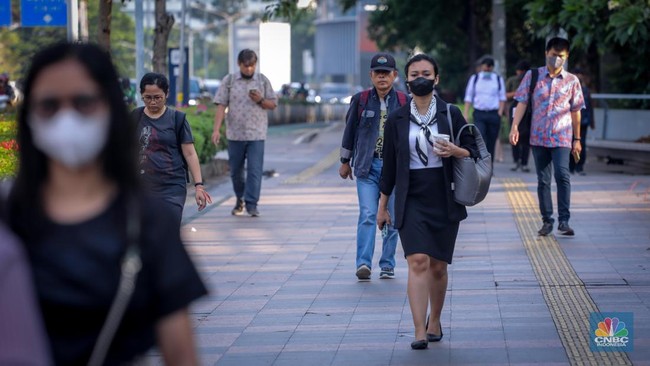
Jakarta, CNBC Indonesia – The phenomenon of downgrading one’s lifestyle has been widely discussed on social media platforms such as Threads. Several users have shared experiences of having to change their daily habits, from switching to cheaper brands and selling vehicles to accepting jobs with much lower salaries.
The trend attracted attention after various Threads accounts, including @aliashariakbar, invited users to describe changes in their lifestyles amid current economic conditions.
“In this economy, what have you downgraded? Me: I used to have a Cortez car and a house in a gated estate; now I live at my in-laws’ house and ride an old Shogun motorbike to work,” the account wrote in a post in late September 2026, cited on Monday (12 October 2026).
The account @wulan_as17 described a similar experience. The user said they had sold their Honda HR-V and replaced it with a more affordable low-cost green car (LCGC).
The account @fun_funny28 said they had switched to a cheaper brand of rice, from Rp470,000 to Rp370,000 for a 20-kilogram pack. Meanwhile, @eveedesu said they had previously been accustomed to buying coffee from outlets such as Tomoro, Fore and Starbucks, but had now switched to instant coffee sachets.
Another user, @psychefeb, said they no longer took part in Pilates, yoga or padel, and now more often looked for products and services offering discounts. The account @fzzhnrnn_ said their family bought fruit less often because prices felt increasingly expensive, despite more family members being in work.
From a salary of Rp30 million to Rp12 million
The downgrading trend is not limited to lifestyles; people’s incomes are also affected. The account @ghaniara.id described how their husband had previously worked on a contract at a state-owned enterprise (SOE), earning more than Rp30 million a month. According to the account, his contract was not renewed as part of efficiency measures. After being unemployed for almost a year, he eventually found a new job paying Rp12 million a month.
Another account, @tolong.bilangin, said its owner had previously worked as a programmer earning Rp19 million, but had now switched to working as an online motorcycle taxi driver.
Amid the many stories, some users also offered support. The account @wahyu_sekar, for example, said lifestyle changes should not always be viewed as a setback, but can also be a way of adapting to circumstances.
Economist highlights weakening middle-class purchasing power
In response to the trend, economist and Next Policy director Yusuf Wibisono said the growing number of people lowering their lifestyle standards was linked to pressure on purchasing power, particularly among the middle class. He said signs of weakening purchasing power had become increasingly common in recent years, despite Indonesia’s continued economic growth.
“In recent years, as the economy has continued to grow strongly, we have increasingly seen signs of weakening public purchasing power: shopping centres that are quiet or even closing, malls with plenty of visitors but few customers at the tills, declining turnover in traditional markets, and middle-class households willing to downgrade their lifestyles to save money,” Yusuf told CNBC Indonesia on Monday (12 October 2026).
Yusuf said pressure on purchasing power was affecting not only low-income households but was increasingly being felt by the middle class as well.
He warned that the weakening of the middle class could become a serious problem for Indonesia’s economy over the long term. Yusuf noted that the middle-class population fell from 60.8 million people, or 23% of the population, in 2018 to 46.7 million, or 16.6%, in 2025. By contrast, the share of people classified as vulnerable to poverty or aspiring to middle-class status rose from 68.5% in 2018 to 74.5% in 2025.
“This fall in the middle class’s purchasing power must be taken seriously because it threatens the achievement of Golden Indonesia 2045,” he stressed.
Yusuf explained that the middle class plays an important role in supporting consumption and economic growth. When this group comes under pressure, people’s ability to buy goods and services beyond basic necessities is also constrained.
He said the issue was closely linked to the declining role of the formal sector in providing quality jobs, whether because of layoffs or the emergence of lower-paid work. He therefore argued that the government should prioritise creating formal jobs with decent wages, rather than relying solely on short-term economic stimulus.
“To save the middle class, broadly creating quality formal jobs is essential, not merely providing temporary fiscal stimulus,” he said.
Yusuf also called for a revival of a competitive manufacturing industry to expand employment opportunities and strengthen the middle class.
Not necessarily a sign of a worsening economy, but a warning
Meanwhile, Syafruddin Karimi, an economist at Andalas University, cautioned that lifestyle downgrading on social media could not, by itself, be taken as proof that economic conditions were worsening for all Indonesians. He said users’ accounts should be seen as an early signal to be tested against national economic data.
“The lifestyle-downgrading phenomenon should be read as a micro-level signal that needs to be tested against macroeconomic data, not immediately treated as proof that everyone’s circumstances are worsening,” Syafruddin told CNBC Indonesia.
He explained that decisions to switch to cheaper brands, sell vehicles or accept lower-paid work showed consumers adjusting their spending in response to expectations about their long-term income. Syafruddin noted that Indonesia’s economy grew by 5.29% year on year in the second quarter of 2026. The Consumer Confidence Index also remained in optimistic territory in September 2026, at 118.1.
However, these conditions coincided with pressure in the labour market. He noted that 63,789 workers were laid off between January and September 2026, while retail sales growth in September was forecast to reach only 1.4% year on year.
“So, this phenomenon does not yet prove that national consumption is contracting, but it is an early warning of pressure on some households,” he explained.
Syafruddin also said the middle class was particularly vulnerable to cost-of-living pressures because of its fixed expenses, including loan repayments, education and housing costs. At the same time, this group is often not eligible for government social assistance.
He said household economic pressure was caused not only by rising prices, but also by limited wage growth, the risk of job losses and rising spending on various needs.
“When nominal incomes do not rise as quickly as living costs and fixed expenses, disposable income shrinks. Households then protect their cash flow by downgrading the quality of goods, postponing major purchases or cutting back on entertainment,” he said.
Syafruddin stressed that switching to cheaper products or selling a vehicle did not necessarily mean someone was becoming poor. In some circumstances, such decisions could be a sound financial strategy to protect savings and meet essential obligations. However, the situation should be treated with concern when such adjustments are forced and repeated because income continues to weaken.
“The warning signs become more serious when households start using debt for routine expenses, drawing on savings for daily consumption, falling behind on obligations, or cutting spending on health and education,” he explained.
Syafruddin warned that the greatest risk arose when a lifestyle reduction stopped being a temporary adjustment and became a prolonged decline in living standards. If more households cut spending, this could put pressure on company sales, hinder investment and slow recruitment.
That, in turn, could further weaken household incomes and consumption. Nevertheless, he stressed that current economic data did not indicate a collapse in national consumption.
“If layoffs rise and real wages fall behind, people on the cusp of the middle class are most at risk of slipping down the income ladder. The impact would extend beyond consumption to tax revenue, credit quality, retail investment and growth prospects,” he said.
To address the situation, Syafruddin advised households to prioritise financial resilience by controlling fixed expenses, maintaining an emergency fund and limiting high-interest consumer debt. He also warned against sacrificing essential needs such as health and education merely to maintain a particular lifestyle.
For the government, he emphasised the importance of creating quality jobs and sustainably increasing people’s incomes.
“A stronger strategy is to raise productivity and job quality so that purchasing power recovers through sustainable income, rather than temporary stimulus,” Syafruddin said.
Source: jawawa.id (https://jawawa.id/newsitem/many-indonesians-are-downgrading-their-lifestyles-economists-reveal-a-hard-truth-1791795129)
Originally published by CNBC Indonesia (https://www.cnbcindonesia.com/lifestyle/20261012130842-33-775345/ramai-warga-ri-downgrade-lifestyle-ekonom-ungkap-fakta-pahit), translated from Indonesian