
Many Changes: Here Are BI’s Decisions at the October 2026 Board of Governors Meeting
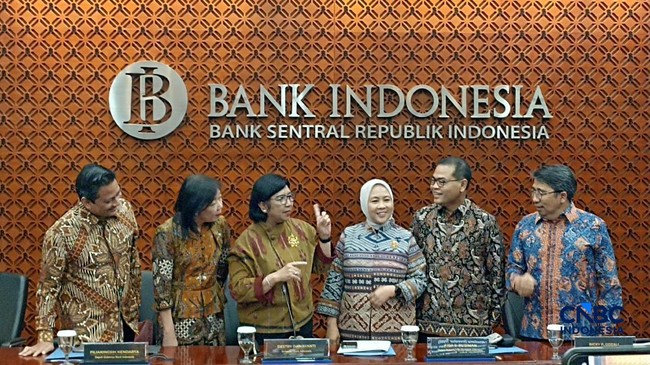
Jakarta, CNBC Indonesia — Bank Indonesia (BI) decided to keep its benchmark interest rate unchanged at its Board of Governors Meeting (RDG) held on 20–21 October 2026.
In its announcement, BI also outlined a number of other policies to maintain rupiah exchange-rate stability, increase the availability of funds in banks, encourage lending and expand the use of digital payments.
At the October 2026 meeting, BI kept the BI Rate at 5.75% and the Lending Facility rate at 6.50%. The Deposit Facility rate, meanwhile, was raised to 5.00%.
BI said maintaining rupiah stability and controlling inflation remained its main considerations in setting monetary policy.
“This monetary policy remains consistent with the exchange-rate stabilisation strategy amid continued strong external pressures, and with efforts to keep inflation within the target of 2.5±1% in 2026 and 2027,” BI said in an official statement on Wednesday (21 October 2026).
At the same time, BI is seeking to sustain economic growth through policies that give banks greater scope to lend to households and businesses.
Alongside its interest-rate decisions, BI announced several other measures.
BI cuts banks’ reserve requirements
One measure is a reduction in the statutory reserve requirement (GWM) for both conventional commercial banks and Islamic banks.
The GWM is the amount of funds banks are required to hold at Bank Indonesia. When the requirement is lowered, banks must place less money at the central bank.
For conventional commercial banks, BI decided to cut the GWM from 9% to 7% in two stages:
1 November 2026: reduced from 9% to 8%.
1 December 2026: reduced again from 8% to 7%.
The same policy applies to Islamic commercial banks and Islamic business units.
BI will reduce the GWM for Islamic banks from 7.5% to 5.5%, also in two stages. On 1 November 2026, it will fall from 7.5% to 6.5%, followed by a further reduction to 5.5% on 1 December 2026.
The GWM cuts will be accompanied by an adjustment to the Macroprudential Liquidity Incentive Policy (KLM), from 6% to 5%, effective 1 December 2026.
BI also stipulated that the portion of average rupiah reserve requirements eligible for remuneration or a return will be capped at 5% of the average rupiah GWM. This remuneration rule will also take effect on 1 December 2026.
In addition to lowering the GWM, BI will manage money-market interest-rate structures to keep them aligned with the BI Rate and the rates on monetary-operation instruments.
BI will also strengthen its market-based, or pro-market, monetary operations as part of its efforts to control inflation and ensure adequate rupiah liquidity.
Exchange-rate stability: BI steps up intervention and foreign-capital incentives
The next set of measures is aimed at strengthening rupiah stability amid pressure in global financial markets.
BI said the rupiah stood at Rp17,985 per US dollar on 20 October 2026, a depreciation of 0.61% from its position at the end of September 2026.
The movement was affected by rising geopolitical tensions in the Middle East, tighter US monetary policy and foreign investor sentiment in Indonesia’s stock market.
To stabilise the exchange rate, BI will continue intervening in foreign-exchange markets, both domestically and overseas. This will include Non-Deliverable Forward (NDF) transactions in offshore markets, as well as spot and Domestic Non-Deliverable Forward (DNDF) transactions at home.
BI has also decided to increase incentives for using DNDF instruments to hedge overseas funding. The increase will take the form of larger reductions in hedging premiums:
Six-month tenor: the premium reduction rises from 25% to 40%.
12-month tenor: the premium reduction rises from 30% to 45%.
The incentives apply to transactions linked to foreign portfolio investment inflows, offshore borrowing by banks and foreign direct investment (FDI).
BI will also continue incentives for conventional buy-swap hedging instruments linked to overseas funding. It will maintain premium reductions of 15% for a three-month tenor, 20% for six months and 25% for 12 months.
BI is also continuing incentives for transactions using local currencies, or Local Currency Transactions (LCT), with partner countries. These include an additional 10% premium on conventional sell-swap hedging and a 10% reduction in DNDF hedging premiums for international trade and investment transactions.
The LCT policy is part of BI’s effort to encourage greater diversification in the use of foreign currencies for transactions with partner countries.
BI said the hedging incentives introduced in June 2026 had attracted US$9.9 billion in foreign capital inflows by 20 October 2026.
BI will continue to optimise its monetary-policy instruments, including hedging incentives and the deepening of money and foreign-exchange markets, to maintain rupiah stability.
Macroprudential policy: zero-down-payment home and vehicle financing extended
In addition to monetary and exchange-rate policies, BI announced several decisions to support bank lending.
One is the extension through 2027 of property financing of up to 100% of a property’s value, as well as vehicle loans with a minimum down payment of 0%.
For property, BI extended the Loan to Value/Financing to Value (LTV/FTV) ratio limit of 100%. This allows banks to finance up to the full value of a property used as collateral, including loans with no down payment, provided applicable requirements are met.
The policy covers all types of property, including landed houses, flats, shop-houses and office-houses. It applies to banks that meet certain criteria, including requirements relating to non-performing loans or financing (NPL/NPF).
BI also extended the minimum 0% down-payment rule for loans or financing for all types of new motor vehicles.
Both policies, previously due to expire on 31 December 2026, have been extended for the period from 1 January to 31 December 2027.
Beyond property and vehicle financing, BI is strengthening the Macroprudential Liquidity Incentive Policy (KLM) to support credit growth. The KLM rate has been set at 5%, comprising two categories of incentives.
First, incentives for lending or financing (the financing channel) will be capped at 3% of third-party funds (DPK). These incentives have also been expanded to support financing for business sectors that contribute to job creation.
Second, incentives for money-market deepening will be capped at 2%. This measure is intended to promote a more even distribution of liquidity and funding between banks.
The strengthened KLM will take effect on 1 December 2026.
BI decided to keep several other macroprudential requirements unchanged:
The Macroprudential Intermediation Ratio (RIM) remains at 84%–94%.
Banks’ Foreign Funding Ratio (RPLN) remains capped at 40% of bank capital.
The Countercyclical Capital Buffer (CCyB) remains at 0%.
The Macroprudential Liquidity Buffer (PLM) remains at 4%, with repo flexibility of 4%.
The Islamic PLM remains at 2.5%, with repo flexibility of 2.5%.
BI will also continue implementing the strengthened Macroprudential Inclusive Financing Ratio (RPIM) policy to widen access to financing.
These measures form part of BI’s efforts to increase lending and financing to the real economy while maintaining financial-system stability.
QRIS to expand to Hong Kong and Timor-Leste
The fourth set of decisions concerns the development of digital payments under the Indonesia Payment System Blueprint (BSPI) 2030.
BI outlined at least four measures to expand digital economic and financial activity.
The first is to extend cross-border QRIS cooperation to Hong Kong and Timor-Leste. BI will begin sandbox trials for both corridors in the fourth quarter of 2026 as part of the development of cross-border QRIS payment services.
The second is to broaden implementation of the Indonesia Credit Card (KKI), in both the retail and government segments.
For retail, BI will strengthen the commitment of first-mover participants and expand the pool of subsequent, or next-mover, participants. For government use, it will optimise the online payment feature. The broader KKI rollout is scheduled to begin in the fourth quarter of 2026.
The third measure is preparation of Payment System Data Infrastructure through the issuance of a Bank Indonesia Regulation (PBI) on the Governance of Payment System Data. The regulation will provide a legal basis for data exchange in the payment system in accordance with the Personal Data Protection Law (PDP). Preparatory work on the regulation will also begin in the fourth quarter of 2026.
The fourth is to strengthen the payment-system industry by organising cooperation between Payment System Providers (PSPs) and Supporting Providers (PPs). This work will also begin in the fourth quarter of 2026.
These four digitalisation measures form part of BI’s policy to support economic growth and expand digital economic and financial activity.
“Bank Indonesia continues to strengthen policy coordination with the Government, the Financial System Stability Committee (KSSK) and other stakeholders to bolster external resilience, maintain economic stability and support sustainable economic growth,” BI said in its official statement.
Source: jawawa.id (https://jawawa.id/newsitem/many-changes-here-are-bis-decisions-at-the-october-2026-board-of-governors-meeting-1792576276)
Originally published by CNBC Indonesia (https://www.cnbcindonesia.com/research/20261021142247-128-778224/banyak-yang-baru-ini-daftar-keputusan-bi-dalam-rdg-oktober-2026), translated from Indonesian