
Manufacturing Industry Under Pressure, PMI Enters Contraction Phase
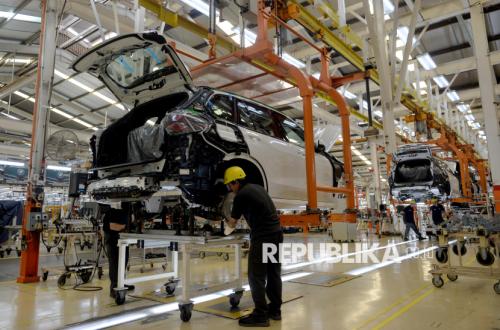
Head of Economics at Trimegah Sekuritas Indonesia, Fakhrul Fulvian, assesses that the decline in Indonesia’s manufacturing Purchasing Managers’ Index (PMI) in April was more influenced by global supply chain disruptions.
“We see a very clear divergence between advanced economies and ASEAN. The United States (US) and Japan are actually experiencing manufacturing acceleration due to the safety stock building phenomenon, while ASEAN, including Indonesia, is starting to come under pressure from cost inflation and supply chain disruptions,” he said in Jakarta on Monday (4/5/2026).
The latest S&P Global data shows that Indonesia’s manufacturing activity has entered a contraction phase, with the PMI falling from 50.1 in March to 49.1 in April. This decline marks the first contraction in the last nine months and is occurring amid increasingly strong inflationary pressures, both globally and domestically.
According to Fakhrul, the pressure on the manufacturing sector is caused by a surge in input costs due to geopolitical conflicts that are driving up raw material prices and supply limitations.
This is reflected in the surge in production cost inflation to the highest level in the last four years, which is then passed on to selling prices at the fastest rate in more than a decade.
“This is a textbook case of cost-push inflation. When costs rise too quickly, producers have no choice but to reduce output or pass on prices to consumers. We see both happening simultaneously in April,” Fakhrul explained.
On the other hand, although there was a slight increase in new orders, this is considered not yet to reflect a healthy demand recovery.
“The increase in orders is more in the nature of front-loading, anticipating future price increases, not because of truly strong demand. This is important to read carefully,” he added.
Furthermore, Fakhrul also highlighted that this PMI weakening is occurring alongside Indonesia’s inflation recorded at 2.42 percent year-on-year (yoy) in April 2026. Although still within the target range, the dynamics in the manufacturing sector indicate emerging potential pressures ahead on input prices.
“Headline inflation does indeed still appear controlled at 2.42 percent, but pressures at the producer level are already rising significantly. This means there is potential for lagging pass-through to consumer inflation in the coming months, especially due to rupiah weakness,” he said.
Furthermore, he emphasised that this situation creates policy challenges that are not straightforward.
“We are at a sensitive point. On one side, the real sector is starting to weaken, but on the other side, price pressures are actually increasing. This demands a more precise policy response, especially on the monetary side and exchange rate stabilisation,” said Fakhrul.
In the regional context, Indonesia is not alone. The Philippines has also entered the contraction zone, while Vietnam and Thailand are experiencing significant slowdowns. Malaysia is the only country that is relatively growing, driven by stockpiling activities.
“This is not just Indonesia’s story, this is ASEAN’s story amid a changing world. When advanced economies stockpile goods out of fear of inflation, developing countries have to bear those price increases,” he concluded.