
Manpower Ministry prepares 3S strategy to shield young workers from AI disruption
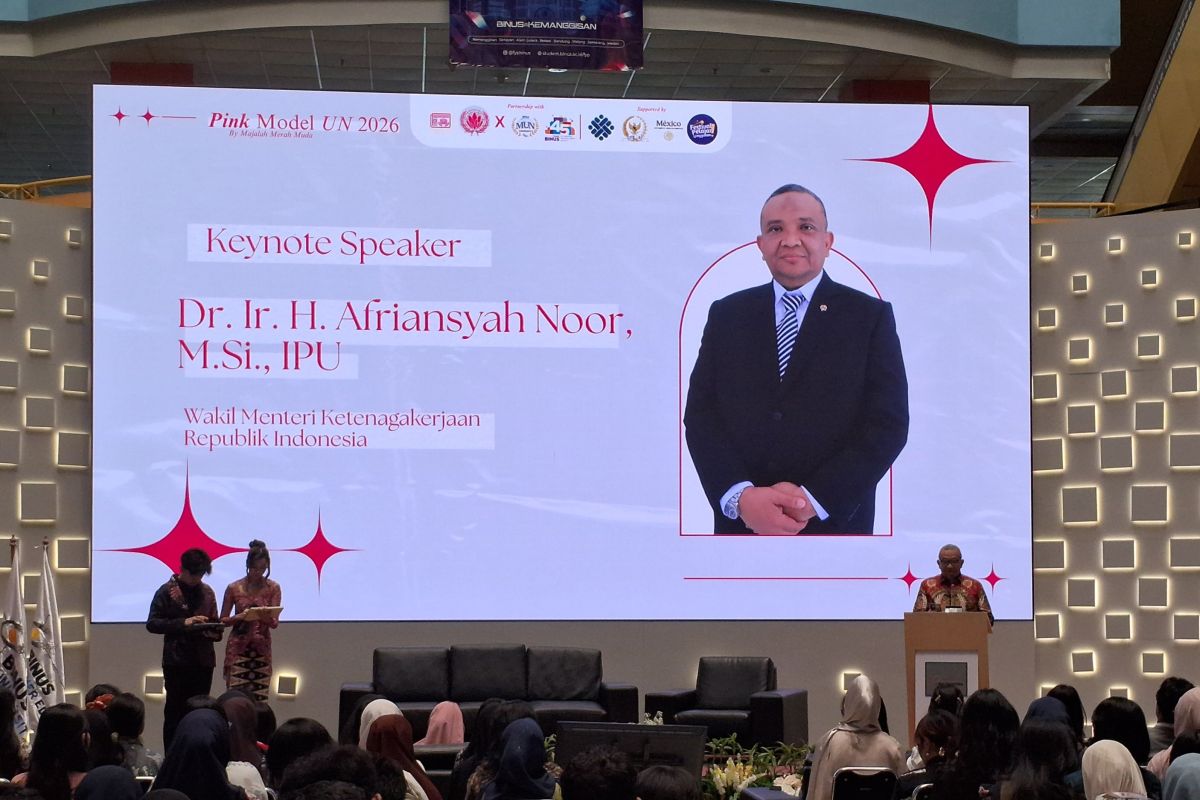
The Ministry of Manpower (Kemnaker) has prepared an upskilling, reskilling and cross-skilling strategy, known as the triple skilling (3S) strategy, to improve the competence of young workers in facing the rapid development of artificial intelligence (AI).
Deputy Manpower Minister Afriansyah Noor said AI has changed the world of work and created demand for new competencies, so the younger generation must be able to adapt to technological developments.
“The Ministry of Manpower views the AI transformation not as a threat to be feared, but as a golden opportunity to accelerate the productivity and competitiveness of the national and global workforce,” Afriansyah said at the Pink Model United Nations (PinkMUN) 2026 event at Binus Campus, Jakarta, Saturday.
He explained that upskilling is carried out to improve existing skills so they remain aligned with technological developments. Reskilling is aimed at workers affected by disruption so they can move to new sectors, while cross-skilling provides a combination of skills across fields to increase career flexibility.
According to Afriansyah, the strategy is important because Indonesia is currently enjoying a demographic bonus, with more than 68 percent of the population in the productive age group.
“This extraordinary quantitative potential could become a boomerang if a skill mismatch occurs, or a mismatch between the skills possessed by young graduates and the real needs of the modern labour market,” Afriansyah said.
To respond to these changes, the ministry is reorienting vocational training curricula by integrating AI literacy, data analysis, automation and non-technical skills, including critical thinking, work ethics, adaptability and leadership.
“Skills such as critical thinking, work ethics, adaptability and leadership are human abilities that can never be replaced by machines or algorithms,” Afriansyah said.
In addition, the ministry continues to modernise vocational and productivity training centres (BPVP) and community job training centres (BLK Komunitas) with modern technology-based facilities and to improve the quality of instructors to keep pace with industrial developments.
BNSP certification continues to refer to the Indonesian National Work Competency Standards (SKKNI).
Beyond technological skills, the ministry is also promoting worker protection amid the growth of flexible working patterns, including freelance work.
He also encouraged the younger generation to keep learning and adapting so they can make the most of AI developments.
“Be an adaptive generation, strive to sharpen your own competencies, make use of all the training facilities provided by the state, and most importantly, jointly safeguard the vision of Golden Indonesia 2045,” Afriansyah said.
Furthermore, the ministry is committed to expanding access to vocational training inclusively, including increasing women’s participation in science, technology, engineering and mathematics (STEM), providing disability-friendly facilities, and reaching young people in frontier, outermost and disadvantaged (3T) regions.