
Manpower Minister Issues Stern Warning, Says National Internship Scheme Must Not Be Used to Replace Workers
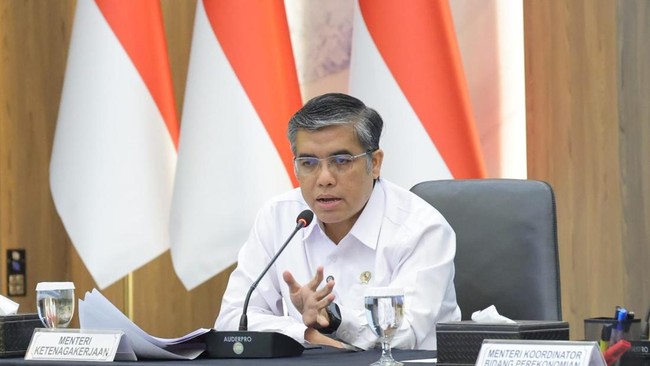
Manpower Minister Yassierli has stressed that the National Internship Programme will not replace permanent employees or lead to redundancies. He said companies cannot be certain they will continue to receive allocations of internship places.
“Many people have told me that the national internship scheme replaces regular workers. That does not seem possible, because companies have no certainty that they will always receive internship places,” Yassierli told reporters at the Coordinating Ministry for Economic Affairs on Wednesday (21 October 2026).
The programme is also limited to six months. “After the six-month internship, who would continue doing that person’s work at the company?” Yassierli said.
He said the government would continue to monitor companies to ensure interns were not used as replacements for regular employees. “We will keep a close eye on companies: if people are interns, they should be interning, not working. The purpose of an internship, once again, is to improve their skills,” he said.
Previously, economists at the Center of Reform on Economics (CORE) Indonesia warned that the National Internship Programme, also known as MagangHub, could encourage companies to substitute regular recruitment with the use of cheap labour.
CORE’s Monthly Review said that because the government fully funds interns’ stipends and the programme is ongoing, companies could come to rely on them continuously.
“The stipend, fully covered by the government, also makes MagangHub a low-cost recruitment channel, creating a risk that regular workers will be replaced or participants will be used as cheap administrative staff,” CORE Indonesia said in its latest report on Thursday (8 October 2026).
CORE’s economists nevertheless acknowledged that the National Internship Programme, delivered through the MagangHub platform, could help speed the transition from education to employment by providing six months of work experience to D3 and S1 graduates who completed their studies no more than a year earlier.
Participants receive a stipend equivalent to the minimum wage, fully funded by the government, as well as work-accident and death insurance and a certificate of competence.
In 2026, the government allocated Rp4.2 trillion for the programme’s second intake, with 150,000 places, up from 100,000 in its first intake in 2025.
Although workplace training could help participants overcome employers’ experience requirements, the programme’s 150,000 places represent only about 2.1% of the 7.22 million unemployed people recorded in May 2026. Its requirement for D3 or S1 qualifications also means it does not reach senior high school and vocational school graduates, who account for more than half of the country’s unemployed (50.39%).