
Manpower Minister and Special Envoy Said Iqbal Discuss Outsourcing Rules and JHT Tax
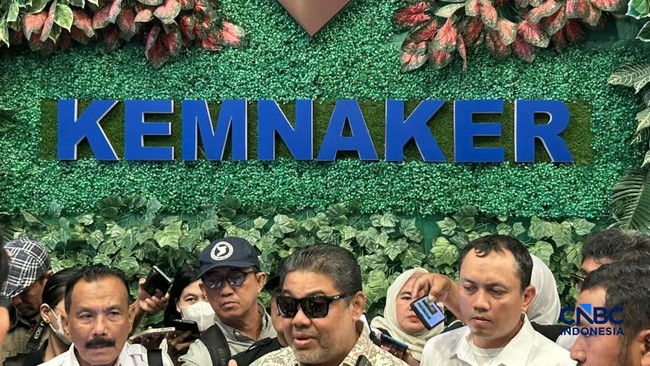
Jakarta - Special Presidential Envoy for Manpower and Labour Welfare, Said Iqbal, held a meeting with Manpower Minister Yassierli at the Ministry of Manpower office in Jakarta on Thursday (9/7/2026). The meeting, which lasted from 14:40 to 16:15 WIB, discussed several issues, primarily concerning the revision of Manpower Ministerial Regulation No. 7 of 2026 on Outsourced Workers.
Said Iqbal stated that both parties agreed the revision must be completed by the end of July 2026 at the latest, after which the Manpower Minister will report to the President. “In the discussion, we agreed that the revision will be finished by July 2026 at the latest and the Manpower Minister will report to the President. Of course, as the Special Presidential Envoy, I will also report to the President, but before the Minister presents to the President and I report, there will be a more in-depth discussion,” he said.
He explained that the discussion covered crucial articles, such as the scope of work permitted to use outsourced workers. In this context, Said Iqbal wants only four scopes of work to be allowed to use outsourced workers: supporting services for catering, security, drivers, and cleaning services. He emphasised that supporting services for oil and mining operations should be removed from the list of permitted scopes for outsourced workers.
Furthermore, he proposed that specifically for State-Owned Enterprises (BUMN) using outsourced workers, there should be very strict requirements, such as the obligation to form a subsidiary company, thereby creating a link with the parent company. “For example, PLN with HPI, HPI is a subsidiary. The outsourced workers at the parent company PLN would have their employment relationship with the subsidiary. For instance, with HPI or Haleyora, the employment relationship must be clear, whether it is a fixed-term contract (PKWT) or a permanent contract (PKWTT). Their social security rights must be complete, the same as in the parent company,” he clarified.
Iqbal further stated that the wages of outsourced workers must not be lower than the minimum wage. If their tenure is longer, their wages must be above the minimum wage. Additionally, if outsourced workers are laid off, they are entitled to severance pay, and upon entering retirement, they are also entitled to a pension guarantee. “So essentially, even though BUMN are allowed to use outsourced workers through established subsidiaries, in reality, there will be no more outsourced workers, because in my suggestion, the outsourced workers’ relationship is with the subsidiary. There will be no more outsourcing agents or labour supply services in the form of CVs, Cooperatives, or Karang Taruna; the subsidiary must be in the form of a Limited Liability Company (PT),” he explained.
The second discussion topic concerned a zero percent tax on Old Age Security (JHT). Iqbal stated that Manpower Minister Yassierli strongly supports the zero percent JHT tax. The Minister will coordinate with Finance Minister Purbaya Yudhi Sadewa to convey his support for the policy. “We share the same understanding and agreement. The Manpower Minister will communicate with Finance Minister Purbaya that he, as the Manpower Minister, agrees that the JHT tax should be zero percent, or if that is not possible, the threshold for the taxable JHT, which is currently above Rp 50 million, should be changed,” said Said Iqbal.
Source: jawawa.id (https://jawawa.id/newsitem/manpower-minister-and-special-envoy-said-iqbal-discuss-outsourcing-rules-and-jht-tax-1783594331)
Originally published by CNBC Indonesia (https://www.cnbcindonesia.com/news/20260709172111-4-749559/menaker-dan-said-iqbal-bertemu-bahas-aturan-outsourcing-ini-hasilnya), translated from Indonesian