
Mangrove Rehabilitation to Support Fisheries Productivity and Food Security
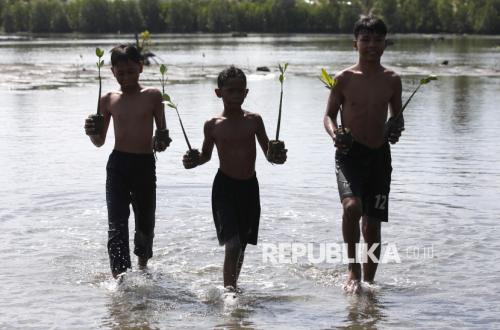
The Ministry of Marine Affairs and Fisheries (KKP) considers mangrove rehabilitation to be one of the important efforts to maintain fisheries productivity while strengthening national food security. This effort is deemed necessary to be carried out sustainably by involving the government, the community, the business sector, and academics so that the restoration of coastal ecosystems provides long-term benefits.
Minister of Marine Affairs and Fisheries Sakti Wahyu Trenggono stated that over the past three decades, Indonesia has lost around 40 per cent of its mangrove areas, with a rate of damage reaching approximately 52,000 hectares per year. In addition, around 19.26 per cent of mangroves in Indonesia are in critical condition due to natural factors and human activities.
According to Trenggono, mangroves have an important function as protectors of coastal areas, habitats for various marine biota, supporters of fisheries productivity, sources of livelihood for coastal communities, and carbon sinks that help mitigate the impacts of climate change.
“Mangrove rehabilitation must not stop at planting activities alone, but must be carried out based on ecological suitability so that ecosystem functions are truly restored,” Trenggono said during the commemoration of World Mangrove Day in Denpasar, Bali, Sunday (26/7).
Trenggono said the success of mangrove rehabilitation depends on the collaboration of various stakeholders through integrated policies, the utilisation of science, community empowerment, strengthened funding, supervision, and public education.
The KKP is also targeting the expansion of marine conservation areas, including mangroves, seagrass beds, and coral reefs, to reach 97.5 million hectares by 2045.
According to Trenggono, this step is necessary to maintain the sustainability of marine resources while supporting national capture fisheries productivity.
“The expansion of marine conservation areas is an effort to maintain national capture fisheries productivity for the future,” he said.
In addition to expanding conservation areas, the KKP is integrating mangrove rehabilitation with the revitalisation of unproductive fishponds in the Pantura (North Coast) area of Java, with an initial phase covering 14,000 hectares. The programme is aimed at improving coastal ecosystems, increasing fisheries production, creating jobs, and strengthening food security.
Trenggono said the demand for food and protein is expected to continue to rise along with the projected global population reaching 9.66 billion by 2050, including around 320.7 million in Indonesia.
Under these conditions, Indonesia is considered to have a strategic position as one of the world’s fisheries producers, with around 23 per cent of the global mangrove ecosystem supporting fisheries productivity and food security.