
Mangrove rehabilitation boosts Bali fishermen's ecotourism capacity
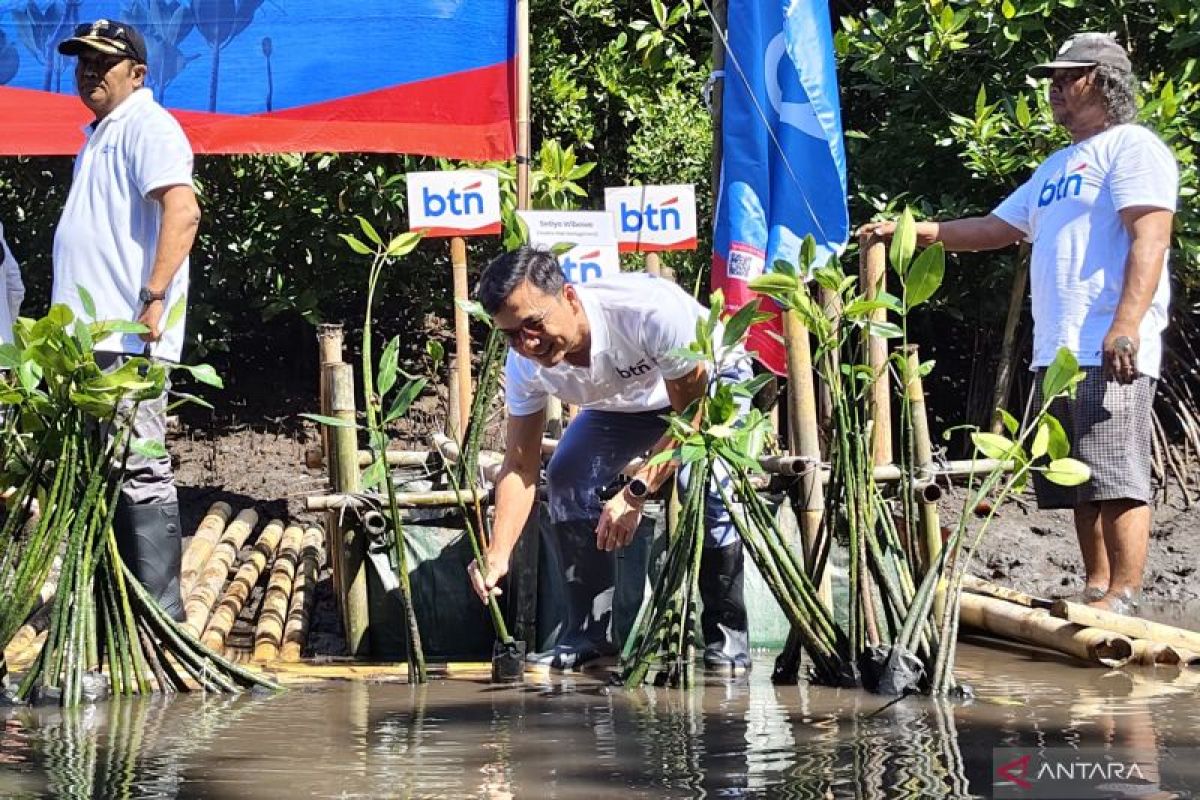
The effort to rehabilitate mangroves and release crabs by state-owned Bank Tabungan Negara (BTN) is adding to the village’s economic potential and the capacity of fishermen who manage the Simbar Segara Mangrove Ecotourism in Pemogan Village, Denpasar, Bali.
“We can progress further, be more detailed and do more for social activities and mangrove planting,” said Ketut Darsana, chairman of the Simbar Segara Joint Business Group (KUB), in Denpasar, Bali, on Friday.
He explained that the KUB consists of 50 fishermen from the local village who also manage activities such as mangrove forest tours with canoe and dinghy rentals.
With the planting of 10,000 mangrove seedlings, he continued, the appeal and density of the mangroves will increase, accompanied by ongoing maintenance efforts.
In addition, the release of dozens of crabs to breed also has the potential to boost the fishermen’s economic prospects.
The area is a natural habitat for three types of crabs — green, purple and red — which are a source of livelihood for the fishermen.
He explained that on average they can catch around three kilogrammes of crab per day, depending on the fishing season, which runs from September to March.
KUB Simbar Segara is one of 12 fishing groups located within the Ngurah Rai Forest Park (Tahura), which covers a total area of 1,373.5 hectares.
Made Yuda Wibawa, a representative of the Ngurah Rai Tahura Technical Implementation Unit under the Bali Provincial Forestry and Environment Service, explained that of the total area, 1,158.44 hectares is conservation land targeted for rehabilitation.
The planting of 10,000 mangrove seedlings is estimated to cover approximately one hectare of mangrove land.
Planting was carried out using a special method involving planting bags and bamboo protection to ensure resilience against tidal changes and to aid adaptation.
In addition to ecotourism, he added, the area is also known as a crab producer, with selling prices estimated at around Rp300,000 per kilogramme, and potentially more than double that price when purchased at restaurants.
Meanwhile, BTN Risk Management Director Setiyo Wibowo explained that the green economy is now an important pillar of the banking industry in promoting environmental friendliness and community empowerment, including for fishermen.
He assessed that mangroves are of significant importance, not only as a coastal defence and the world’s largest source of oxygen, but also as a centre of economic growth.
Moreover, Indonesia holds 23 per cent of the world’s total mangrove area, according to data from the Indonesian Ministry of Forestry, or around 3.45 million hectares, making it the largest in the world.
“Mangrove forests are not only a fisheries ecosystem but also support ecotourism. This potential can be developed for other ecosystems,” he said.
On the occasion, in addition to planting mangrove seedlings and releasing crabs, a plastic waste collection was also held. According to data from the local KUB, an average of around 10 kilogrammes of plastic waste is collected per day.
Source: jawawa.id (https://jawawa.id/newsitem/mangrove-rehabilitation-boosts-bali-fishermens-ecotourism-capacity-1786092892)
Originally published by Antara (Indonesian) (https://www.antaranews.com/berita/5684103/rehabilitasi-mangrove-tambah-kapasitas-nelayan-kelola-ekowisata-bali), translated from Indonesian