
Manggarai-Cikarang DDT: The Stalled Project Behind the East Bekasi KRL Accident
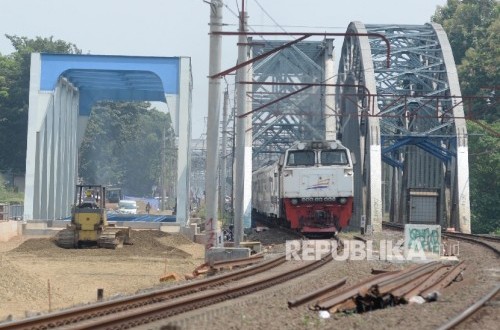
REPUBLIKA.CO.ID, JAKARTA – “The plan is for the DDT (double-double track) to be completed in 2020; one can imagine that if we wait until 2022, the journey capacity will be very minimal. Therefore, I ask the Director General of Railways to be more intensive so that this project can be completed in 2020.”
This statement was once made by the Minister of Transportation for the 2019-2024 period, Budi Karya Sumadi, during an inspection of Manggarai Station, Jakarta, in March 2018.
DDT or double railway track is a four-track railway infrastructure system (two pairs of double tracks) that separates long-distance train journeys (KAJJ) from electric rail trains (KRL) on the Manggarai-Cikarang route spanning 35 kilometres (km).
The Head of the Jakarta and Banten Regional Railway Technical Office, Jumardi, said that the double track railway construction project has been planned since 2002. Initially funded by a loan from the Japan International Cooperation Agency (JICA) with the condition of 100 per cent clear land.
“However, midway through, land acquisition faced obstacles, so the Directorate General of Railways (DJKA) has funded the budget since 2015,” said Jumardi in April 2019.
In reality, the completion target for the Manggarai-Cikarang DDT has continuously missed from year to year. In 2015, the Ministry of Transportation (Kemenhub) under Minister of Transportation Ignasius Jonan estimated that the 34.14-kilometre Manggarai-Cikarang double track railway project would be completed in early 2018.
The Director General of Railways at Kemenhub under Jonan, Hermanto Dwiatmoko, explained that the DDT project funds consist of IP-508 loan divided into three periods: the period from 11 September 2002 to 11 September 2012, the extension period from 11 September 2012 to 11 September 2016, and the B1 package contract period from 1 December 2012 to 31 August 2016.
“The DDT construction is divided into four work packages. Package A (Manggarai-Jatinegara) worth Rp3.440 trillion, Package B2(1) (Jatinegara-Bekasi) Rp900 billion, Package B2(2) (Jatinegara-Bekasi) Rp260 billion, and Package B1 (Bekasi-Cikarang) worth Rp1.121 trillion,” said Hermanto on the official Kemenhub website in 2015.
As of 2021, the DDT project completion is only on the Manggarai to Bekasi line via Jatinegara. This means that the Cikarang Line KRL and KAJJ are no longer on the same track on the Manggarai-Bekasi route. Meanwhile, the next DDT towards Cikarang has not been realised. Thus, both types of trains still have to share the same track on the Bekasi to Cikarang route.
Slow construction
The slow construction of the Manggarai-Cikarang DDT has come under scrutiny following the incident where the Argo Bromo Anggrek train collided with the Jabodetabek KRL at East Bekasi Station. Former Commissioner of PT Kereta Api Indonesia (Persero) or KAI, Riza Primadi, said that the tragedy at East Bekasi Station, which claimed many lives, is not just a statistic.
Riza stated that this incident is a manifestation of systemic negligence maintained under the noses of policymakers,” said Riza through a post on LinkedIn on Wednesday (29/4/2026).
Source: jawawa.id (https://jawawa.id/newsitem/manggarai-cikarang-ddt-the-stalled-project-behind-the-east-bekasi-krl-accident-1777593145)
Originally published by Republika (https://ekonomi.republika.co.id/berita/tebxcs370/ddt-manggaraicikarang-proyek-mangkrak-di-balik-kecelakaan-krl-bekasi-timur), translated from Indonesian