
Mandaya Hospital Introduces Robotic Surgery Technology for Tumours and Kidney Procedures
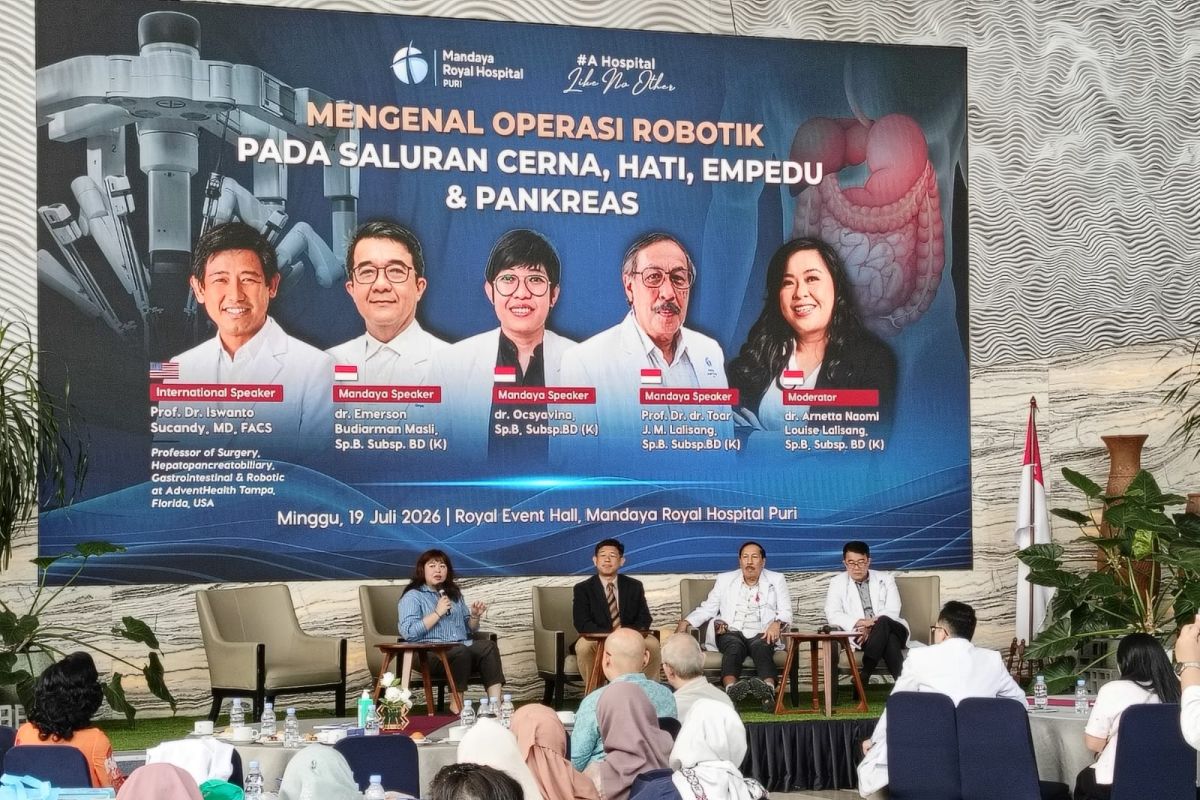
RS Mandaya Royal Puri in Tangerang, Banten, has introduced the latest fifth-generation surgical robot technology to facilitate complex minimally invasive medical operations such as liver tumour resection, kidney transplantation and uterine cancer removal.
President Director of Mandaya Hospital Group, dr. Benedictus R. Widaja, said in Tangerang on Monday that the arrival of the robot, named Da Vinci Xi, forms part of the hospital’s commitment to strengthening innovation-based healthcare services in Indonesia.
The stability of the robot’s arms, equipped with tremor-filtration technology, is able to eliminate unintended movements of the surgical instruments, ensuring that surgical procedures inside the patient’s body can proceed with a very high degree of safety.
“Through the presence of this state-of-the-art technology, the Indonesian public no longer needs to travel abroad to obtain high-precision surgical services,” said dr. Ben in a statement.
Furthermore, dr. Ben Widaja explained that with just one Da Vinci Xi robot, the medical team can carry out various complex operations simultaneously.
Among the other procedures it can perform are prostate removal and colon resection, with future development plans including heart bypass surgery.
He said the technology is fully controlled by specialist surgeons through a high-resolution three-dimensional (3D) console. The flexibility of the four robotic arms surpasses the physical limitations of two human hands, particularly when performing intricate procedures such as holding, clamping, cutting and suturing organs in very narrow and hard-to-reach areas of the body.
The arrival of the Da Vinci Xi completes the five robotic technologies now owned by the hospital, in line with its position as a centre for advanced robotics and precision technology in Indonesia.
In the field of urology, the hospital already has the Zamenix, a flexible-armed robot for treating large kidney stones without open surgery, as well as the MonaLisa, used for prostate cancer biopsies with higher sampling accuracy.
In orthopaedics, RS Mandaya Royal Puri operates CORI, a robot used in both partial and total knee replacement procedures, helping doctors determine implant positioning with greater precision based on the patient’s knee anatomy.
Meanwhile, for neurosurgery needs, the hospital has introduced three-dimensional brain neuronavigation technology combined with robotic microscope alignment to guide doctors in locating brain tumours in real time with sub-millimetre accuracy, while keeping the surrounding brain tissue safe.
“This entire suite of robotic system innovations is expected to give patients more medical options, offering procedures with minimal incisions, a high degree of precision, and supporting a far faster recovery process, in line with developments in modern medical technology,” he said.