
Mandatory Halal Certification by October 2026, Business Readiness Remains a Challenge
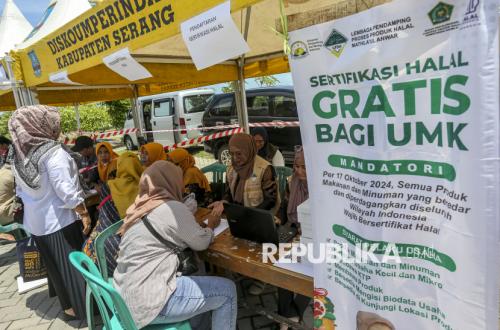
The obligation for halal certification for micro and small enterprises (UMK), certain products, and imported products will take effect no later than 17 October 2026. However, the readiness of business operators remains a challenge.
“Based on Bappenas data, the reality on the ground is that only around 4 percent of business operators have halal-certified products,” said INDEF economist A. Hakam Naja in a statement to Republika on Friday (21/8/2026).
Hakam assessed that halal certification should not be viewed as a burden on producers. Certification can serve as a form of consumer protection as well as an economic opportunity amid growing public attention to products that are healthy, of high quality, and aligned with held values.
The market potential is substantial. Hakam noted that Indonesia’s Muslim population reaches around 250 million people, while the global Muslim population is around 2 billion. Global Muslim consumer spending reached 2.6 trillion US dollars in 2024 and is projected to reach 3.56 trillion US dollars by 2029.
According to Hakam, digitalisation needs to be accelerated to pursue certification at scale. A digital system can speed up registration, product status tracking, and verification of certificate validity.
However, its implementation still faces obstacles in the form of digital literacy among UMK operators, complex bureaucracy, limited human resources, and the number of halal auditors. The challenges are even greater for imported products and high-technology products such as pharmaceuticals, medical devices, biological products, and cosmetics.
Hakam also highlighted the self-declare scheme for UMK. The mechanism that allows business operators to declare the halal status of their products themselves without an audit by a Halal Inspection Agency (LPH) is considered to carry risks of assessment errors and weak oversight.
He therefore encouraged periodic evaluation and random inspections of products that obtained certificates through self-declaration. This step is considered important to maintain the credibility of certification and consumer trust.
On the other hand, the mandatory halal certification can be an added value for business operators. Products that meet halal standards have a greater chance of being chosen as consumer awareness of healthy, high-quality, and halal products increases.
Hakam encouraged the government and stakeholders to strengthen the halal ecosystem through coordination among BPJPH, MUI, LPH, Halal Product Process Assistants (Pendamping PPH), business operators, Islamic banking, universities, research institutions, and consumers.
According to Hakam, strengthening this ecosystem is necessary so that Indonesia does not merely become a market for halal products, but is able to become a global halal power and achieve its target of becoming the world’s halal centre by 2029.