
Managing Electronic Waste from Campuses, XLSMART Promotes Circular Economy
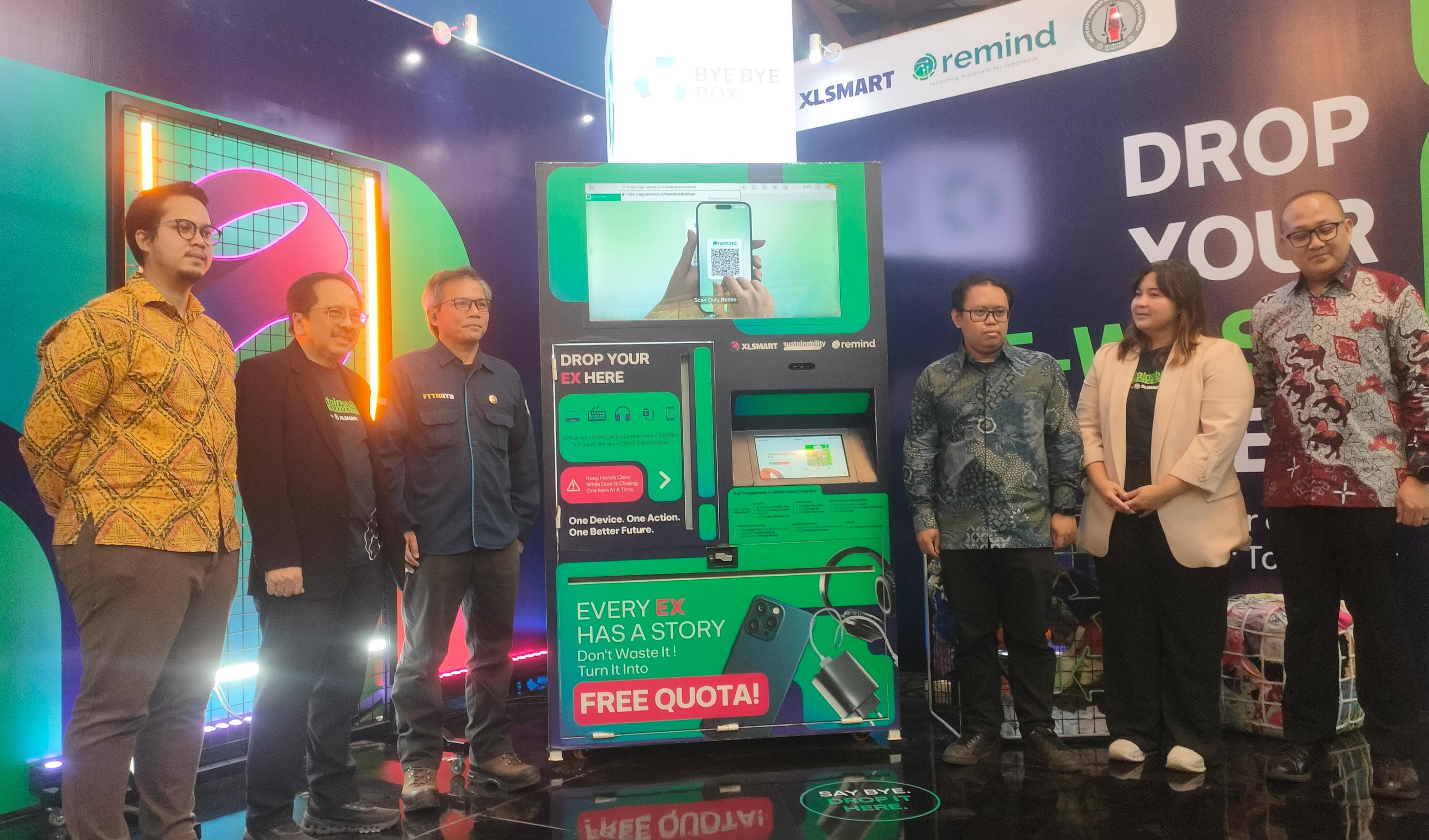
The growth in the use of electronic devices, alongside expanding digital connectivity, has brought a new challenge: the increase in electronic waste (e-waste). Devices that have reached the end of their lifespan require not only a disposal site but also a management system capable of recovering materials and preventing waste from ending up in irresponsible channels.
This issue has prompted XLSMlarT, together with REMIND, to develop the #ByeByeBox Campus Roadshow programme. The Bandung Institute of Technology (ITB) served as the initial location for the programme, which ran from 14–28 September 2026. The programme is aimed at introducing e-waste management while encouraging changes in student behaviour regarding the disposal of unused electronic devices.
#ByeByeBox is an E-Waste Reverse Vending Machine developed to make it easier for the public to surrender small, unused electronic devices. The surrendered devices are not merely collected; they are scanned, weighed, recorded, and subsequently directed towards a material recovery process.
Merza Fachys, Director and Chief Regulatory Officer of XLSMART, stated that the development of digital technology must be accompanied by responsibility towards its environmental impact. “Users of #ByeByeBox simply need to bring small, unused electronic devices and follow the instructions on the screen. The devices are then scanned and validated using cameras and AI technology, automatically weighed, and then accepted and recorded in the REMIND system,” said Merza.
According to him, the collected e-waste is further processed through a material recovery approach. Materials that still hold value are endeavoured to be reintegrated into the usage cycle, thereby reducing waste disposal and supporting circular economy principles.
During the first stage of the campaign, which runs until November 2026, XLSMART and REMIND target the collection of 600 kilograms of e-waste. All collected waste will be recorded and measured to determine the programme’s impact, not only in terms of waste volume but also in terms of participation and behavioural change.
Muhammad Dzikri Ahira Soefihara, Founder and CEO of REMIND, stated that #ByeByeBox is designed to make e-waste management more accessible and measurable. “Technology assists the process of collection, recording, and material recovery, ensuring that electronic devices no longer in use can still hold value in the next usage cycle,” he said.
Campus as a Space for Change
The selection of ITB as the initial location was not solely due to the number of students and technological activity. The campus is viewed as a space that brings together education, research, technology, and sustainability awareness.
Dzikri noted that this ecosystem is relevant for introducing e-waste management to the younger generation. “ITB was chosen as the starting point for the #ByeByeBox Campus Roadshow because it is a relevant space that brings together technology, science, sustainability, and tangible student action,” he remarked.
Syafrizal, Dean of the Faculty of Mining and Petroleum Engineering at ITB, stated that universities play a role in driving the emergence of new, more sustainable solutions and habits. The presence of #ByeByeBox on campus serves as a means for students to understand e-waste issues and participate in their management.
The programme involves XLSMART, REMIND, the ITB Metallurgy Student Association, ITB, GSMA, and BAPPENAS. This collaboration brings together elements of business, technology, academia, waste management, and sustainable development policy.
Nizhar Marizi, Director of Environmental Affairs at the Ministry of PPN/BAPPENAS, stated that a circular economy requires cross-sector cooperation and community involvement. “The success of the programme is not only seen from the amount or weight of e-waste collected, but also from the number of participants, the level of engagement, behavioural changes, and the impact of e-waste management that can be reported concretely and measurably,” said Nizhar.
Incentives to Drive Participation
To encourage participation during the activation at ITB, users of XL, AXIS, and Smartfren receive data bonuses based on the weight of e-waste submitted through #ByeByeBox. E-waste under 1 kilogram receives a 500 MB bonus, 1–2 kilograms receives 1 GB, while more than 2 kilograms receives 1.5 GB. The bonus is valid for one day.
For participants who do not yet use these three services, there is an opportunity to obtain a starter pack while supplies last. This incentive scheme is one way to encourage the public to transform unused electronic devices from items that are merely stored into materials that can be managed and recovered.
Similar efforts are being undertaken internally by XLSMART. The company manages e-waste originating from operational activities, such as the decommissioning of telecommunications towers, network equipment, information technology devices, batteries, and electronic assets that have reached the end of their useful life.
Management is carried out alongside third parties that possess the necessary competence in accordance with applicable regulations. Thus, waste management does not stop at collection but continues through processes aimed at recovering materials and ensuring more responsible handling.
Through #ByeByeBox, XLSMART and REMIND are attempting to bridge technology with behavioural change. The campaign positions students and the public not merely as technology users, but as part of the chain of managing technological impacts.