
Malaysia Faces New Data Centre Crisis as Singapore's Past Woes Resurface
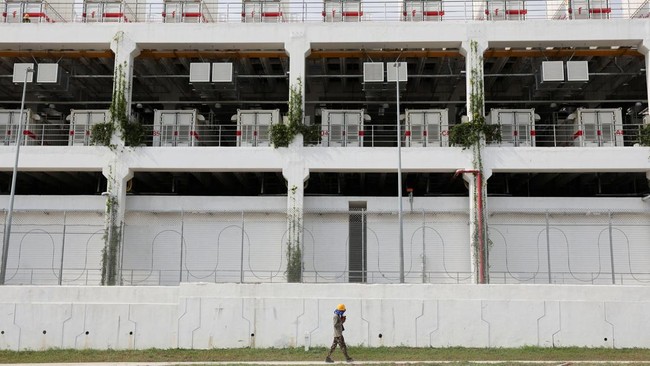
Jakarta, CNBC Indonesia – Malaysia’s rapid data centre growth once drew global attention, with the country touted as Southeast Asia’s new data centre hub, taking over Singapore’s position.
After several years of enjoying a steady influx of foreign investment, Malaysia is now facing a new crisis. Indonesia’s neighbour is confronting large-scale protests related to a data centre complex in the southern tip of Johor.
For context, Johor is the epicentre of Malaysia’s data centre construction boom. It is not only Johor – heated debate has also begun to emerge in Selangor.
Selangor is the country’s richest and most populous state. Complaints have surfaced regarding the burden borne by communities as a result of the data centre surge.
“Two years ago, the main focus was simply building capacity,” said Cheam Tat Inn, managing director of Equinix, the US-based data centre operator for the Malaysia region, quoted by Reuters on Friday (24/7/2026).
“The conversation now is more oriented towards things like: How will you use energy? Are you considering renewable energy sources? They want to see how you will grow sustainably and responsibly,” he added.
This marks a significant shift for Malaysia, which previously worked aggressively to attract hyperscaler companies in its bid to win AI infrastructure investment. Malaysia was flooded with interest because it offered lower land costs and affordable electricity supply.
The situation places the developing Asian region in roughly the same position as the data centre industry in developed countries such as Ireland, the Netherlands and Singapore.
Several years ago, when extremely rapid industry growth began to raise concerns about competition for water and electricity resources with households and the agricultural sector, those countries faced a similar dilemma.
Malaysia is recorded as the fastest-growing data centre market in Southeast Asia. Johor alone has attracted investment worth more than US$35 billion (Rp629 trillion).
Global hyperscalers, together with data centre developers and operators, continue to make massive investments to support AI services that require increasingly enormous computing capacity.
The focus is now sharper on sustainability in order to gain the “social licence” from local communities. The government has also tightened standards to maintain public support.
In Johor, Chinese company ZDATA told Reuters that its data centre operates entirely on treated wastewater, and it is finalising a renewable energy deal with state utility firm Tenaga Nasional to reduce the burden on the electricity grid.
Japan’s NTT said its data centre will use a closed-loop cooling system to limit water usage. Meanwhile, Bain Capital-backed Bridge Data Centres said solar power accounts for more than half of the electricity supply for its operations in the region.
“Data centres generally enjoy strong support because we are all using more data and wanting higher speeds,” said Chris Howard, executive director at consultancy firm JLL.
“However, this stands in stark contrast to the acceptance of data centres by local communities, driven by concerns about rising energy prices and water consumption, or even simply because the buildings are seen as eyesores,” he said.
JLL estimates that growing public rejection is one of the factors behind delays of at least three months on 57% of projects worldwide last year.
New Requirements to Build Data Centres in Malaysia
New data centre projects in Johor are required to demonstrate their electricity supply sources, with renewable energy increasingly becoming an absolute requirement for approval. Late last year, the state government announced a blanket ban on two categories of extremely water-intensive data centres.
These are data centres requiring up to 50 million litres of water per day, equivalent to the capacity of 20 Olympic-sized swimming pools.
Selangor has not directly banned any proposals, but conducts stringent reviews to ensure projects meet global standards on energy and water efficiency, said Ng Sze Han, a member of the state executive council in charge of investment, trade and mobility, speaking to Reuters.
One key aspect of its approach is a requirement to use 30% local content in areas such as integrated circuit design and cooling systems.
“These are very capital-intensive projects, but historically their impact on the local economy has been limited,” said Ng.
Last April, the Socialist Party, an opposition party, specifically criticised a massive RM1.75 billion (Rp7.6 trillion) data centre project in the state, arguing that the project prioritised corporate interests over those of local communities.
As Malaysia tightens oversight, investment may begin shifting to other countries in the region, said Savills analyst Nicholas Tuan.
“We have already seen increased activity and demand in markets such as Thailand, where larger-scale data centre complexes are being developed in the southern region,” he said.
At the same time, Johor in particular remains attractive as one of the “most stable” locations in terms of infrastructure, government support and resource availability, he added.