
Malaysia faces balancing act on EV hub ambition with need to ‘preserve market space’ for domestic firms
analysis Asia
Malaysia faces balancing act on EV hub ambition with need to ‘preserve market space’ for domestic firms
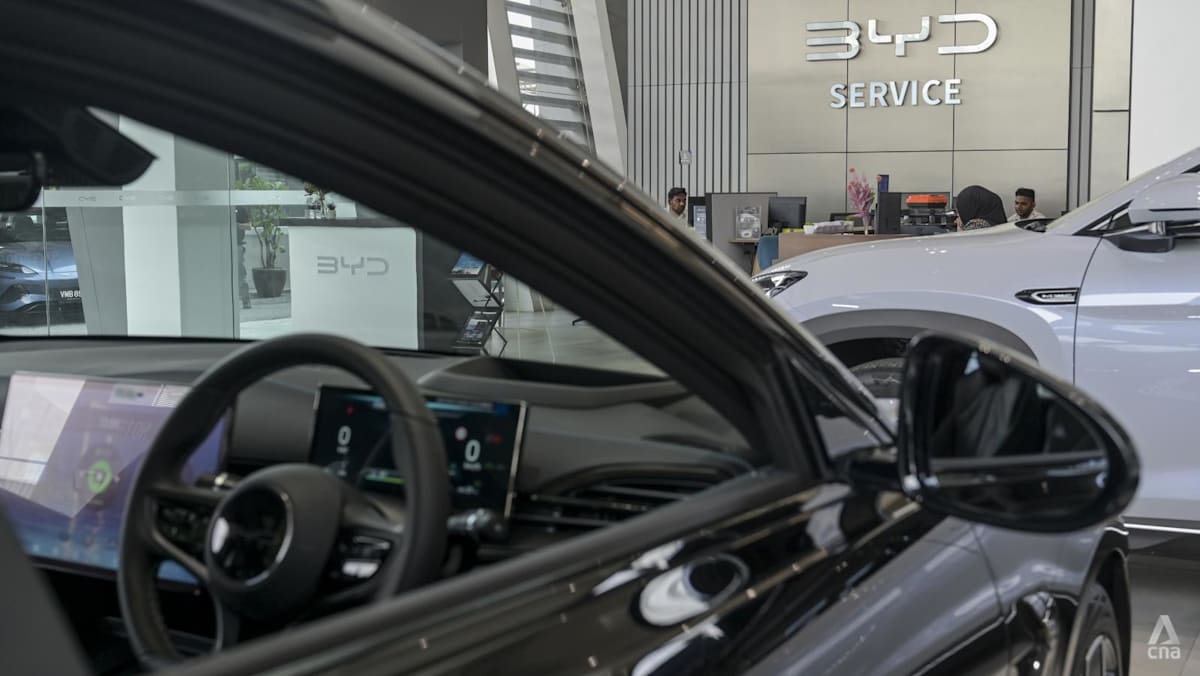
A reported standoff between BYD and Malaysia’s Ministry of Investment, Trade and Industry (MITI) over strict manufacturing conditions has left the Chinese automaker’s RM1.3 billion Tanjung Malim assembly plant in limbo.
KUALA LUMPUR: Malaysia’s move to impose conditions on Chinese electric vehicle (EV) giant BYD’s planned local assembly operations has cast a spotlight on a broader dilemma: how to pursue the country’s ambitions of becoming a regional automotive hub without undermining domestic carmakers, suppliers and jobs.
Analysts say the reported disagreement between Malaysia and BYD has raised questions over whether the country can attract major foreign EV investments while maintaining long-standing protections for its national automotive industry - a sector built around local vendor networks and industrial policies developed over decades.
At the centre of the standoff are conditions set by Malaysia’s Ministry of Investment, Trade and Industry (MITI) for BYD’s proposed assembly plant in Tanjung Malim, Perak.
Malaysia’s Minister of Investment, Trade and Industry Johari Abdul Ghani told business news portal The Edge in its Mar 30 edition that BYD has been unable to agree with the ministry’s terms.
This includes that it exports at least 80 per cent of the cars produced in Tanjung Malim and price the remaining 20 per cent for domestic sales reportedly at above RM200,000 (US$49,500) a unit.
“These were the terms they couldn’t agree on. We have to protect our auto industry,” he was quoted as saying.
In a statement on Mar 31, MITI denied its policies were protectionist, but acknowledged they were designed so that “local assembly focuses on higher-value segments, preserving market space for national players like Proton and Perodua while still offering affordable EV solutions”.
However, it added that the minimum sale price “allegation is inaccurate”, as that for locally assembled electric vehicles by international carmakers was set at RM100,000.
MITI asserted that the policies are designed to create “deep local value, technology transfer and sustainable jobs” rather than act as a barrier to entry.
BYD had announced in August last year that it was set to begin local assembly at a new RM1.3 billion (US$320 million) facility at the KLK Tech Park in Tanjung Malim by the second half of 2026.
BYD had been earmarked to be the anchor tenant at the KLK Tech Park, with its first phase of operations initially set to occupy 150 acres.
“This commitment is not only about delivering innovative products, but also about investing in the future of Malaysia’s EV ecosystem — from local assembly, to talent development, and electric mobility,” said Liu Xueliang, the general manager of BYD Asia Pacific Auto Sales Division, in a press release on Aug 22.
While the site at KLK Tech Park has already been cleared of its former oil palm trees and prepared for development, the actual construction of the BYD assembly plant is unknown.
In response to CNA’s queries on the company’s plans and whether it is re-evaluating its Malaysian investment, a BYD spokesman said: “We have no further comment at this time.”
Analysts said that while Malaysia’s policies aim to protect its automotive supply chain and ensure that the EV transition does not disrupt its existing industrial ecosystem, they may deter large-scale international car manufacturing investments.
“Stricter conditions can raise the threshold for investment and delay or reshape specific projects. But Malaysia remains an active destination for automotive investment, particularly for firms willing to align with its industrial policy objectives,” said Jamil Ghani, a doctoral candidate at the Nanyang Technology University’s S Rajaratnam School of International Studies (RSIS).
“The policy question is how to manage the pace and structure of market entry, so that competition can take place without destabilising the broader ecosystem,” said Jamil, whose doctoral research focuses on Chinese foreign direct investment in the region.
BYD “NOT SINGLED OUT”, SAYS MITI
In its Mar 31 statement, MITI said its approach is “not protectionist but developmental” and is underpinned by the National Automotive Policy’s Next-Generation Vehicle vision and the country’s New Industrial Master Plan 2030.
Under these goals, Malaysia seeks to move beyond basic assembly into higher-value activities such as advanced manufacturing, engineering and technology transfer to become a regional production and export hub for Next Generation Vehicles.
MITI said investments by automotive firms without “clear export commitments or localisation plans” bring limited benefits and make it harder to achieve “deep and sustainable localisation”.
The ministry said its framework is meant to encourage “long-term, high-value commitment” from investors.
It said that both BYD and another Chinese automotive maker Chery had been granted interim manufacturing licences last year in September and June respectively.
The licence granted to BYD was on the basis of an export-oriented production profile, with a majority of output destined for international markets to leverage Malaysia’s free trade agreements and regional supply chains, MITI added.
“These conditions are not unique to BYD but reflect a consistent approach applied to all new automotive investments in Malaysia beginning September 2025 (except those using existing local assembly facilities).”
In line with this, MITI mandated “additional conditions” on BYD’s licence as follows: domestic sales limited to 10,000 units per year, which corresponds to 20 per cent of BYD’s total projected production capacity.
“This is a pro-export condition aimed at ensuring that investment contributes to Malaysia’s trade balance and global supply chain integration. It is not a restriction on total production but a strategic measure to encourage export orientation,” said MITI.
It added t
Source: jawawa.id (https://jawawa.id/newsitem/malaysia-faces-balancing-act-on-ev-hub-ambition-with-need-to-preserve-market-space-for-domestic-firms-1775645654)
Originally published by CNA (https://www.channelnewsasia.com/asia/malaysia-ev-ambition-dilemma-protect-local-industry-car-makers-6033221)