
Makassar City Government and RAPPO Strengthen Collaboration to Achieve a Clean Makassar
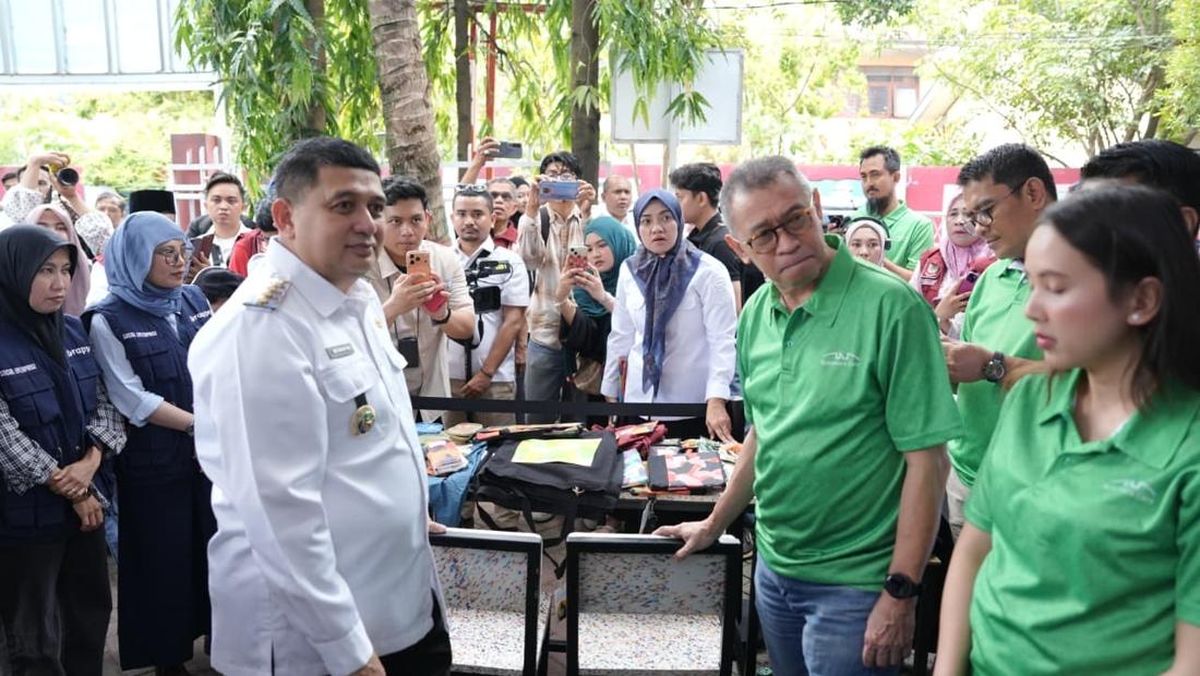
The Makassar City Government is strengthening collaboration with communities and the private sector to promote community-based waste management while empowering women. This effort is realised through synergy with Komunitas Berdaya Nusantara and RAPPO Indonesia in a programme for processing economically valuable plastic waste.
Makassar Mayor Munafri Arifuddin views this cooperation as a concrete step towards realising the vision of Makassar as a superior, inclusive, safe, and sustainable city.
He expressed this during his attendance at the Komunitas Berdaya Nusantara Programme for Women’s Empowerment, held by Nusantara Infrastructure at the Panampu Ward Office, Tallo District, on Wednesday (13/5).
“Today, I feel proud and optimistic. The presence of Komunitas Berdaya Nusantara partnering with RAPPO Indonesia is not just an ordinary ceremonial event,” he said.
“This is a real step towards what we have always aspired to together: a superior, inclusive, safe, and sustainable Makassar,” added Appi, as he is familiarly known.
Munafri emphasised that the Makassar City Government wants to ensure that women are not just spectators in development but play the role of main actors.
Through this empowerment programme, women are given access to skills and creative spaces to enhance economic independence. He also stressed the importance of innovation in addressing the global challenge of plastic waste.
According to him, through the creativity of the mothers together with RAPPO Indonesia, plastic waste that was previously valueless can now be processed into environmentally friendly fashion products with high economic value.
“The plastic waste problem is a global challenge. But in the hands of our mothers, waste that was once valueless is transformed into world-class environmentally friendly fashion products,” he explained.
He assessed that private sector involvement is key to solving various city problems, including waste management.
He continued that Makassar’s problems cannot be solved by the government alone. Collaboration with the private sector is needed so that the resulting solutions are more optimal.
On that occasion, Munafri revealed that Makassar City produces around 800 tons of waste every day.
However, the current transportation capacity only reaches about 67 percent, so there is still around 30 percent of waste that is not handled maximally.
He also emphasised the condition of the Final Disposal Site (TPA) which still uses an open dumping system, targeted to be stopped this year in accordance with directives from the Ministry of Environment.
The Makassar City Government is currently in the process of changing this system to a sanitary landfill.
“In the future, the waste entering the TPA will no longer be household waste directly, but residues from processing results,” said the Golkar politician.
Appi also hopes for support in building a 3R TPS (Reduce, Reuse, Recycle) in the Panampu area to strengthen community-based waste management.
The Makassar City Government is also preparing a strategic project in the form of a Waste-to-Energy Power Plant (PSEL) or waste to energy with an investment value of around Rp3 trillion. The project is targeted to process up to 1,000 tons of waste per day and generate electricity of 20-25 megawatts.
“This is something we must respond to together. Without the city government’s readiness, this investment will not be maximal. Therefore, collaboration among all parties is very much needed,” he clarified.
The Chairman of IKA FH Unhas encouraged strengthening synergy with those factories. The resulting processed products are then redistributed to community groups as resellers, as done by RAPPO Indonesia, thus providing added economic value for residents.
In addition to focusing on waste management, Munafri mentioned that Nusantara Infrastructure also contributes to the stunting reduction programme in Makassar City.
Appi stated that stunting rates in Makassar continue to decline thanks to collaboration between the government and the private sector.
Furthermore, the Makassar City Government continues to promote the implementation of a circular economy through the management of organic and inorganic waste.
For organic waste, the government is developing a small-scale farming concept based on compost at the ward and neighbourhood (RW) levels.
One innovation being developed is modern teba, a method of processing organic waste with a compost pit system that can be harvested in 5-6 months.
“This compost fertiliser is then used by the community for farming on small plots of land, so that every unused corner of the city can become productive,” he revealed.
In addition, the maggot cultivation programme is continuously being developed as a solution for processing organic waste. Munafri stated that one kilogram of maggots can process up to five kilograms of waste, while also being usable as valuable economic livestock feed.
“We hope that collaboration between the government, private sector, and community can continue to be expanded to create a cleaner Makassar City,” he concluded.
It is known that the Nusantara Infrastructure programme at the Panampu Ward Office starts from simple yet impactful steps, with the community sorting waste directly from home.
The sorted waste is then deposited at the Nusantara Clean Village Waste Bank as the initial collection and management centre. From there, valuable plastic waste such as HDPE, PP, and LDPE is collected by the RAPPO Indonesia team for further processing.
The process does not stop there; it also brings real social impacts. Coastal women in Nelayan Untia Village are actively involved in the plastic cleaning and shredding stages.
It also opens economic opportunities while empowering local communities. As a result, waste that was previously valueless is transformed into functional recycled products with market value.
Now, these products have penetrated markets in Makassar and Jakarta.