
Makassar Accelerates Antang Landfill Transformation to Sanitary Landfill, Progress Hits 40 Percent
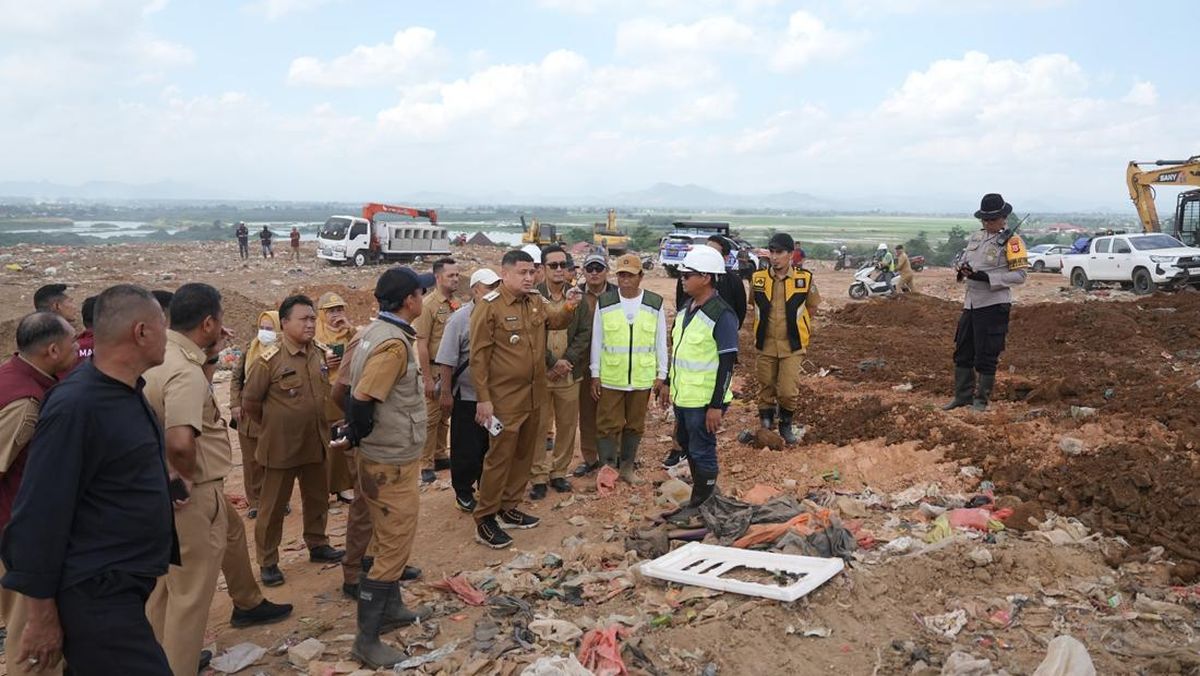
The Makassar City Government is accelerating the rehabilitation of the Antang Final Disposal Site in Manggala District to comply with national regulations mandating an end to the open dumping system and a switch to a more environmentally friendly sanitary landfill system. The site remediation follows an administrative directive from the Ministry of Environment regarding waste management at TPA Antang. Makassar Mayor Munafri Arifuddin stated that the open dumping system is no longer permitted. “That is why, with the time given, we are ensuring that this landfill must become a sanitary landfill,” Munafri said during a direct inspection of the remediation and covering progress at the TPA Antang area on Tuesday (9/6/2026).
The sanitary landfill method involves covering waste gradually in specific areas, then levelling and compacting it using heavy equipment before sealing it with a layer of cover soil. This system aims to safely isolate waste, reduce environmental pollution, prevent pungent odours, and minimise the risk of leachate contamination. “This sanitary landfill requires cover soil so that the entire landfill area is covered with fill material. Once everything is covered, the openings that exist later will no longer be for mixed household waste, but will be filled with residue that has undergone a sorting process,” Munafri explained.
He stated that the transformation of waste management must also start from the source of waste, namely households and residential environments. Currently, the city government is building an integrated waste management system by strengthening Reduce-Reuse-Recycle Waste Processing Sites (TPS 3R), temporary storage sites, and various other supporting facilities at the local level. “Many processes will be carried out at the sub-district and district levels, particularly the TPS 3R and temporary TPS. This must be implemented quickly,” he said.
With the accelerated remediation of TPA Antang and the strengthening of the waste sorting system at source, the city government is targeting the waste management transformation towards a sanitary landfill system to be realised soon. In its implementation, all sub-district and district heads have been gathered to ensure area-based waste management runs simultaneously. According to Munafri, the progress of the TPA Antang remediation towards a sanitary landfill system has currently reached more than 40 percent. Covering is carried out daily using cover soil material on areas that were previously open dumping sites.
“The covering progress has reached above 40 percent. The steeper areas are still temporarily serving as disposal sites for waste brought by collection trucks, but this will gradually decrease due to government intervention to ensure the sorting process runs,” Munafri said. He confirmed that all city government resources have been maximised to accelerate the process of closing open areas at TPA Antang until the set target is achieved. The goal is to ensure daily cover soil application until the specified deadline, so that the Makassar City Landfill is no longer an open dumping site.
Although the remediation progress continues, Munafri acknowledged that several obstacles remain on the ground. One of the biggest challenges is that waste sorting at the source is not yet optimal. According to Munafri, much of the waste sent to the landfill still arrives mixed, complicating the management process and hindering efforts to make the landfill solely a residue disposal site. “Not all areas are intensively carrying out sorting. There are still many trucks arriving carrying mixed waste, so openings that should only be filled with residue still have to accommodate large volumes of waste,” he said.
He is optimistic that the volume of waste entering the landfill will gradually decrease if the sorting process at the community level runs optimally. Munafri stressed that the waste issue actually lies within the community environment, while the landfill is merely the final disposal location. “Waste is in the sub-districts and districts, here (the landfill) is just the disposal site. Therefore, the disposal site must be minimised. Only residue should enter the TPA,” Munafri stated.
To support the change in the waste management system, the city government is also preparing regulations that can encourage community participation in waste sorting. Munafri reminded that waste management cannot be solely the burden of the government but requires the involvement of all elements of society. Thus, regulations must guide the community to ensure their participation. “Because this is a city-wide issue, everyone must take part and bear responsibility,” Munafri explained.
Furthermore, Munafri touched on the low awareness among some citizens regarding environmental cleanliness. This is evident from the amount of litter scattered in many public spaces after use. “We also hope for public awareness to maintain the environment and manage waste properly,” Munafri concluded.