
Major SOE Overhaul: 1,074 Companies to Be Cut to 200
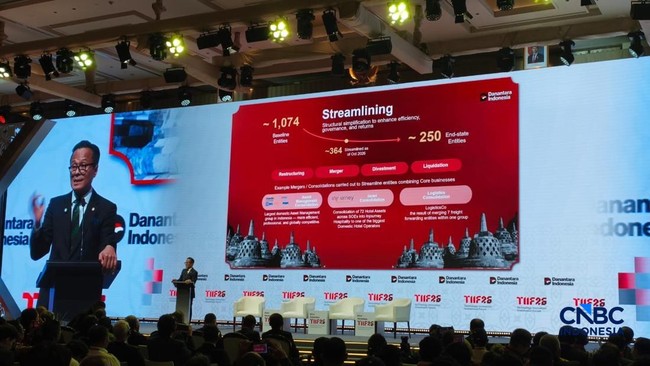
Jakarta, CNBC Indonesia – The Daya Anagata Nusantara Investment Management Agency (BPI Danantara) is carrying out a sweeping transformation of state-owned enterprises (SOEs). BPI Danantara Chief Operating Officer Dony Oskaria said the move is intended to improve the quality of state-owned companies, which are a key foundation for the long-term sustainability of Danantara Indonesia.
Dony, who also serves as Head of the SOE Agency, said the transformation involves a major restructuring of the SOE structure. The number of companies is to be reduced from 1,074 to around 250, and the current target is to bring it below 200 in order to create a more efficient and stronger structure.
“The key is how we can improve the quality of the SOEs themselves. This is the largest corporate restructuring ever undertaken in the world. Initially there were 1,074 companies, and eventually there will be 250. At present, we are targeting at least fewer than 200 companies,” the official BUMN ID Instagram account quoted him as saying on Wednesday (28 October 2026).
As a state-owned-enterprise-based sovereign wealth fund (SWF), Danantara’s success depends heavily on its ability to improve the performance and quality of state-owned businesses.
“The first thing we need to understand is that Danantara Indonesia is a combination of state-owned enterprises and a sovereign wealth fund. If we fail to manage our SOEs, Danantara Indonesia will no longer exist,” he said.
According to data from Danantara Indonesia, the 1,074 SOEs and subsidiaries include many businesses operating in the same sectors, with transactions layered between companies. Financial performance was considered weak and concentrated.
A total of 52% of SOEs and subsidiaries recorded net losses in the 2024 financial year, while 97% of dividends came from just eight of the largest SOEs. Debt had also accumulated without effective controls, and some business models were considered mismatched with their markets.
In terms of governance, there were more than 100 legal cases and disputes between companies. Reported practices included financial engineering and creative accounting, as well as fraud, collusion and fictitious vendors.
Based on these findings, Danantara identified three priorities: simplifying the portfolio, restoring financial discipline and strengthening governance.
The transformation plan is divided into five phases running through 2030. In 2025–2026, the focus is on restructuring and consolidation, including fundamental business reviews of all SOEs and groups, business simplification and consolidation, and post-merger integration.
In 2027, the focus will shift to developing human resources and corporate culture through a unified job-grading system, Danantara Corporate University, and performance-based, meritocratic talent management.
In 2028, Danantara plans to drive innovation through technology, including the digitisation and automation of processes, data-based decision-making, and the use of technology and artificial intelligence (AI).
The 2029 phase will focus on value creation, including expanding access to regional and global capital through initial public offerings, bond issuance and fundraising. The ultimate goal for 2030 is to become a world-class corporation, with SWF standards comparable to leading global peers, world-class governance and institutional capabilities, and representation in the Fortune Global 500 and Forbes Global 2000.
For the initial phase, Danantara is conducting fundamental business reviews of each SOE in three steps. First, it compares business models, margins and productivity with global best practice, including revenue structures, cost structures and EBITDA margins.
Second, it analyses markets and internal capabilities from four perspectives: industry growth and competition, regulation, financial condition, and organisational and operational capacity. Finally, it assigns each entity one of four corporate actions.
Around 636 entities have so far been assigned an action: 200 are slated for consolidation, about 15 for financial restructuring, 213 for liquidation and 208 for divestment.
Following the review, Danantara aims to simplify the structure from around 1,074 entities to approximately 250. By October 2026, around 364 entities had been streamlined through restructuring, mergers, divestments and liquidations.
Examples of consolidation include the merger of Indonesia’s largest investment management firms, involving entities such as Mandiri Investasi, BNI, BRI and PNM. In addition, 72 hotel assets belonging to various SOEs were consolidated under Injourney Hospitality to create one of the country’s largest hotel operators.
In logistics, LogisticsCo was established through the merger of seven freight-forwarding entities within one group.
Danantara said the transformation was beginning to improve performance. Consolidated SOE net profit for the first eight months of 2026 reached Rp214.9 trillion, up 18.4% year on year from Rp181.5 trillion in the same period of 2025. Annualised return on equity (ROE) also rose by 0.6 percentage points to 8.0% in August 2026, from 7.4% previously.
Two SOEs are also said to have moved from losses to profits after receiving capital support from Danantara Asset Management: PT Krakatau Steel Tbk (KRAS) in December 2025 and Len Industri in March 2026.
Several SOEs recorded significant year-on-year profit growth as of August 2026. The largest increase was at PT Semen Indonesia Tbk (SMGR), at 427%, followed by Pupuk Indonesia at 233% and Danareksa at 110%. PTPN III rose 55%, Pertamina 48%, Pelindo 45%, PT Bank Tabungan Negara Tbk (BBTN) 35% and PT Bank Mandiri Tbk (BMRI) 16%.
Restructuring efficiencies are also expected to deliver significant financial benefits. Closing companies deemed no longer necessary is projected to save up to US$3.5 billion a year, while strengthening the foundations of SOEs as strategic assets for Danantara.
“Basically, if I close these companies, we immediately save US$35 billion every year,” he said.
Source: jawawa.id (https://jawawa.id/newsitem/major-soe-overhaul-1-074-companies-to-be-cut-to-200-1793177484)
Originally published by CNBC Indonesia (https://www.cnbcindonesia.com/market/20261028143547-17-780234/transformasi-bumn-besar-besaran-dari-1074-bakal-jadi-200-perusahaan), translated from Indonesian