
Major Asian Currency Sell-off: Ringgit and Rupiah Hit Hardest, Two Nations Remain Resilient
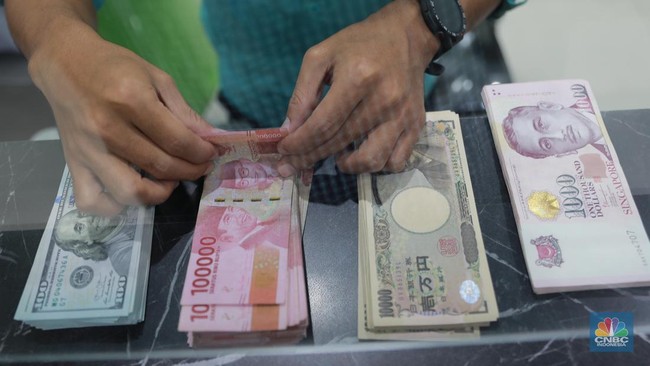
The majority of Asian currencies weakened against the US Dollar during early trading on Monday (8/6/2026). Pressure persisted as the US Dollar Index (DXY) remained stable around the 100 level.
According to Refinitiv data as of 09:15 WIB, eight out of ten monitored Asian currencies depreciated against the US Dollar, while two managed to strengthen. The Malaysian Ringgit faced the deepest pressure, falling 1.04% to MYR 4.067/US, makingittheworstperformerinAsiathismorning.TheIndonesianRupiahfollowedinsecondplace, weakening0.61, moving further away from the psychological level of Rp18,000/US$.
Thailand’s Baht also corrected by 0.30% to THB 32.90/US, followedbytheVietnameseDong, whichfell0.28. The Chinese Yuan was under pressure by 0.26% to CNY 6.783/US, theTaiwanDollarweakened0.15, the Singapore Dollar dropped 0.05% to SGD 1.29/US, andtheJapaneseYensawaslightcorrectionof0.02.
Conversely, the South Korean Won managed to strengthen by 0.57% to KRW 1,550.13/US, andthePhilippinePesoroseslightlyby0.08.
The US Dollar Index (DXY) was observed to have strengthened slightly by 0.02% to 100.093 at the same time. The DXY remains near the 100 level after gaining more than 1% last week. The strength of the US Dollar was supported by solid US labour market data. Data released on Friday showed the US economy added 172,000 jobs in May, significantly exceeding market expectations of 85,000 jobs, while the unemployment rate remained stable at 4.3%.
Following this data release, market participants increased the probability of a US Federal Reserve interest rate hike in December 2026 to nearly 70%, up from approximately 50%. Nevertheless, the Fed is still expected to maintain interest rates at the policy meeting on 16-17 June 2026 under the leadership of new Chairman Kevin Warsh.
Expectations for a more hawkish Fed were further reinforced by rising tensions in the Middle East. This situation has pushed oil prices higher and reignited inflation concerns. The US Dollar also continues to benefit from safe-haven demand. Negotiations between the US and Iran regarding a temporary peace deal have shown little progress, while clashes between Israel and Hezbollah militias continue in Lebanon. Iran has asserted the need for a ceasefire in Lebanon before accepting a US proposal to extend a ceasefire and reopen the Strait of Hormuz. US President Donald Trump stated on Thursday that negotiations with Iran are in their final stages, though he provided no further details. Meanwhile, Iranian Foreign Minister Abbas Araghchi previously stated that no real progress has been made, despite both parties continuing to exchange messages through mediators.
The combination of strong US labour data, expectations of a Fed rate hike, and geopolitical tensions has revitalised demand for the US Dollar. This has ultimately constrained the potential for appreciation in other currencies, including most of Asia, which largely weakened this morning.