
Main Power Supply in Flores Normal, PLN Focuses on Restoring Network
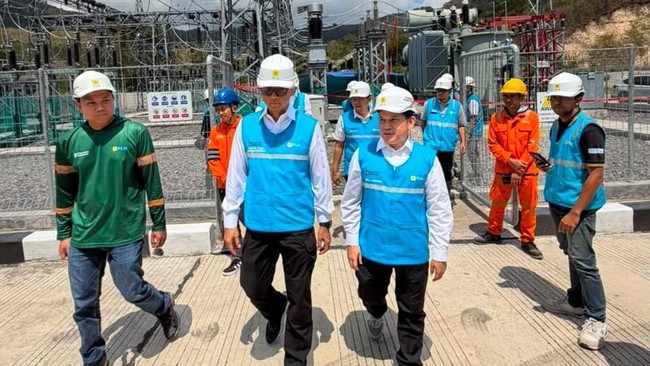
State electricity company PT PLN (Persero) is moving quickly to secure and restore the electricity system in the Flores region of East Nusa Tenggara (NTT) following a magnitude 7.7 earthquake that struck on Saturday morning (15/8). PLN President Director Darmawan Prasodjo went directly to the field to ensure the acceleration of electricity restoration in the affected areas runs optimally.
Darmawan said that immediately after the earthquake occurred, PLN deployed all its resources to secure electricity infrastructure while gradually restoring supply. The entire process was carried out with the safety of the public and field personnel as the top priority.
In less than 12 hours after the earthquake, all 11 substations (GI) that had been affected were successfully restored and are now back to 100 percent operation. The recovery of all substations is an important step to ensure the main supply system returns to normal while accelerating the distribution of electricity to the distribution network and customers across various parts of Flores.
“Alhamdulillah, from the generation side, the available supply capacity has reached 111 MW. This is more than enough to serve the current load of around 95 MW as well as the normal condition of around 105 MW. All 11 substations have also been restored 100 percent. This means that from the main supply side, we are very ready,” Darmawan said in a written statement on Sunday (16/08/2026).
He expressed appreciation to all parties who have supported the electricity restoration process in Flores.
“Thank you for the support and collaboration of the Regional Government, BPBD, TNI, and Polri who have jointly supported PLN’s restoration efforts in the field. This synergy has greatly helped us face various challenges and accelerate the electricity restoration process in the affected areas,” Darmawan added.
After the main supply is back in a ready condition, Darmawan explained that PLN’s restoration focus is now on the distribution network. One feeder remains — the electricity network that channels power from the substation to customers — which is still experiencing disruption due to the impact of the earthquake and landslides. A number of electricity poles were also reported to have collapsed and broken, requiring repair or replacement.
“We are deploying all our strength and personnel in an all-out effort to repair and replace the damaged poles. We hope the feeder that is still experiencing disruption can be restored today, as long as disaster conditions allow,” Darmawan said.
Meanwhile, General Manager of PLN’s East Nusa Tenggara Regional Main Unit (UIW), F. Eko Sulistyono, said there are two areas that have experienced quite severe impacts, namely Nagekeo Regency and Reo. PLN is giving special attention to these two areas by conducting detailed mapping of damage points and handling needs in the field.
“We are deploying personnel, materials, and equipment massively and in a focused manner to the Nagekeo and Reo areas. If necessary, additional support will be immediately mobilised from other regions to accelerate network restoration and ensure customers in the affected areas can regain electricity supply,” Eko said.
Eko stressed that the entire restoration process will continue to be directly supervised until all customers are reconnected. PLN is also coordinating closely with the Regional Government, the Regional Disaster Management Agency (BPBD), TNI, and Polri so that handling in the field proceeds quickly, safely, and in a coordinated manner.
“We will continue to directly supervise until all customers are reconnected. However, amid ongoing aftershocks, personnel safety remains the priority. We must move quickly, but still ensure every step in the field is carried out safely,” he asserted.
In addition to restoring the network, PLN is prioritising electricity supply for public and vital facilities, including hospitals, airports, government offices, evacuation sites for residents, and other public service facilities. The reliability of electricity supply is essential to support the handling of earthquake victims while maintaining the continuity of basic public services.
“PLN will continue to be in the field and work together with all parties until the electricity condition returns to normal. Speed of restoration is important, but the safety of the public and personnel remains the top priority,” Eko added.