
MAI Formulates Strategic Direction for Indonesia Towards Golden Indonesia 2045 from Al-Azhar Grand Mosque
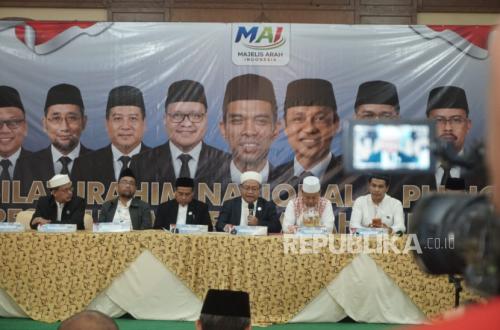
The Majelis Arah Indonesia (MAI) held a National Gathering and its first Plenary at the Al-Azhar Grand Mosque on Monday. The forum was attended by seven of the nine MAI Presidium members, who provided strategic views and recommendations on the direction of the community, nationhood, geopolitics, economy, education, media, security, Islamic boarding schools, and the management of Indonesia’s natural resources. The gathering produced strategic recommendations projected as a contribution of civil society thought to the government and all stakeholders in facing geopolitical changes and national development challenges.
MAI views that Indonesia requires a strong, independent strategic direction based on values, data, expertise, and national interest, while remaining grounded in religious values, the constitution, Pancasila, and the ideals of Golden Indonesia 2045.
In the field of community affairs, MAI encourages the consolidation of various elements of the Muslim community into a constructive and productive front to voice the community’s conscience and defend the truth amidst the nation’s complex issues. This consolidation is to be realised through strengthening ties and synergy among Islamic movements, programmed discussion forums, and the involvement of community figureheads. This agenda must run in parallel with strengthening the grassroots economy, improving the quality of education and digital literacy, and continuous community cadre development. MAI also stressed the importance of maintaining national unity and protecting the younger generation from narcotics, online gambling, corruption, and other social ills.
Regarding international geopolitics, MAI recommends a reactualisation of the Free and Active Foreign Policy within a framework of ‘Strategic Autonomy 2.0’. Indonesia is urged to navigate the multipolar world without being trapped in the dichotomy of US-China rivalry. The nation’s position must be based on national interests by building issue-based national interests and expanding strategic partnerships through BRICS, OECD, G20, ASEAN, and other international forums. MAI also encourages Indonesia to play a stronger role as part of the Global South, including advocating for reforms of the UN Security Council, the international monetary system, the IMF, the World Bank, and the WTO to be fairer and more adaptive. On the issue of Palestine, MAI pushes for strengthened Indonesian diplomacy to achieve full Palestinian independence through political channels, economic reconstruction, and international legal mechanisms, including the ICJ and ICC.
MAI asserts that political sovereignty must be supported by economic, technological, food, energy, and maritime sovereignty. The council therefore urges the protection of strategic downstreaming policies for commodities like nickel, bauxite, and rare earth minerals, alongside building food and energy security architectures resilient to geopolitical shocks. In the digital realm, Indonesia must ensure its national data infrastructure is not dependent on foreign monopolies, strengthen cyber defences, and take an active role in shaping global norms on artificial intelligence and autonomous military technology with a humanitarian orientation. In the Indo-Pacific, MAI encourages strengthening the ASEAN Outlook on the Indo-Pacific (AOIP), including keeping the South China Sea and the Malacca Strait open and enhancing Indonesia’s maritime deterrence.
In the field of Islamic economics, MAI pushes for a role as a government sparring partner using an evidence-based approach that integrates Islamic values, expertise, data, and field experience. MAI proposes developing a Policy Center that not only produces ideas but also develops pilot models, measures impact, compiles policy briefs, and encourages policy replication. Recommended agendas include a Maqashid Sustainability Test to measure economic, social, environmental, and intergenerational impact, a ZISWAF Impact Lab, developing Islamic boarding schools as green and blue economy models, and a Halal Financing Corridor for MSMEs. The implementation model is formulated simply and measurably: Problem identification, Model Development, Pilot Project, Impact Measurement, Policy Brief, and Replication.
MAI assesses that digital transformation presents significant challenges to the nation’s social and religious life. Media, therefore, must not only be a channel for information distribution but also part of the public moral development ecosystem. This can be achieved through educational information, correct and contextual religious literacy, strengthening tolerance, and preventing hate speech, provocation, discrimination, hoaxes, and disinformation. MAI encourages the media to become a space for healthy dialogue and to build a digital culture that is ethical, responsible, and respectful of differences.
MAI also gave serious attention to the professionalism of security institutions and law enforcement. For the Indonesian National Armed Forces (TNI), MAI stressed consistency in focusing on the task of national defence. Meanwhile, the Indonesian National Police (Polri) is encouraged to strengthen law enforcement and public order through a humanist community policing approach. MAI also pushes for strengthened accountability, internal oversight, meritocracy in recruitment and promotion, budget and procurement transparency, and the political neutrality of both the TNI and Polri.
MAI views Islamic boarding schools not merely as religious educational institutions, but as one of the pillars of civilisation and a key element in realising the Golden Indonesia 2045 vision.
Source: jawawa.id (https://jawawa.id/newsitem/mai-formulates-strategic-direction-for-indonesia-towards-golden-indonesia-2045-from-al-azhar-grand-mosque-1786416742)
Originally published by Republika (https://khazanah.republika.co.id/berita/tjl2x1472/dari-masjid-agung-alazhar-mai-rumuskan-arah-strategis-indonesia-menuju-indonesia-emas-2045), translated from Indonesian