
Mahyeldi: Regions must serve as breeding grounds for future leaders
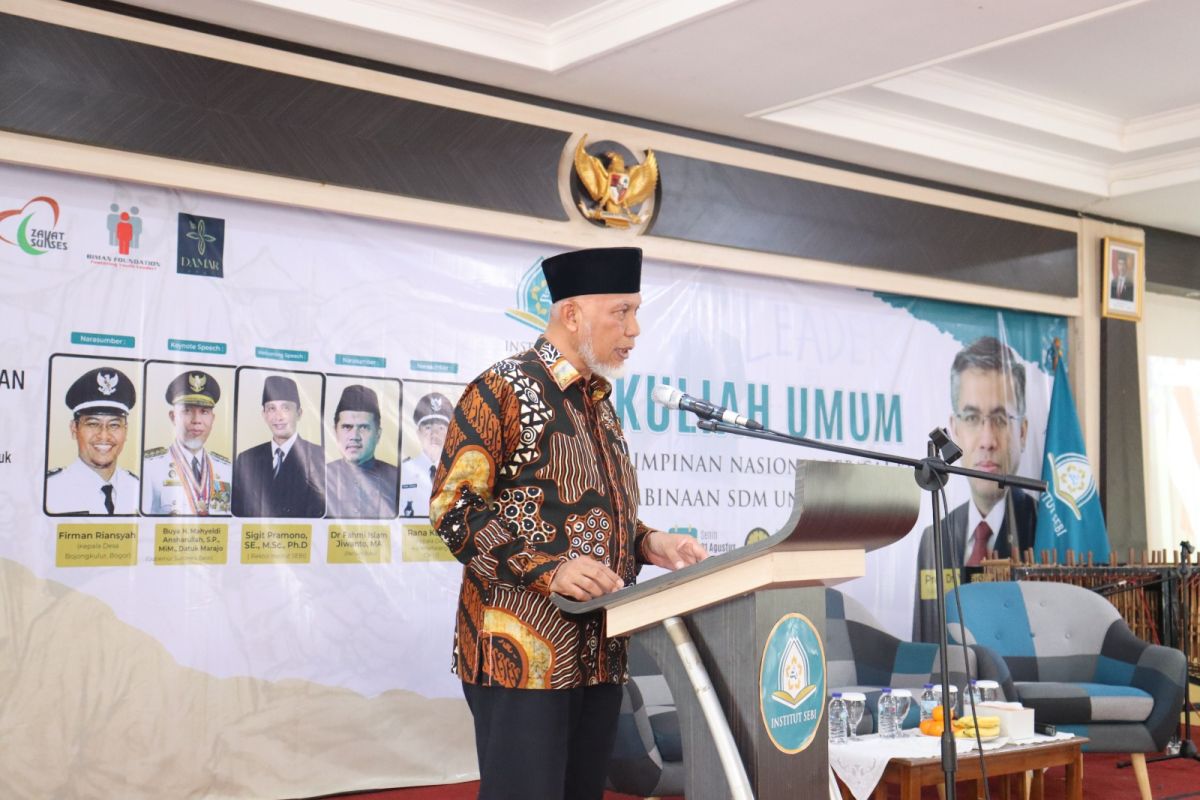
Jakarta (ANTARA) - The Governor of West Sumatra, Mahyeldi Ansharullah, believes that regional governments must serve as spaces for nurturing superior human resources to produce Indonesia’s future leaders.
“The nation’s future is not won by technology alone, but by humans who are capable of providing it with direction,” he stated during a public lecture and book launch at the SEBI Institute in Depok, West Java, as reported in Jakarta on Thursday.
He noted that regional development should be measured by the government’s ability to develop humans possessing competence, character, integrity, and adaptability, alongside economic growth, infrastructure development, and investment.
According to him, regional governments hold a strategic position in human resource development because they are closest to the community. The ecosystem for human development includes schools, universities, families, the business world, society, villages, and the government.
He stated that the large number of people of productive age should be viewed as an opportunity that needs to be managed seriously. Mahyelly assessed that this condition requires policies capable of connecting education with the needs of the working world, including through skill enhancement, the strengthening of digital literacy and artificial intelligence (AI), as well as providing space for the younger generation to participate in solving real problems in society.
“National leadership is ultimately built from the regions. Regions must be the birthplace of humans who are competent, characterised, brave enough to take responsibility, and capable of working for the broader interest,” he said.
In facing changes caused by the development of AI, he proposed the ‘4I’ concept: faith (iman), knowledge (ilmu), integrity (integritas), and innovation (inovasi). He believes these four elements are necessary so that technology can be used to increase human capacity and generate solutions for society.
Furthermore, he offered the ‘5T’ development approach: find (temukan), forge (tempa), improve (tingkatkan), grow (tumbuhkan), and assign (tugaskan). This approach encompasses identifying potential, character building, competency enhancement, the development of networks and creative spaces, and providing opportunities for the younger generation to lead the resolution of real-world issues.
He also referenced the leadership tradition of West Sumatra, which has produced several national figures such as Mohammad Hatta, Mohammad Natsir, Haji Agus Salim, Tan Malaka, and Buya Hamka. He believes this history should serve as a foundation for building an ecosystem that allows new leaders to emerge in accordance with the needs of the era.
Minister of Manpower Yassierli, who also delivered a public lecture at the same event, stated that Indonesia’s current challenge is creating high-quality jobs that rely on expertise and research. He highlighted Indonesia’s position at 55th out of 139 countries in the 2025 Global Innovation Index and the need to improve the quality of talent and the knowledge-based workforce.
Addressing students, he emphasised the qualities young people should possess: competence, curiosity, empathy, and courage, while encouraging them to build practical skills through works, organisations, projects, and community service. Regarding the development of AI, he urged the younger generation not to fear competing with technology. He noted that the human competitor of the future is another human who is capable of utilising AI, whereas empathy, ethics, and human relationships remain essential skills to be developed.