
Mahfud MD Delivers Public Lecture on Pancasila and the Relationship Between Religion and State at UMY
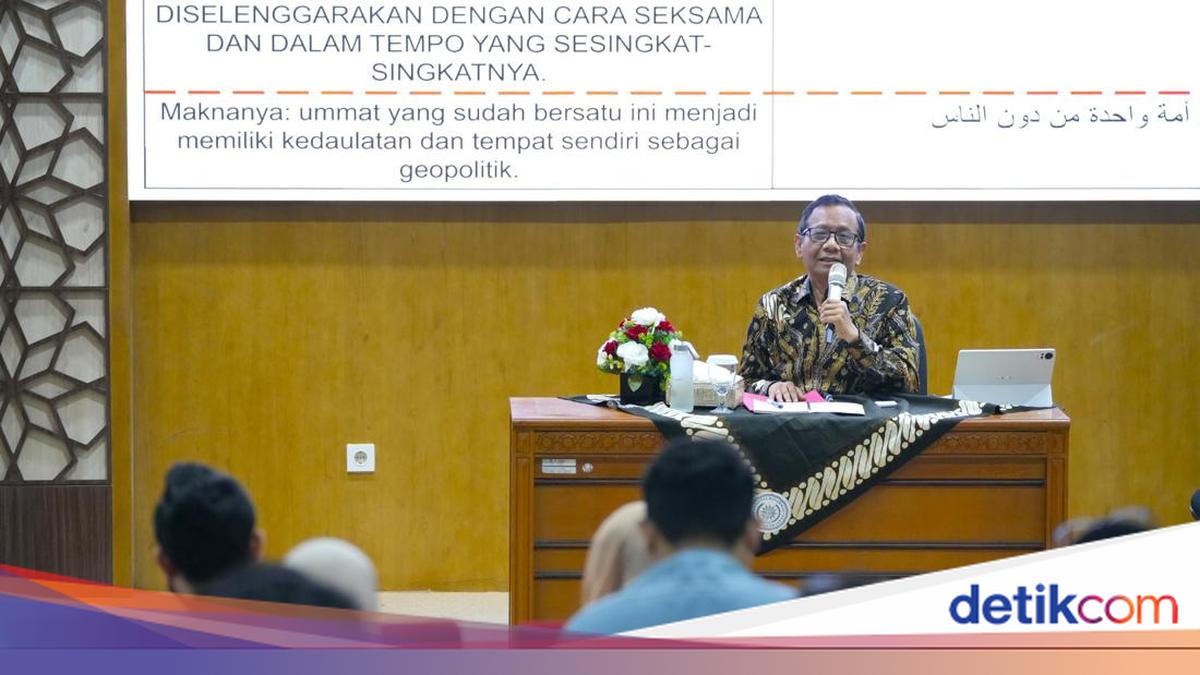
Academic Prof Dr Mahfud MD delivered a public lecture at Universitas Muhammadiyah Yogyakarta (UMY) themed ‘Point of View: Pancasila and the Relationship Between Religion and State’. During the lecture, Mahfud outlined the history of the relationship between religion and the state in Indonesia.
As reported by detikNews, Mahfud explained the history of the debate regarding the connection between religion and the state in Indonesia, spanning from the pre-independence era to the formulation process of Pancasila as the state foundation.
His presentation began by explaining the polemic that occurred in 1938 between Soekarno and Mohammad Natsir regarding the concept of the Indonesian state after independence. Mahfud explained that at that time, Bung Karno wrote that Indonesia should become a secular state, similar to Turkey during the era of Kemal Ataturk. Meanwhile, Natsir believed that Indonesia should be an Islamic state because Islam regulates all aspects of human life.
“That debate lasted from 1938 until 1945,” Mahfud stated in a written statement on Monday (28/9/2026).
Mahfud explained that the debate resurfaced during the sessions of the Investigating Committee for Preparatory Work for Independence (BPUPKI). In those sessions, some figures desired Indonesia to be an Islamic state, while others wanted it to be a secular state.
The debate took place from 29 May to 1 June 1945, when Soekarno delivered a speech regarding the five foundations of the state. Mahfud noted that the BPUPKI subsequently formed the Committee of Eight to seek an agreement on the state foundation.
However, Bung Karno assessed at the time that the committee’s composition was unbalanced, consisting of six representatives from the secular nationalist group and two representatives from the Islamic group. This composition was later changed to the Committee of Nine, which consisted of four representatives from the nationalist group, four from the Islamic group, and one Christian representative.
“The task of the Committee of Nine was to find a compromise—whether an Islamic state or a secular state—because Indonesia was about to achieve independence,” said Mahfasting.
From the discussions of the Committee of Nine, the Jakarta Charter was born as a result of the agreement on the state foundation. Mahfud explained that this formulation was then brought to the BPUPKI session as the result of the Committee of Nine’s deliberations.
However, following the Proclamation of Indonesian Independence on 17 August 1945, the formulation of the Jakarta Charter underwent changes during the session of the Preparatory Committee for Indonesian Independence (PPKI) on 18 August 1945.
Mahfud explained that Mohammad Hatta conveyed that if the Jakarta Charter formulation continued to include provisions regarding Islamic law, Eastern Indonesia would secede from the Republic.
“Bung Hatta said that if the word ‘Islam’ remained, the people of Eastern Indonesia would leave the Republic,” said Mahfud.
Mahfud explained that during the PPKI session on 18 August 1945, changes were made to several formulations in the Jakarta Charter, including changing the first principle to ‘Belief in the One and Only God’, removing the provision that the President must be Muslim, and altering the formulation regarding Islamic law.
“All references to Islam were removed from the constitution. ‘Belief in God with the obligation to carry out Islamic law for its adherents’ was changed to ‘Belief in the One and Only God’,” said Mahfud.
According to Mahfud, this change was a constitutional decision made by the PPKI as the authorised body to finalise decisions regarding the Indonesian constitution.
“The Pancasila currently in effect is the legitimate Pancasila,” said Mahfud.
Mahfud also explained Indonesia’s position regarding the relationship between religion and the state. In his view, Indonesia is not a religious state, nor is it a secular state.
Mahfud explained that a religious state only recognises one religion as the basis of the state, whereas a secular state does not manage religion. Meanwhile, in a Pancasila state, the state continues to manage the religious life of its citizens.
“It is not a religious state, because a religious state only recognises one religion. It is also not a secular state, because a secular state does not manage religion. However, in a Pancasila state, religion is managed,” said Mahfud.
Mahfud concluded the public lecture by quoting the view of Abdurrahman Wahid (Gus Dur), who described Indonesia as a country that is ‘neither a religious state nor a secular state’. According to him, the Pancasila state continues to manage the religious life of the community without establishing a single religion as the foundation of the state.