
M6.7 Palu Earthquake Reveals Complexity of Active Faults in Palu-Sigi
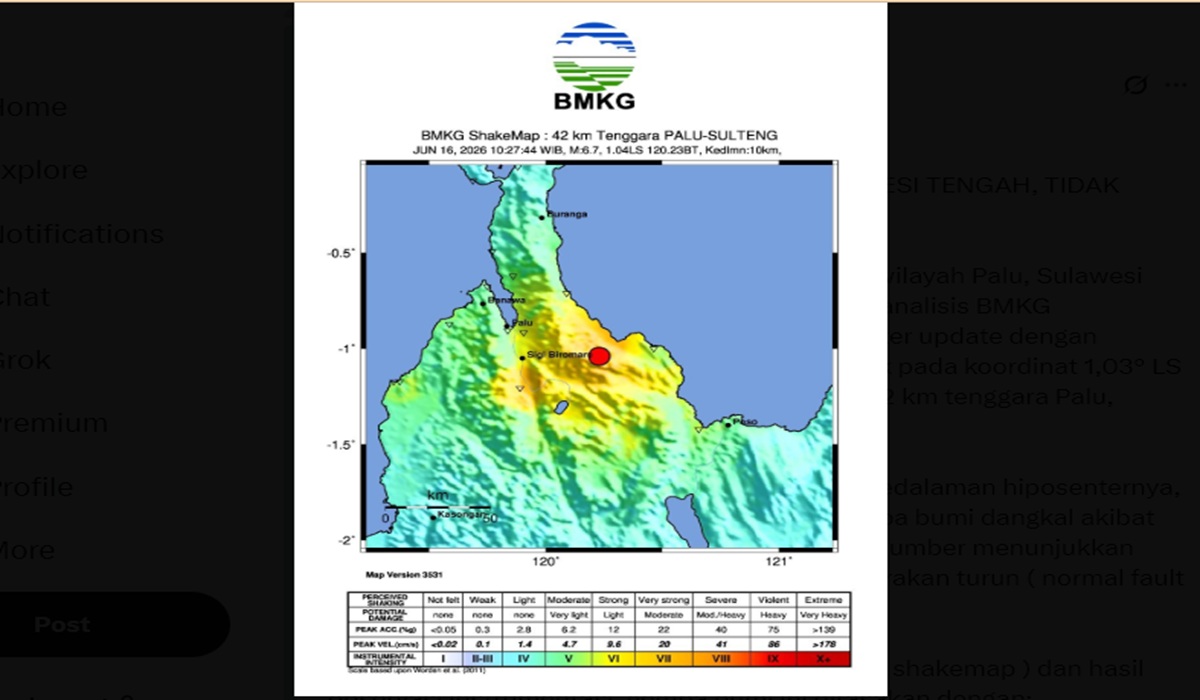
A member of the Indonesian Association of Disaster Experts (IABI), Daryono, has revealed six key facts regarding the magnitude 6.7 earthquake that shook Palu and Sigi in Central Sulawesi on Tuesday (16/6). According to him, the shallow nature of the quake, the complexity of the active fault system, and local geological conditions were the main factors causing the strong tremors and resulting damage.
Daryono explained that the Palu earthquake was a shallow crustal earthquake typically triggered by active fault activity. The relatively shallow hypocentre depth meant the seismic energy did not weaken significantly before reaching the surface, concentrating maximum shaking in the epicentral region, including Palu City, Sigi Regency, and Parigi Moutong.
‘The near-field effect was very dominant because the seismic wave amplitudes did not experience significant attenuation before reaching the ground surface,’ he stated on Wednesday (17/6). He added that this condition was reinforced by the presence of soft sediment layers filling the basin in the affected area. The contrast between the bedrock and sediment layers triggered a seismic wave amplification phenomenon, increasing the duration and intensity of the shaking.
Daryono noted that the second fact is the earthquake’s location within a highly complex tectonic deformation zone. The epicentre is influenced by several active faults, including the Sausu, Palolo, Malei, Parigi, and Tokararu faults, as well as the Saluki Fault Segment and the Lorelindu Fracture Zone. The interaction of these faults reflects dynamic tectonic conditions, particularly due to stress transfer from the Palu-Koro Fault system eastward through a fragmented deformation zone.
‘The distribution of seismic energy in this area is not accommodated linearly but is divided into a complex stress pattern, potentially triggering various fault mechanisms simultaneously,’ he said.
Thirdly, the earthquake exhibited a normal fault mechanism. Daryono explained that the Palolo and Sausu areas are located in a pull-apart basin formed by the dynamics of the Palu-Koro Fault. This condition causes the Earth’s crust to stretch, creating normal faults that form basins and fill with sediment. He noted that this transtensional deformation zone means stress release is not only dominated by strike-slip movement but also vertical movement, producing shallow shaking with the potential for local amplification.
Fourthly, the earthquake proved to be destructive. According to data from the National Disaster Management Agency (BNPB), damage was recorded to 67 housing units, comprising 26 lightly damaged, six moderately damaged, and 12 heavily damaged. Additionally, six places of worship, two bridges, one public facility, two office buildings, three business premises, and a section of the road connecting Palu, Sigi, and Poso were damaged. Sigi Regency was the worst-affected area, with a total of 47 damaged houses.
Fifthly, the area is part of a long history of significant seismic activity. Daryono recorded that a magnitude 4.5 earthquake occurred in 1983, followed by a magnitude 5.9 Palu-Poso earthquake in 1995 that injured 26 people and damaged 115 houses in Parigi Regency. Seismic activity continued with a magnitude 4.8 quake in 2005 and a magnitude 6.6 Palu-Poso earthquake in 2017, which injured 25 people and damaged 348 buildings, including 168 houses and several places of worship.
‘This series of events shows that the seismic threat in this region is persistent and requires a comprehensive understanding of its tectonic characteristics,’ Daryono said.
Sixthly, anticipating future Palu earthquakes requires increased vigilance regarding the entire active fault system in Central Sulawesi. He stressed that mitigation efforts must not only focus on the main fault but also on the branching active faults, which are often overlooked yet still have the potential to trigger destructive earthquakes. ‘Mitigation must consider the entire existing active fault network because the threat comes not only from the main fault but also from branch faults that can produce strong shaking,’ he emphasised.
Source: jawawa.id (https://jawawa.id/newsitem/m6-7-palu-earthquake-reveals-complexity-of-active-faults-in-palu-sigi-1781666419)
Originally published by Media Indonesia (https://mediaindonesia.com/humaniora/901305/gempa-palu-m67-perlihatkan-kompleksitas-sesar-aktif-di-palu-sigi), translated from Indonesian