
Luhut invites Tsinghua University to develop AI research in Bali this year
I want to see Tsinghua University join AI research on this island in the near future, even very soon. If possible, I want this to happen this year.
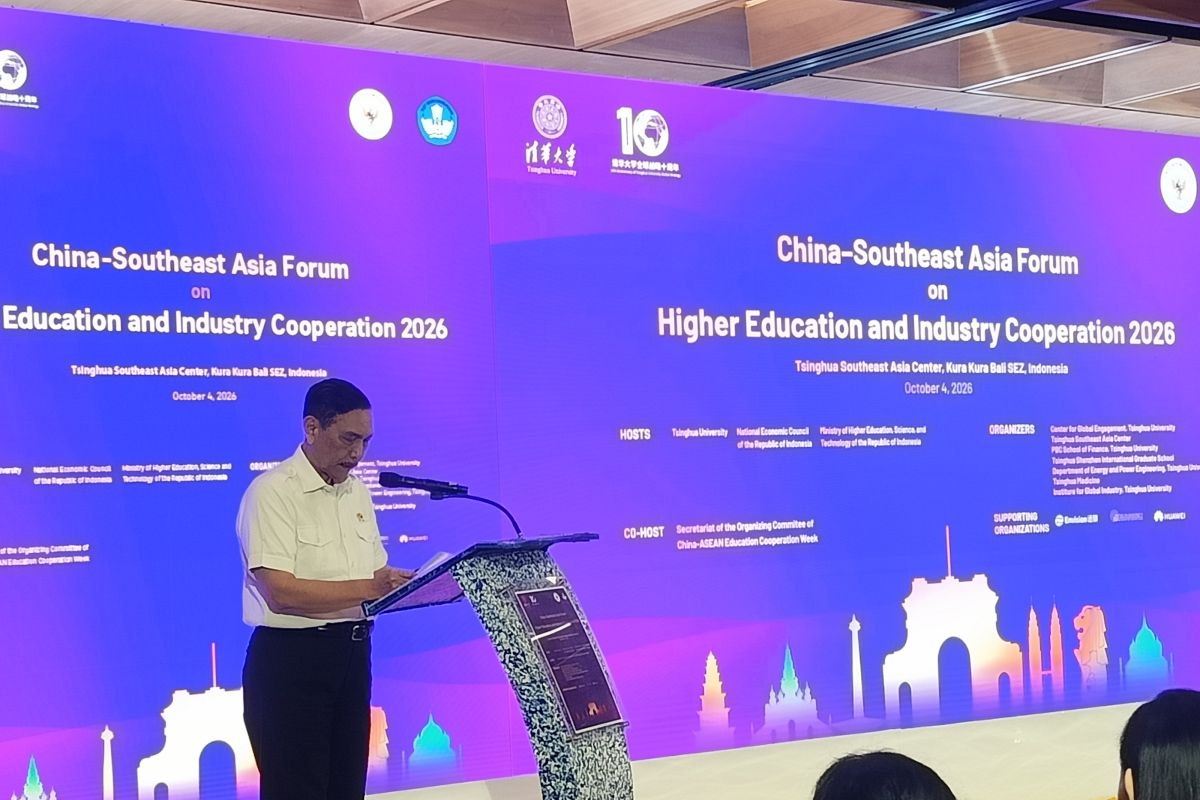
Denpasar (ANTARA) - The Chairman of the National Economic Council (DEN), Luhut Binsar Pandjaitan, has invited China’s Tsinghua University to strengthen collaboration in artificial intelligence (AI) research within the Kura Kura Bali Special Economic Zone (SEZ) to accelerate technological development and digital transformation.
“I want to see Tsinghua University join AI research on this island in the near future, even very soon. If possible, I want this to happen this year,” said Luhut while speaking at the China Southeast Asia Forum on Higher Education and Industry Cooperation 2026 in Kura Kura Bali SEZ, Denpasar, on Sunday.
Luhut stated that Indonesia already possesses an AI research centre in Kura Kura Bali. He expressed hope that this facility would be strengthened through the support of researchers and technological expertise from Tsinghua, which he considers to possess robust capabilities in the development of artificial intelligence.
According to him, such collaboration is vital as the government strives to develop government technology (GovTech) to enhance efficiency, increase transparency, and reduce the potential for corruption in public services.
Luhut noted that President Prabowo Subianto has issued instructions to ensure that the development of government technology is executed effectively. Consequently, research and technological support from China, specifically from Tsinghua University, is expected to bolster these efforts.
He emphasised that Indonesia-China cooperation needs to enter a new phase, moving beyond a focus on industrial investment and technology transfer to producing joint innovations.
“We do not only want equipment. We want scientists, knowledge, and an innovation ecosystem,” he said.
Luhut also invited Tsinghua to establish joint laboratories, research programmes, research funding, and scientific publications alongside Indonesian universities and researchers.
He assessed that Kura Kura Bali holds a strategic position to serve as a hub for educational, research, and industrial collaboration between Indonesia, China, and the Southeast Asian region.
According to Luhut, this cooperation must yield tangible benefits for technological development and the improvement of Indonesian human resource quality, rather than being merely an exchange of ideas.
He added that Indonesia and China possess great potential to connect universities, scientists, entrepreneurs, industry, and the younger generation in creating innovations that address societal needs.
Through this collaboration, Luhut hopes that Bali can evolve into a hub for talent, technology, and research that brings academics together with the business world, thereby strengthening Indonesia’s position in regional innovation within Southeast Asia.