
Luhut Confident Digital Ecosystem Can Prevent Budget Leakages Worth Thousands of Trillion Rupiah
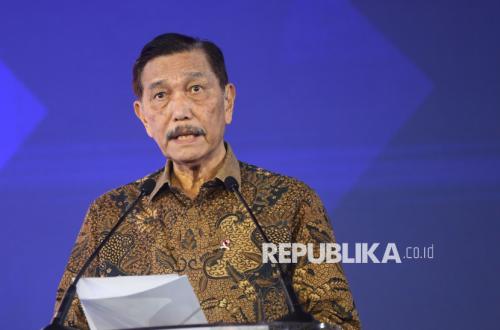
JAKARTA – The Chairman of the Committee for the Acceleration of Government Digital Transformation (KPTDP), Luhut Binsar Pandjaitan, believes the digital ecosystem is key to saving state budgets. Luhut said the critical minerals sector is also included in the government’s digital ecosystem development plans.
“This just needs to be continuously developed (from Simbara). It will create efficiency. We are currently building an ecosystem that prevents people from being corrupt, or at least narrows the space for corruption,” Luhut said during a press conference on the Coordination of the Social Assistance Digitalisation Piloting in 42 Regencies/Cities at the National Economic Council (DEN) office, Jakarta, Wednesday (17/6/2026).
The Chairman of the National Economic Council (DEN) stated that the government continues to push the development of the digital ecosystem through the Inter-Ministry or Agency Mineral and Coal Information System (Simbara). According to him, this step is a real breakthrough in closing state leakage gaps.
“So there is no need for various methods, just use this system. We tried it with Simbara, already for coal, and nickel too. This just needs to be continuously developed,” Luhut continued.
In his calculations, Luhut assessed that the digital ecosystem can drive efficiency in the critical minerals sector. Additionally, the digital system is also considered capable of closing off space for corruption.
“I think the efficiency could be thousands of trillion rupiah, maybe Rp 1,500 trillion, maybe Rp 2,000 trillion. Leakages can also be suppressed. As the President conveyed regarding critical minerals, everything becomes very controlled,” he said.
Luhut conveyed that the development of the digital ecosystem in the critical minerals sector will follow the expansion of social protection digitalisation (Perlinsos) to 42 regencies/cities and one province. According to him, Perlinsos is present as a portal, not an application, which allows social assistance registration using only the national identity number (NIK) and facial verification.
Luhut said the social assistance registration process, which previously took up to 200 days, can now be completed in a matter of minutes. A similar impact, he said, is beginning to be seen in Bali and Surabaya. Costs that previously had to be borne by the community, up to Rp 150,000, have also dropped to almost zero.
“We have proven that technology created by the nation’s own people is capable of solving problems that have been challenges for decades. With increasingly accurate and integrated data, the President can make more precise decisions to ensure state assistance is truly received by the people who need it,” Luhut said.
To date, nearly 370,000 citizens have accessed the Digital Perlinsos service to register or submit appeals. This data forms the basis for expanding the service to 42 regencies/cities.
Luhut explained that this portal unifies data from eight ministries/agencies through Digital Public Infrastructure (DPI), which is a first-of-its-kind approach in Indonesia. Citizens who already have a Digital Population Identity (IKD) can access the portal independently, while those who do not yet have an IKD can be assisted by companion agents.
He said this innovation is supported by three foundations of Digital Public Infrastructure: digital identity and biometric verification to ensure the authenticity of applicants; government data exchange through the Government Service Linkage System connecting population, DTSEN, employment, electricity, and asset data; and a digital payment system for fast and transparent aid distribution.
As a step to ensure the service reaches the entire community, Luhut said the Ministry of Social Affairs, together with related ministries/agencies, has prepared 60,000 companion agents to assist with the registration process while closing the digital literacy gap.
“The trial is being expanded to 42 regencies/cities in 25 provinces to test governance, infrastructure, and regulations before wider implementation. Since June 4, 2026, a limited trial has been running in Surabaya and all of Bali, covering nine sub-districts and 14 urban wards/villages,” Luhut continued.
As of June 16, 2026, more than 6,100 heads of families (KK) have registered through the portal, assisted by over 700 companion agents consisting of civil servants (ASN), Family Hope Programme (PKH) officers, Sub-district Social Welfare Workers (TKSK), community leaders, PKK, and Dasawisma.
In the long term, Luhut said improvements in targeting accuracy are projected to unlock potential spending efficiency of around Rp 170 trillion to Rp 260 trillion, equivalent to USD 10 billion to USD 15 billion.
“This figure is a strategic estimate, not savings that have been realised, and still depends on data quality and the success of programme expansion. Every data change must have a clear audit trail,” he said.
Luhut said this programme is the result of cross-ministry/agency collaboration under the KPTDP, involving the Special Advisor to the President for Digitalisation and Government Technology, the Minister of PANRB, the Minister of Komdigi, the Minister of PPN/Bappenas, the Minister of Home Affairs, the Minister of Social Affairs, as well as leaders of other agencies handling population, state finances, payment systems, statistics, land, employment, cyber security, and corruption prevention.
He hopes the Perlinsos portal can be expanded nationally by October 2026.