
Luhut and Others Present Prabowo with Seven Recommendations for Indonesia’s Economy
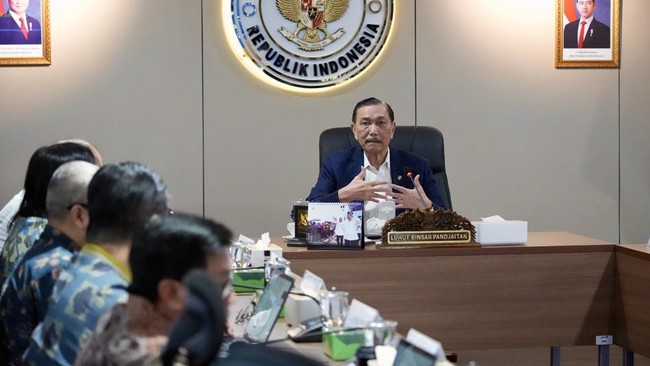
President Prabowo Subianto summoned the National Economic Council (DEN), several economic ministers and the Governor of Bank Indonesia to Merdeka Palace in Jakarta on Tuesday afternoon (20 October 2026).
At the meeting, the DEN presented recommendations and strategic assessments on global economic developments and measures to strengthen the national economy. It put forward seven recommendations and assessments. The first was the digitalisation of social protection, aimed at improving transparency and ensuring social assistance reaches the right recipients.
DEN chairman Luhut Binsar Pandjaitan said the integrated digital portal for managing social protection assistance, known as Perlinsos, would be launched on 10 November 2026. The programme has been trialled across the country.
Luhut made the remarks after a limited meeting with Prabowo at Merdeka Palace on Tuesday (20 October 2026). DEN deputy chair Mari Elka Pangestu and members Arief Anshory, Haryanto Adikoesoemo, Heriyanto Irawan, Mochamad Firman Hidayat and Septian Hario Seto also attended.
“We reported that Perlinsos will be rolled out or launched by the President on 10 November. This social-protection programme brings fairness to the people,” Luhut said, as quoted on Wednesday (21 October 2026).
Firman Hidayat said the Perlinsos digitalisation programme had been trialled in all 514 districts and municipalities in Indonesia.
There are currently 11.5 million households registered in the digital Perlinsos system. In addition, 775,000 Perlinsos agents are helping residents register for its database.
The DEN also reported on the impact of the Free Nutritious Meals (MBG) programme, including its effects on student attendance, enthusiasm for learning, meal quality and the distribution of beneficiaries.
Firman said the programme had produced several notable findings. MBG recipients, he said, were absent from school less often than non-recipients.
“The gap is quite large, particularly in the poorest first decile. Non-recipients are more likely to be absent, while recipients are relatively more likely to attend school,” Firman said.
The DEN also found that MBG recipients were more enthusiastic about learning, suggesting they were better able to absorb lessons than non-recipients.
According to Firman, the quality of meals affects students’ enthusiasm for learning. Its data showed that 95% of MBG recipients said they felt more enthusiastic when they received good-quality meals.
As of September, however, MBG beneficiaries remained concentrated in urban areas rather than rural ones. A substantial number of affluent students were also receiving the meals, compared with poorer students.
“This means there needs to be better prioritisation, particularly for 3T areas—frontier, outermost and least developed regions—as well as rural areas and poor communities. Our study shows that the programme can reduce school absenteeism, increase enthusiasm for learning and ease hunger at school,” he said.
The DEN also reported on and made recommendations concerning the effects of El Niño and La Niña, which could affect food availability.
According to the DEN’s findings, the cooling of sea-surface temperatures that can trigger increased rainfall will affect food production.
“This could affect food availability and also create the possibility of flooding. We therefore need contingency plans for events beyond our control because they are natural phenomena, although they can be predicted,” Luhut said.
He recommended that the President prepare food stocks and calculate rice-planting schedules.
The DEN also used collected data to identify locations at risk of drought and recommended preparing pumps and adjusting the planting schedules of food crops.
The council’s other recommendations concerned industrial downstreaming, including nickel, aluminium and lithium-battery components, to increase domestic value added and exports.
The DEN, ministers and other agencies also discussed energy security, including strategies to maintain the price of subsidised fuel, strengthen fuel-procurement systems and improve the targeting of energy subsidies.
Forest and land-fire management was another key subject, including the watering of peatland and strengthening health services for affected communities.
Finally, in response to market volatility, the government said it would reform the capital market by strengthening enforcement and governance.
“President Prabowo has paid close attention to the various studies and data presented as considerations for policymaking. The DEN also emphasised the importance of using accurate, study-based data to support sound policies and strengthen Indonesia’s economic independence,” the Cabinet Secretariat said in a post on its Instagram account on Wednesday (21 October 2026).
Source: jawawa.id (https://jawawa.id/newsitem/luhut-and-others-present-prabowo-with-seven-recommendations-for-indonesias-economy-1792543839)
Originally published by CNBC Indonesia (https://www.cnbcindonesia.com/news/20261021063307-4-777997/temui-prabowo-luhut-cs-sampaikan-7-rekomendasi-buat-ekonomi-ri), translated from Indonesian