
Luhut and Chatib's Report to Prabowo: From Free Nutritious Meals to GovTech
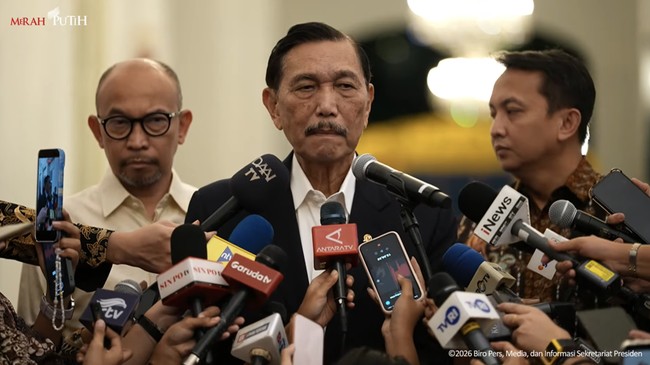
The National Economic Council (DEN) met with President Prabowo Subianto at the Merdeka Palace in Jakarta. DEN provided reports to Prabowo on the latest economic conditions and the Free Nutritious Meals (MBG) programme. Also discussed were plans for the implementation of GovTech, the implementation of PT Danantara Sumberdaya Indonesia (DSI), and the development of an international financial centre or family office in Bali. The meeting was attended by DEN Chairman Luhut Binsar Pandjaitan and DEN members including Chatib Basri, Hario Seto, and Mochammad Firman Hidayat.
Regarding the MBG survey, Hario Seto explained the survey was conducted randomly at 800 points. It found that 86.9% of MBG service units (SPPG) currently do not have a single small SME supplier located nearby. He noted that three SMEs are partnered with each SPPG, proving that the MBG programme not only achieves the president’s goal of improving the nutrition of Indonesian children but also creates a new supply chain ecosystem. Seto also found that 65% of these SME sectors are located within the same regency as the SPPG location, meaning these units are supplied by SMEs rather than large suppliers. Regarding employment, Seto stated that 99% of the empowered people are from surrounding areas, resulting in a high performance satisfaction rate of up to 70% in the regions. However, some aspects can be improved, such as providing capital assistance for SMEs to allow them better working capital, serve more SPPGs, and diversify commodities. This is seen as a driver for achieving 5.61% growth.
Luhut also reported to the president on the implementation of GovTech. The digitalisation of a one-data system for government will be connected with the national single window at the Ministry of Finance. According to Luhut, this could increase tax revenue, especially if the 64 million SMEs in Indonesia are detected as potential taxpayers. He said it is important because with GovTech, those 64 million SMEs can be brought in to participate by paying 0.5% tax. If that happens, the tax ratio could rise from around 9% to perhaps 12% or 13%. Luhut added that if state revenue increases significantly, there is an opportunity to lower taxes in the future and create jobs, as the comprehensive GovTech system could help form new SMEs in line with the MBG programme. The pilot project for this programme has already been running in 42 regencies/cities. Luhut mentioned the programme is already running successfully in Banyuwangi city. If 41 of these models are successful, a national rollout across all 514 regencies/cities is planned for October this year. Luhut claims the programme’s operation can deliver savings of up to hundreds of billions in the future.
Luhut also reported on the plan to build an international financial centre or family office. He stated that a meeting on the implementation plan for a family office in Bali is scheduled for around July, which has the potential to attract hundreds of billions of dollars in foreign investment into Indonesia. He stressed that this potential must be safeguarded with good news.
Regarding an update on PT DSI, Seto stated that DEN also conducted a study on the illegal practice of invoice fraud or under-invoicing. He confirmed indications of under-invoicing for several commodities, involving amounts in the billions of dollars. To address this, the Mineral and Coal Monitoring System (SIMBARA) can perform auto-blocking using AI or algorithms to force business compliance with regulations. Seto noted the president’s emphasis that this system could also eradicate illegal mining through traceability, ensuring every ton of CPO and coal must come from legal sources. This includes integration with the monitoring of Export Proceeds in Foreign Exchange (DHE).
Chatib also stated the meeting discussed the current macroeconomic situation. An important issue raised was the risk of price increases that could occur due to the weakening of the Rupiah, which would affect the lower-middle income groups. According to Chatib, what needs to be done is to build trust in the government through budget efficiency, including regarding the MBG programme. Firman Hidayat reported that Indonesia’s economic fundamentals are in good condition. He stated that the current situation is far from the 1998 crisis conditions, seen from high macro indicators, stable inflation, and healthy corporate balance sheets. Corporate debt in US dollars is much lower compared to 1998 conditions. Corporate cash flow is also still high, allowing for the mitigation of uncertainty. From the banking side, the capital adequacy ratio is above 25%, indicating a sufficiently strong banking system. However, he reminded of the need to be vigilant against global economic uncertainty, particularly as the impact of war is expected to last longer than anticipated.