
Luhut: AI Will Reduce Corruption and Minimise Face-to-Face Interactions
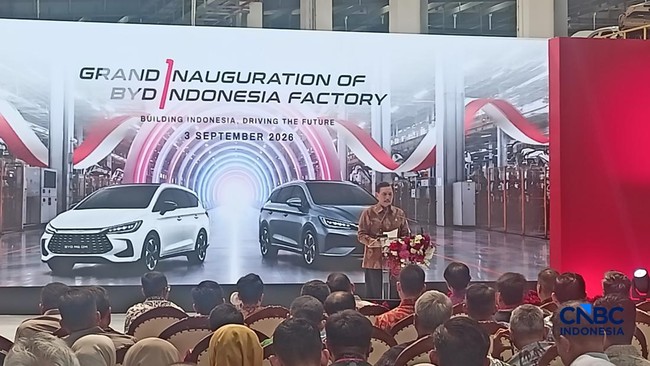
Luhut Binsar Pandjaitan, Chairman of the National Economic Council (DEN), has revealed the government’s ambition to promote the use of Artificial Intelligence (AI) to transform the governance system. One of the expected impacts is the reduction of corruption potential by cutting direct interactions between individuals within government services.
Luhut stated that the government is currently pushing for the implementation of AI-based Government Technology. According to him, the digitalisation of governance will make administrative processes and services more transparent while simultaneously reducing the need for the public to meet officials in person.
“Because we are now promoting AI-based Government Technology, it will create transparency, make us more open, and that will reduce corruption,” said Luhut during the inauguration of the BYD factory in Subang, West Java, on Thursday (3/9/2026).
The use of technologies such as facial recognition and biometrics will become an essential part of the government’s data collection system. With such a system, the identification process for citizens can be conducted digitally, thereby reducing reliance on manual processes.
“Because face-to-face meetings will be significantly reduced because everything can be obtained through facial recognition and biometrics,” he added.
Luhut considers this digitalisation of data collection to be a significant leap forward under the administration of President Prabowo Subianto.
“I believe this data collection will be a great leap during President Prabowo’s era,” said Luhut.
He noted that technology-based data systems will also play a role in improving the distribution of social assistance (bansos). The government can use this data to identify citizens who qualify as recipients of aid.
Luhut even revealed plans to change the pattern of incentive distribution. In the future, the government is said to be reducing incentives through product subsidies and instead directing them directly to eligible citizens.
“Because for social assistance, we might no longer provide incentives to products; we will provide incentives directly to people,” he said.
He stated that citizens wishing to receive social assistance will need to register. With a more integrated database, the government is expected to be able to identify those who truly meet the criteria for recipients.
“So, the tens or hundreds of millions of our residents who are qualified to receive cash transfers, I believe we can implement this by the beginning of next year,” concluded Luhut.