
LRT Jabodebek Directional Signage and Information Screens Assist Passengers with Journey Continuation
Jakarta (ANTARA) - The public is increasingly using the LRT Jabodebek as a transport option for daily activities. This is reflected in the number of users in the first half of 2026, which reached 16,018,611, an increase of 23 per cent compared to the same period the previous year. After alighting from the LRT Jabodebek, many users continue their journey using other modes of transport, such as the KRL Commuter Line, the Whoosh High-Speed Train, the Airport Train, MRT Jakarta, Transjakarta, and other online transport services.
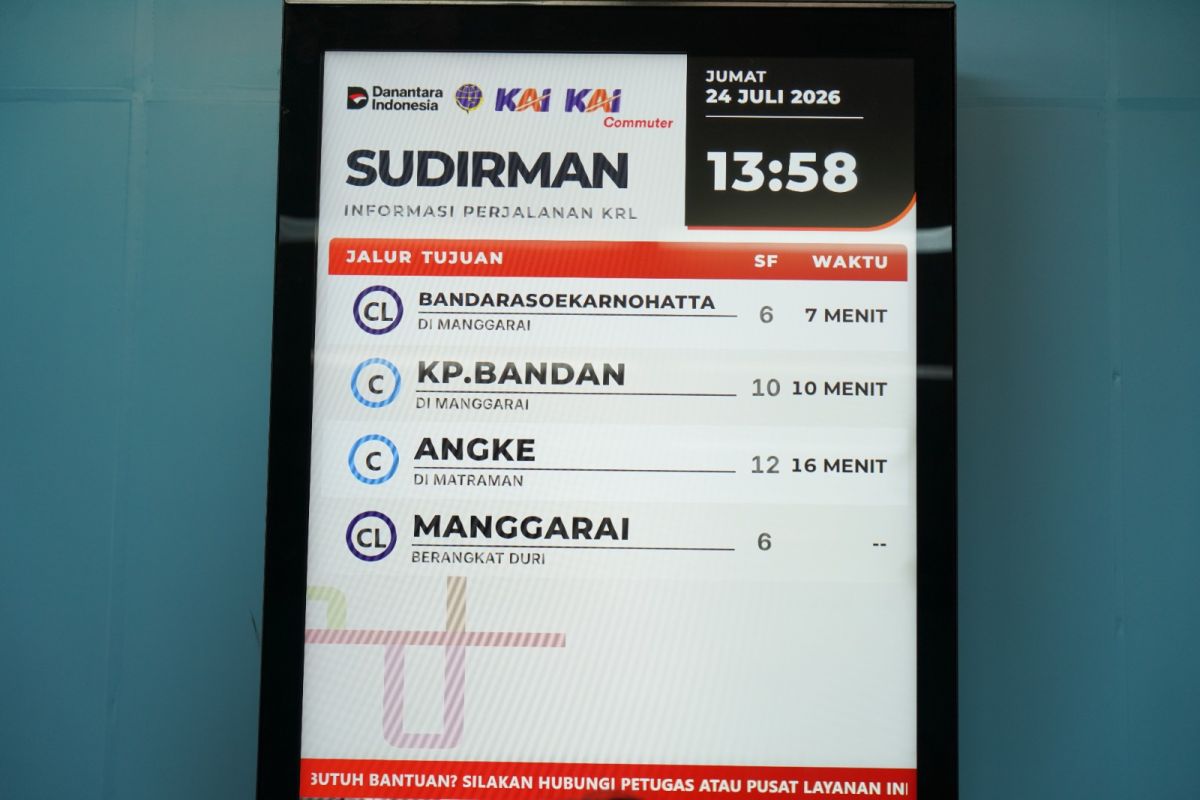
However, some users are still unaware that onward journey information is already available through directional signs and information screens at several LRT Jabodebek stations, whether they are integrated with other modes or directly connected to office centres and tourist destinations. These signs make it easier for users to find information and directions when switching to the next mode of transport, eliminating the need to open multiple applications or search for information separately.
LRT Jabodebek Public Relations Manager, Radhitya Mardika, stated that travel information is an essential part of creating a more comfortable public transport experience. It is also beneficial for new users when planning their mobility, allowing them to arrange their journeys more efficiently. “Many LRT Jabodebek users continue their journey using other modes of transport. The directional signs and information screens available at LRT Jabodebek stations can be used to find directions to connecting transport or to activity centres and crowded locations near the LRT Jabodebek stations,” he said.
The available directional signs and information screens display various modes of transport integrated with LRT Jabodebek, such as the KRL Commuter Line, Airport Train, Whoosh High-Speed Train, MRT Jakarta, TransJakarta, and pick-up points for online transport. All information is presented concisely, enabling users to quickly decide on their next journey.
Based on data from the first half of 2026, the average number of monthly users at LRT Jabodebek stations with intermodal integration or proximity to community activity centres is as follows: Dukuh Atas Bank Syariah Indonesia recorded 409,347 tap-ins and 357,099 tap-outs; Pancoran recorded 155,827 tap-ins and 232,215 tap-outs; Cawang recorded 132,725 tap-ins and 112,514 tap-outs; Cikoko recorded 219,307 tap-ins and 217,884 tap-outs; Bekasi Barat recorded 154,776 tap-ins and 166,035 tap-outs; and TMII recorded 106,080 tap-ins and 97,141 tap-outs. Halim station recorded 41,104 tap-ins and 35,442 tap-outs.
“A user’s journey does not end when they alight from the LRT Jabodebek. The ease of obtaining information to continue the journey is also an important part of public transport service, so that intermodal transfers can be done more practically,” he added. In addition to maintaining operational reliability, LRT Jabodebek also continuously strives to ensure that all passenger service facilities can be utilised optimally, providing real benefits for users in their daily mobility. Through the use of directional signs and information screens at stations, LRT Jabodebek hopes the public can plan intermodal journeys more easily, save transfer time, and utilise public transport more optimally.