
LPS strengthens BPR-BPRS governance through five training sessions in 2026
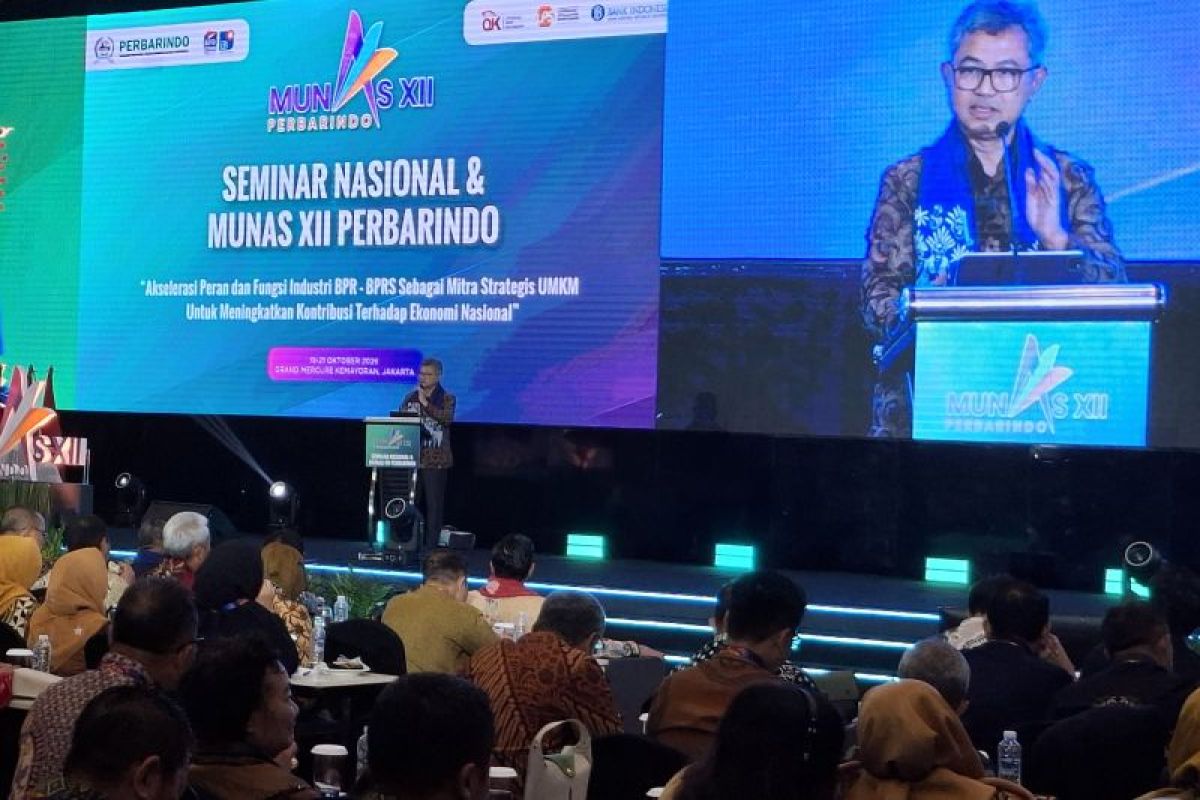
Jakarta (ANTARA) – The Indonesia Deposit Insurance Corporation (LPS) held five governance training sessions for Rural Banks (BPR) and Sharia Rural Banks (BPRS) during 2026 to strengthen management across the sector.
Doddy Zulverdi, a member of the LPS Board of Commissioners responsible for the Deposit Guarantee Programme and Bank Resolution, said the training was intended to reach around 350 to 400 BPRs and BPRSs and improve bank managers’ ability to identify risks early.
“We also want to encourage BPRs and BPRSs to continue developing and move up to the next level,” Doddy said at the 12th National Seminar and National Congress of Perbarindo in Jakarta on Monday.
He said the training materials were developed from LPS’s experience handling troubled banks, so that BPR-BPRS directors and managers could understand the factors that may undermine a bank’s financial health and business continuity.
“We have put together these training materials based on real lessons from the banks we have handled,” he said.
In addition to governance training, LPS held 20 outreach and education sessions for BPRs and BPRSs in various regions during 2026 to improve understanding of deposit-guarantee rules.
Through these activities, LPS hopes bank managers will apply the guarantee requirements more effectively and give the public accurate information about how their deposits are protected.
In August 2026, LPS and the Financial System Stability Committee (KSSK) reported that, as of June 2026, 99.97 per cent, or around 15.5 million customer accounts at BPRs and BPRSs, were fully covered by the deposit guarantee.
Meanwhile, Financial Services Authority (OJK) data published on 16 October showed that the assets, third-party funds and loans of the BPR-BPRS sector grew by 3.22 per cent, 3.14 per cent and 3.37 per cent respectively year on year in August 2026.
Despite the sector’s positive growth, Doddy said the quality of loans and financing needed to improve.
In August 2026, the gross non-performing loan (NPL) ratio at BPRs was 12.8 per cent, while the gross non-performing financing (NPF) ratio at BPRSs stood at 15.1 per cent.
Doddy said stronger governance was needed to maintain customer confidence and reinforce BPRs’ and BPRSs’ role as financing partners for micro, small and medium-sized enterprises (MSMEs) across the regions.
“These figures clearly show that, to strengthen their role as strategic MSME partners, BPRs and BPRSs need to improve their performance,” he said.
He said LPS’s experience dealing with troubled banks demonstrated the importance of effective internal oversight to prevent abuse of authority, irregularities in lending and other management problems.
From the start of its operations in 2005 to early October 2026, LPS had liquidated 161 banks: one commercial bank and 160 BPRs and BPRSs.
However, Doddy stressed that problems at banks handled by LPS were not representative of the entire sector, as most BPRs and BPRSs continued to be managed well.
“Of course, many BPRs and BPRSs are still well managed, and they are the majority,” he said.
To maintain this position, LPS called for greater integrity among bank owners and directors, more effective internal oversight, and better risk management.
Doddy also underscored the importance of independence for supervisory boards, internal audit and compliance functions, including through whistleblowing mechanisms that protect those who report wrongdoing.
In lending, BPRs and BPRSs are expected to conduct careful credit assessments and provide support to borrowers, ensuring that increased MSME financing remains consistent with prudential principles.
LPS is also seeking to strengthen and expand governance training, including by exploring digital-based mechanisms to build the capacity of BPR-BPRS managers.
“With a strong industry, we will not only maintain public confidence but also create more opportunities for MSMEs to grow and contribute to the national economy,” he said.