
LPEI Corruption Trial: Witnesses Reveal Financing Risks and Takeover Collateral Status
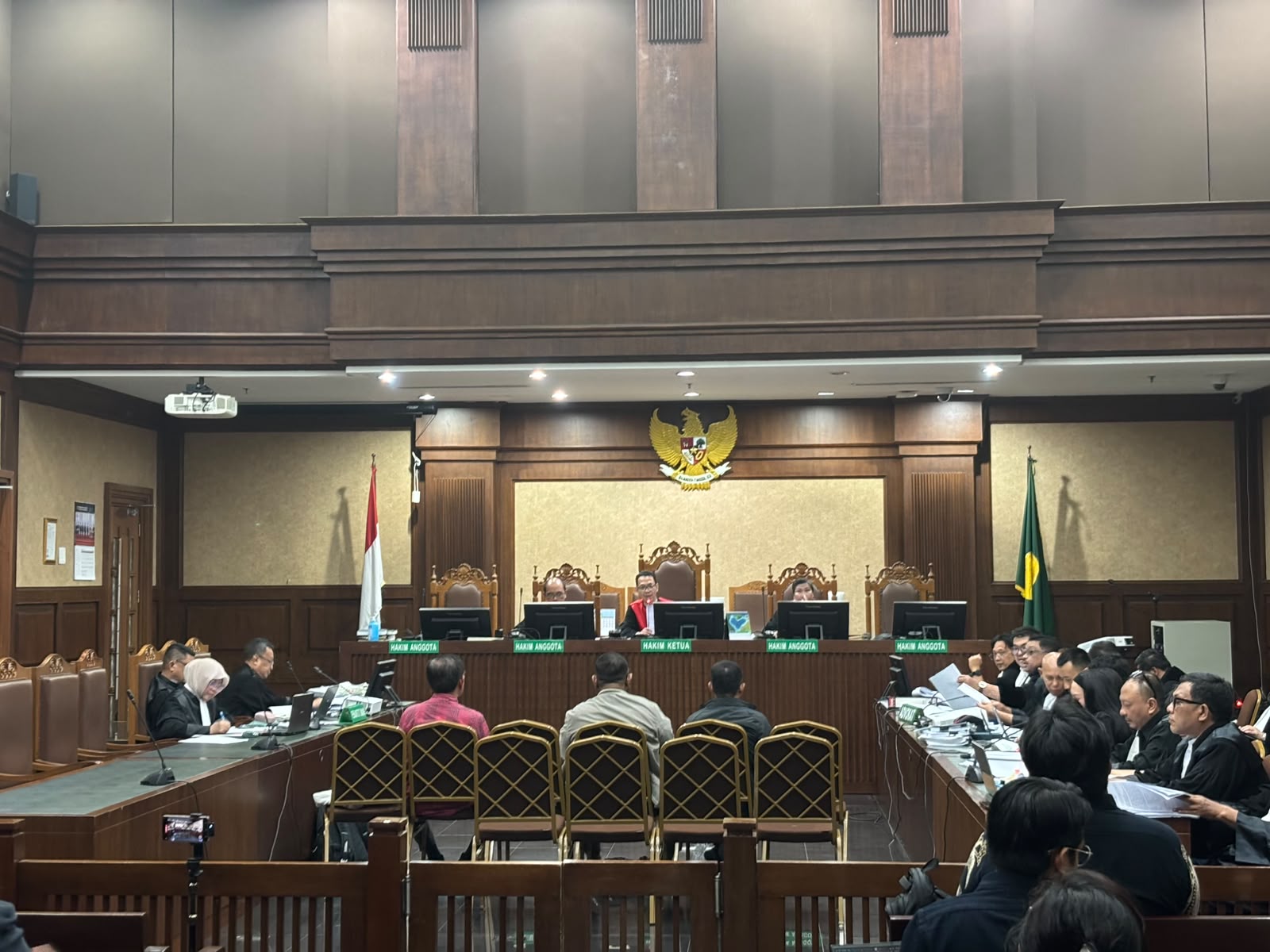
Three internal witnesses from the Indonesian Export Financing Institution (LPEI) revealed the risk analysis process, document legality, and collateral binding in the provision of financing facilities to PT Tebo Indah and PT Pratama Agro Sawit during a corruption trial at the Jakarta Corruption Court on Friday. The three witnesses presented by the Public Prosecutor were former LPEI Risk Analyst for the 2017–2019 period Azhari Maulidin, Legal Division employee Sunu Widi Purwoko, and Head of the Legal Division Department Nugroho Kusumo Wibowo. They provided testimony in the case against defendants Handoko Limaho, Dwi Wahyudi, Rian Wahyudi, and Liu Raymond. During the trial, Azhari explained that he had conducted a review of five Financing Analysis Memoranda submitted by PT Tebo Indah and PT Pratama Agro Sawit. “I conducted a review starting from the debtor’s credit rating, the maximum credit limit, character aspects based on experience and OJK SLIK history, production capacity, repayment ability, analysis of historical and projected financial statements, to risks, mitigation, financing structure, and disbursement conditions,” Azhari told the panel of judges. According to Azhari, the analysis results indicated several risks that needed to be mitigated, including the debtor’s negative cash flow condition. Therefore, a guarantor and a letter of undertaking were required to anticipate possible project cost overruns. The prosecutor then highlighted the Letter of Undertaking (LOU), which was one of the supporting documents for the financing. According to Azhari, the document could not be equated with a corporate guarantee because it lacked the legal force to guarantee payment if the debtor failed to meet its obligations. “According to the corporate financing manual, what is considered a guarantee must be made notarially and contain a statement guaranteeing payment if the debtor defaults. Meanwhile, the LOU submitted was only best effort in nature, with no guarantee statement,” he said. Azhari also stated that discussions regarding the LOU had taken place before he served in the Risk Division, so he had never proposed that the document be changed into a corporate or personal guarantee. Meanwhile, witness Sunu Widi Purwoko from the LPEI Legal Division said that his division did not review the substance of the LOU because the document was only received during the signing process of the financing agreement. “We did not review the LOU draft. The document was also not a notarial deed, so we did not know whether it required approval from the General Meeting of Shareholders or the board of commissioners,” Sunu said. According to Sunu, the contents of the LOU only contained a statement to make best efforts and did not contain a legal obligation to guarantee repayment if the debtor defaulted. “The LOU only stated best effort, ensuring the best, but there were no words guaranteeing if the debtor’s facility defaulted. And it was not notarial,” he said. During the trial, the prosecutor also highlighted findings in the closing memo prepared by the Legal Division after the signing of the financing agreement. Sunu explained that the closing memo served as documentation of the legal conditions at the time the contract was signed, as well as an administrative basis for the Operation and Settlement Division. He revealed that in the closing memo for MAP 003, it was noted that collateral in the form of land and plantations covering approximately 7,000 hectares in Tebo Regency could not yet be bound as LPEI security because it was still collateral at the previous bank, CIMB. Answering the prosecutor’s question regarding why the financing proceeded even though the collateral was not yet bound, Sunu confirmed the condition. “The fixed asset collateral was not yet available because the land was still bound to the previous bank. This was a takeover financing,” Sunu said. He added that the Legal Division only carried out procedures according to the applicable operational standards. “After the MAP was signed, the Credit Approval Memorandum was issued, and the Credit Agreement Letter was published, our task was to execute according to the SOP. We only recorded the deficiencies in the closing memo, including that the collateral was still with CIMB,” he said. This testimony was reinforced by the Head of the LPEI Legal Division Department, Nugroho Kusumo Wibowo. He explained that the legal document examination process was carried out through a maker-checker-approver mechanism. According to Nugroho, in a credit takeover scheme, one form of risk mitigation was carried out by relying on a notary to ensure that assets previously pledged to another bank could be transferred and bound as LPEI security after the takeover process was completed. “At the time of a takeover, one of the mitigations was to rely on trust in the notary to ensure that after the takeover process was completed, the asset could be bound as security,” Nugroho said. After hearing the testimony of the three witnesses, the Chief Judge closed the examination for the time being and stated that the trial would be continued at the next session if the prosecutor still had additional questions for the witnesses.