
LPEI Corruption Defendants Submit 172 Evidence Items Alleging Fund Flows to Other Parties
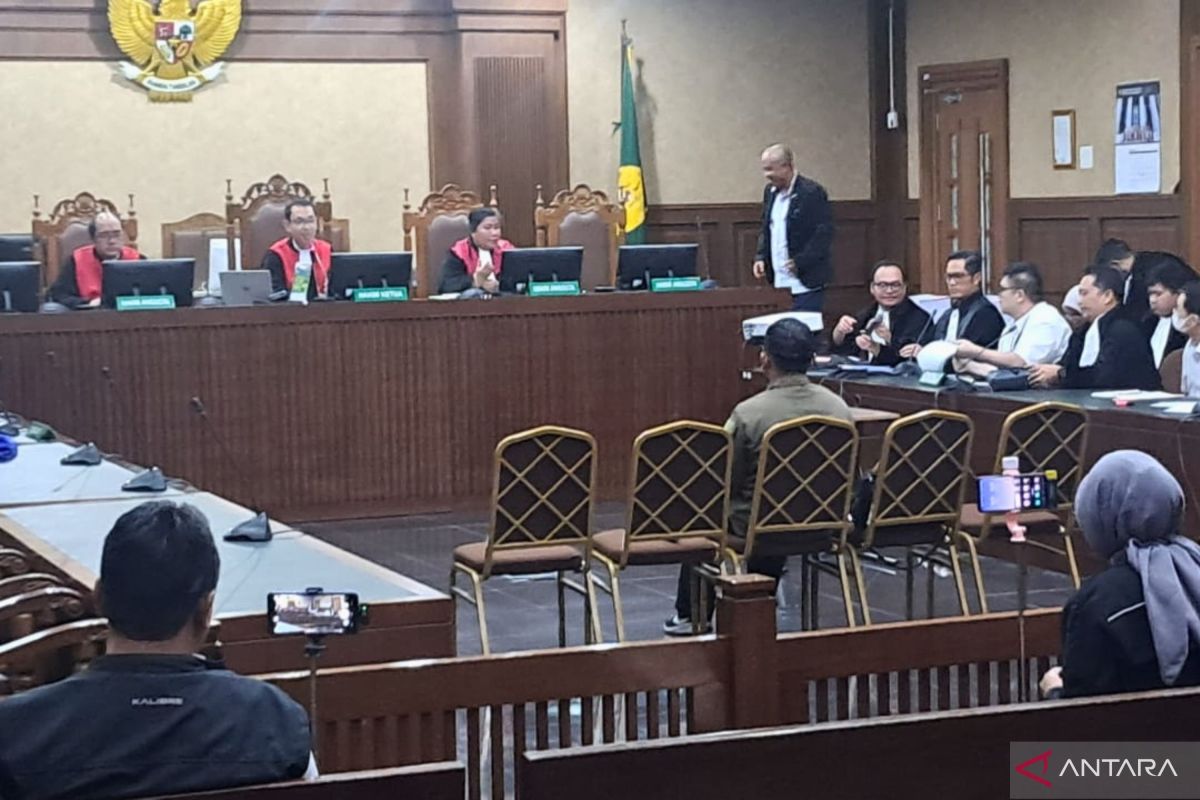
Jakarta (ANTARA) - Two defendants in the LPEI case, Handoko Limaho and Liu Raymond, on Monday submitted 172 pieces of evidence related to alleged fund flows to third parties after the two no longer managed the companies, at a hearing at the Corruption Court of the Central Jakarta District Court.
The defendants’ legal team, led by Febri Diansyah, submitted 87 documentary exhibits for Handoko as beneficial owner of PT Tebo Indah (TI) and PT Pratama Agro Sawit, and 85 documentary exhibits for Liu as Director of PT TI.
All documents were presented in printed hard copy and digital soft copy form, accompanied by a brief exposition of the substance of the evidence submitted.
“With this evidence, we want to distinguish who actually misused the funds and who enjoyed those funds,” said Febri.
He explained that the exhibits were submitted to provide a complete picture of the use of financing from Lembaga Pembiayaan Ekspor Indonesia (LPEI, the Indonesia Export Financing Agency) and to rebut the assumption that the two defendants enjoyed the funds for personal gain, arguing the funds were used for the companies.
Febri said most of the evidence consisted of documents from the suspension of debt payment obligations (PKPU) process of PT Tebo Indah and PT Pratama Agro Sawit (PAS), export investment financing application documents, documents on the use of financing funds, and recapitulations of company bank statements.
The legal team also submitted homologation documents showing the acknowledgement of PT Tebo Indah’s and PT PAS’s debts to LPEI as part of the debt settlement process through the Commercial Court.
In addition, the lawyers presented asset appraisal documents showing that PT Tebo Indah’s planted area reached approximately 6,500 hectares in 2020, along with several fiduciary guarantee deeds which they said formed part of the collateral for the LPEI financing.
Febri highlighted the company’s account mutations, which showed fund flows to certain parties after Handoko and Liu were no longer serving as managers of PT Tebo Indah.
He said an analysis of the accounts showed transactions allegedly used for personal interests by the company’s new owners, including alleged fund flows from PT Tebo Indah through PT Agro Inti Semesta (AIS) to Petrus Candra and members of his family.
According to the legal team, these transactions took place between 2022 and 2024, after the two defendants no longer controlled the company.
“With this evidence, we want to distinguish who actually misused the funds and who enjoyed those funds,” he said.
The defence also presented other evidence in the form of documents on the construction of PT Tebo Indah’s palm oil mill, which they said demonstrated that the LPEI financing was genuinely used to build company facilities, including increasing the mill’s capacity from 30 tonnes of Fresh Fruit Bunches (TBS) per hour to 45 tonnes per hour.
The panel of judges accepted the entire bundle of evidence for study as part of the trial’s evidentiary process.
Chief Judge Edward Agus said all the documentary evidence submitted would be examined along with other case files.
However, the Chief Judge reminded the parties that the submission was not a closing statement, but a brief presentation of the exhibits handed over.
Accordingly, the Chief Judge set the agenda for the next hearing, which will hear four additional witnesses requested by the public prosecutor and previously also sought by the defence, namely Petrus Candra, Stefani Candra, Saiful Hendra, and Kosen Limaho.
The four witnesses are scheduled to testify on Wednesday (12 August), while the examination of the defendants is scheduled for Thursday (13 August).
The case relates to alleged corruption in LPEI’s national export financing between 2015 and 2020, which according to the prosecutors’ indictment allegedly caused state losses of around Rp992.82 billion.
Besides Handoko and Liu, there are six other defendants in the case, namely Andi Maulana Adjie, Head of the Sharia Financing Division Department at LPEI from 2011 to 2017; Intan Apriadi, Head of Sharia Financing Division Department I from 2007 to 2016; and Komaruzzaman, Head of Sharia Financing Division Department II from 2011 to 2016.
Also charged are Gamaginta, Head of LPEI’s Sharia Financing Division Department I from 2017 to 2018; Dwi Wahyudi, Executive Director I of LPEI from 2009 to 2018; and Ryan Wahyudi, Relation Manager for Sharia Financing I at the Sharia Financing Department, Sharia Financing Division I of LPEI from 2015 to 2018.
The defendants are alleged to have jointly committed several interrelated criminal acts, viewed as a single continuing unlawful act that enriched Handoko Limaho and Liu Raymond at the expense of state finances or the national economy.
The defendants’ alleged unlawful acts began when Handoko, together with Liu, applied for financing facilities.
However, the application was accompanied by feasibility study documents and asset appraisal reports from a Public Appraisal Services Office (KJPP) showing oil palm planted areas that did not correspond to actual conditions.
Handoko and Liu are also alleged, among other things, to have used fiduciary deeds covering inventories and trade receivables that did not match the audited financial statements, and to have drawn down the financing facilities using supporting documents in the form of fictitious invoices and contracts.
For these acts, the eight defendants are charged under Article 603 or Article 604 in conjunction with Article 20 letter c of the National Criminal Code, in conjunction with Article 8 of Law Number 31 of 1999 as amended by Law Number 20 of 2001 on the Eradication of Criminal Acts of Corruption.
Source: jawawa.id (https://jawawa.id/newsitem/lpei-corruption-defendants-submit-172-evidence-items-alleging-fund-flows-to-other-parties-1785772507)
Originally published by Antara (Indonesian) (https://www.antaranews.com/berita/5678385/dua-terdakwa-kasus-lpei-serahkan-172-alat-bukti-aliran-dana-pihak-lain), translated from Indonesian