
LPDB Supports Sugarcane Downstreaming, Cooperatives Urged to Become Key Players in Sugar Industry
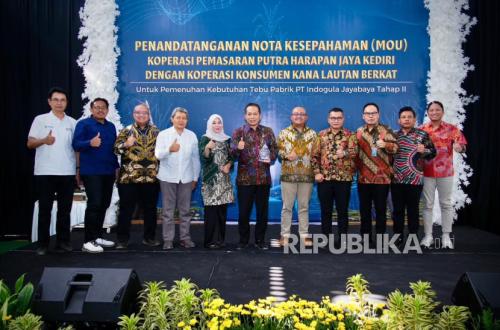
The government is encouraging cooperatives to play a larger role in the national sugar industry to strengthen sugarcane downstreaming and reduce dependence on sugar imports. This move is being implemented by connecting farmers, cooperatives, processing industries, and marketing networks into one integrated supply chain.
This push was marked by the signing of a cooperation agreement between Koperasi Konsumen KANA Lautan Berkat, Koperasi Pemasaran Putra Harapan Jaya Kediri, and PT Indogula Jayabaya in Kediri, East Java, on Saturday (6/6/2026). The collaboration is expected to strengthen the national sugar industry ecosystem from upstream to downstream.
The Minister of Cooperatives, Ferry Juliantono, stated that such partnership models are a strategy to strengthen downstreaming in the agricultural sector while supporting national sugar self-sufficiency targets. “This cooperation demonstrates that cooperatives are capable of being primary actors in production, distribution, and downstreaming to strengthen the people’s economy. Cooperatives need to be continuously encouraged so they do not only operate in the financing sector but also play a role in production, processing, and distribution. To achieve sugar self-sufficiency as directed by the President, we will reduce sugar imports while simultaneously boosting national sugar production,” Ferry said in a statement received on Sunday (7/6/2026).
According to Ferry, the development of a cooperative-based sugar industry also needs to involve more sugarcane farmers and local communities. In doing so, the resulting economic benefits will not only be felt by business actors but will also create jobs and improve the welfare of communities in sugarcane production centres.
Koperasi Konsumen KANA Lautan Berkat is a partner recipient of revolving funds from LPDB Koperasi in 2025, operating in commodities and exports. Currently, the cooperative is developing the sugar industry through PT Indogula Jayabaya in Kediri. Meanwhile, Koperasi Pemasaran Putra Harapan Jaya Kediri has a business base in the marketing and distribution of agricultural commodities, including sugarcane. The synergy between the two cooperatives and the processing industry is seen as a way to strengthen the national sugar business chain, which has long been fragmented.
The President Director of LPDB Koperasi, Krisdianto, stated that the collaboration between cooperatives and processing industries is a model that can strengthen cooperatives in the real sector while increasing the added value of agricultural commodities. “LPDB Koperasi is present not only as a financing institution but also as a catalyst for the development of the cooperative business ecosystem. The cooperation between Koperasi KANA, Koperasi Putra Harapan Jaya, and PT Indogula Jayabaya is a concrete example of how cooperative financing can drive the growth of cooperative-based industries that provide greater added value for members and farmers,” said Krisdianto.
Krisdianto explained that the sugar sector is a strategic sector directly related to national food security. Therefore, he noted, LPDB Koperasi encourages financing for productive cooperatives that have an orientation towards industrial development and downstreaming. “We see the business model built in this cooperation as very promising because it integrates sugarcane farmers, marketing cooperatives, processing industries, and market access. With a strong ecosystem, cooperatives will not just be spectators but will be able to become key players in the national sugar industry supply chain,” said Krisdianto.
He hopes that this partnership model can be replicated in various other agricultural commodity-producing regions. According to him, strengthening cooperatives in the real sector is key to increasing commodity added value and strengthening national food security. Through this cooperation, the parties aim to create a more efficient, competitive, and sustainable sugar supply chain. In addition to increasing sugarcane productivity and national sugar processing capacity, the collaboration is also expected to strengthen the position of farmers in the industrial value chain and increase the contribution of cooperatives to the national economy.